
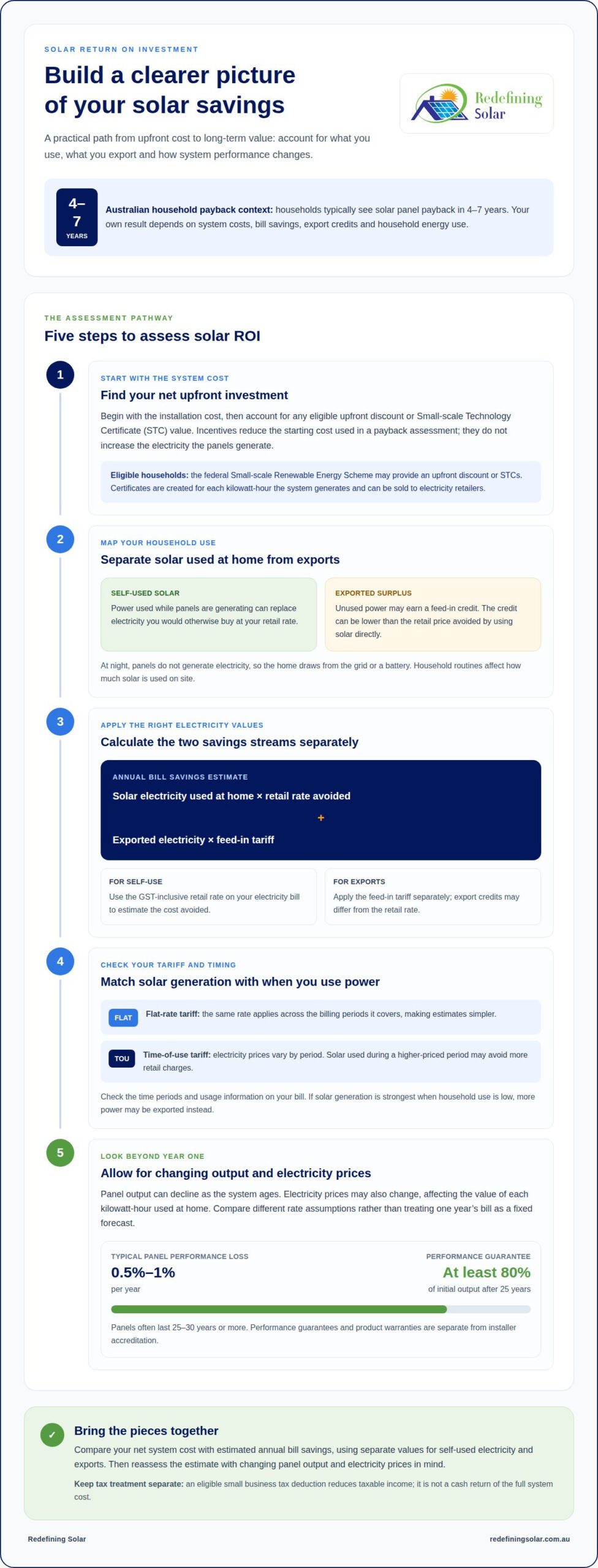
Solar can be a sound long-term investment, but the numbers depend on how your household uses power. In Australia, households typically see solar panel payback in 4-7 years. Your solar system’s return on investment depends on how installation costs compare with the electricity bill savings and export credits it can deliver.
It’s reasonable to want a clearer picture before deciding. The solar system return on investment depends on more than the payback period: your daytime energy use, electricity rates, system size and available incentives all affect the outcome.
This guide explains how to assess costs and savings, how Australian incentives and feed-in tariffs may contribute, and why the same system can deliver different results for different households. You’ll get a practical framework for understanding solar payback and long-term returns without relying on a one-size-fits-all estimate.
Key Takeaways
- Account for gradual panel performance loss and changing electricity prices when estimating long-term savings, not just the first year’s output.
- Eligible households may benefit from the Small-scale Renewable Energy Scheme, which can reduce upfront costs through an upfront discount or small-scale technology certificates.
- Using solar power while it’s being generated can affect your bill differently from exporting surplus electricity, so time-of-use rates and feed-in tariffs matter.
- Payback varies by state and territory; compare local conditions and household energy use rather than relying on one national estimate.
What Are Some Factors That Affect Solar ROI?
Your solar savings depend on system output, household energy use and the electricity rates on your bill. Panel performance changes over time, and the amount of solar electricity you use directly affects the value of each kilowatt-hour.
In Australia, panels often last 25-30 or more years, and typical performance guarantees provide at least 80% of initial output after 25 years. Product warranties and performance guarantees are separate from installer accreditation, which can matter when assessing eligibility for incentives.
Panel degradation and electricity price changes
Panel degradation is the gradual decline in how much electricity solar panels generate as they age. Panels typically lose about 0.5% to 1% of performance per year, so future output may be lower than the first year’s.
Electricity prices also affect the value of solar generation. If your retail rate rises, each kilowatt-hour used at home may offset a higher charge; if rates fall, the avoided cost may be lower. Compare different rate assumptions rather than treating one year’s bill as a fixed forecast.
Annual electricity bill savings
Estimate annual bill savings by multiplying the solar electricity you use at home by the retail rate you avoid, then add any export credit separately.
This is an illustration, not a guaranteed bill reduction: exported energy may earn a different feed-in tariff. Use the GST-inclusive rate on your electricity bill, and calculate self-used power separately from exports. Rebates and upfront credits affect the system’s net cost, not how much electricity it generates.
Self-consumption of solar electricity
Self-consumption means using solar electricity in your home while the panels are generating it. Running appliances during sunny periods can increase the share of solar energy that replaces grid electricity you would otherwise buy at your retail rate.
Unused power may be exported for a feed-in credit, which can be lower than the retail price you avoid by using solar directly. At night, panels don’t generate electricity, so your home draws from the grid or a battery. That timing makes household routines important when estimating savings.
Government incentives and small-scale technology certificates
Australian solar incentives can reduce the upfront amount used to calculate payback. The main federal mechanism for eligible systems is the Small-scale Renewable Energy Scheme.
Federal incentives and tax credits
Under the Small-scale Renewable Energy Scheme, eligible households may receive an upfront discount or small-scale technology certificates (STCs). Certificates are created for each kilowatt-hour of electricity a solar system generates and can be sold to electricity retailers, helping reduce the system’s upfront cost.
This support affects your starting investment, not the annual energy your panels generate. Include the discount or certificate value in your net system cost when estimating the payback period. Queensland households can also consider this Australian Government scheme; the available material here does not support a specific Queensland rebate amount or eligibility rule.
Because incentives depend on eligibility, don’t treat the reduction as a fixed amount for every household. A lower upfront cost can shorten payback, while electricity prices and the amount of solar power you use continue to shape savings over time.
Government tax breaks
A tax deduction is different from a rebate: it reduces taxable income rather than directly lowering the installation bill. Eligible small firms with annual revenue under A$50 million may instantly subtract the cost of a solar system from taxable income in the installation year, subject to conditions.
For a business, tax treatment may affect the after-tax cost used in an investment assessment, but it does not mean the full system cost is returned as cash. Tax treatment and energy savings are separate parts of the calculation, so account for them separately when assessing payback.
For households and businesses alike, incentives can offset the initial investment, while ongoing savings depend on the electricity the system generates and how much is used on site. To explore a system suited to your property, consider residential solar systems.
Time-of-use metering and feed-in tariffs
Your electricity tariff affects the value of solar power you use and export. A time-of-use meter applies different electricity prices at different times, while a feed-in tariff credits surplus energy sent to the grid. These charges and credits affect solar system return on investment by changing the value of each kilowatt-hour.
A flat-rate tariff charges the same rate across the billing periods it covers. This makes estimating simpler, but may obscure when your household uses electricity and when your panels generate it. With time-of-use pricing, grid electricity costs vary by period, so the value of using solar directly can vary too.
If your household uses more electricity during a higher-priced period, solar generation used then may avoid more retail charges. If your panels generate most strongly when your home uses little power, more energy may be exported instead. Check the time periods and usage information on your bill to estimate how your tariff affects savings.
Feed-in tariffs pay or credit you for eligible excess solar electricity exported to the grid. These rates can differ from the retail price you pay to import electricity, so an exported kilowatt-hour may not offset a kilowatt-hour bought from the grid at the same value.
To compare plans, estimate the solar energy you’ll use at home separately from the energy exported. Apply the relevant retail rate to electricity you avoid buying, then apply the feed-in tariff to exports. This is clearer than applying one rate to all solar generation and makes your solar system return on investment estimate more useful.
Some states and territories offer feed-in tariffs that provide bill credits or payments for exported electricity. The credit’s contribution depends on the tariff and the amount exported. Switching plans can change both import charges and export credits, so assess the combined effect rather than focusing on the highest advertised export rate. Government incentives may reduce upfront costs, but tariff settings influence ongoing bill savings throughout the system’s operating life.
How do solar installation costs and payback periods compare across Australian states and territories?
Solar payback varies with the system’s upfront cost, household electricity use, solar generation and local tariffs. A standard 5 kW system’s illustrative payback estimates differ across several states.
| State | Illustrative payback period for a standard 5 kW system |
|---|---|
| New South Wales | 4-5 years |
| Queensland | 5 years |
| South Australia | 3-5 years |
| Victoria | 7-8 years |
| Western Australia | 5-6 years |
These estimates show why a single national figure can mislead. Even with the same system size, the time needed to recover the investment can differ with location and household circumstances. Treat examples as illustrations, not promises of what every home will achieve.
Installation costs depend on the system selected and the property. System size, equipment and installation requirements all shape the cost. A larger system may cost more upfront, while its value depends on how much electricity it generates and how much your household uses.
For a useful comparison, consider the net upfront cost alongside expected annual bill savings. Account for eligible incentives, the share of solar power used at home and credits earned from exports. A household that uses more generated electricity can avoid more grid purchases, while exported energy earns the applicable feed-in tariff.
Payback estimates for New South Wales, Queensland, South Australia, Victoria and Western Australia illustrate regional differences. In the Australian Capital Territory, Tasmania and the Northern Territory, local generation, electricity plans and household usage still shape the calculation. Compare the same system size and assumptions across locations rather than treating state estimates as directly interchangeable.
For a property-specific estimate, discuss a residential solar system suited to your energy use and installation requirements.
Redefining Solar: Solar Thermal Water Heating System
Redefining Solar supplies and installs solar thermal water heating systems, an option if reducing the energy used to heat water is one of your household’s goals. Unlike solar panels, which generate electricity, solar thermal systems use the sun’s heat to warm water.
Solar thermal water heating may suit a household where water heating is a substantial part of energy use, alongside a residential solar system. Consider the two needs separately: electricity savings and water-heating energy use affect different parts of your household’s energy costs.
If you’re planning a solar installation, upgrading an existing system or considering solar thermal water heating, contact Redefining Solar for a free solar assessment tailored to your property and energy needs.
Make your next solar decision with confidence
Your solar system return on investment is most useful when it reflects how your property uses energy, not a generic estimate. Consider what you want the system to achieve, whether that’s meeting household electricity needs, supporting a commercial site or preparing for future battery storage. Those priorities help shape a solution suited to your property and plans.
Redefining Solar supplies residential and commercial solar systems and offers battery-ready upgrades. A free solar assessment can help you consider which option suits your energy goals and whether solar thermal water heating is relevant to your property. Start with a practical discussion of your needs, without relying on assumptions or promises about savings.
Contact Redefining Solar today to talk through your solar plans and move towards a well-informed decision.
Frequently Asked Questions
Solar Panel ROI: Are Solar Panels a Good Investment in 2026?
Solar panels can be a worthwhile investment in Australia when the value of electricity you avoid buying outweighs the system’s upfront and ongoing costs. Your result depends on the property’s energy use, how much solar power is used directly, the export tariff and system performance. For a 2026 decision, assess those factors together rather than relying on a broad payback estimate.
Want a better Return on Investment?
Use more solar electricity while your panels are generating it. If practical, shift flexible activities such as running the dishwasher or washing machine into sunny hours, when solar power may replace electricity bought from the grid. Also compare the import rate and export credit on your plan. A strong export rate alone may not deliver the best overall value if your household buys power at costly times.
What is the cost and payback time of a home solar system?
Installation pricing depends on the system size, equipment and property requirements, and is provided after a quote request. For context, Australian households typically see solar panel financial payback periods of 4-7 years. That range is a general guide, not a personal estimate: your daily energy use, solar generation, electricity plan and eligible incentives affect both the net upfront cost and savings.
How Do I Calculate the Solar Payback Period?
Divide the system’s net upfront cost by its estimated annual financial savings. Include applicable upfront incentives when calculating net cost, then estimate savings from electricity used on site and any export credits. Payback becomes shorter when net cost falls or annual bill savings rise. Keep assumptions consistent, especially for energy use and tariffs.
How long does a solar photovoltaic system (PV) system take to pay for itself?
Australian households typically see financial payback in 4-7 years, though a particular home’s result depends on its system and energy habits. A household using much of its generated power during daylight may avoid more grid purchases than one exporting a larger share. Tariff changes, system output and upfront incentives also affect the time needed to recoup the investment.
How much can Australian households save on electricity bills with solar panels?
Savings vary with system size, household electricity use, solar generation and the amount of power exported. To estimate the effect on your bill, separate electricity used directly from exported energy: direct use offsets grid purchases, while exports earn the applicable feed-in credit. Your retail rate and export tariff affect each differently, so your bill history and usage pattern provide a more useful estimate than a general figure.