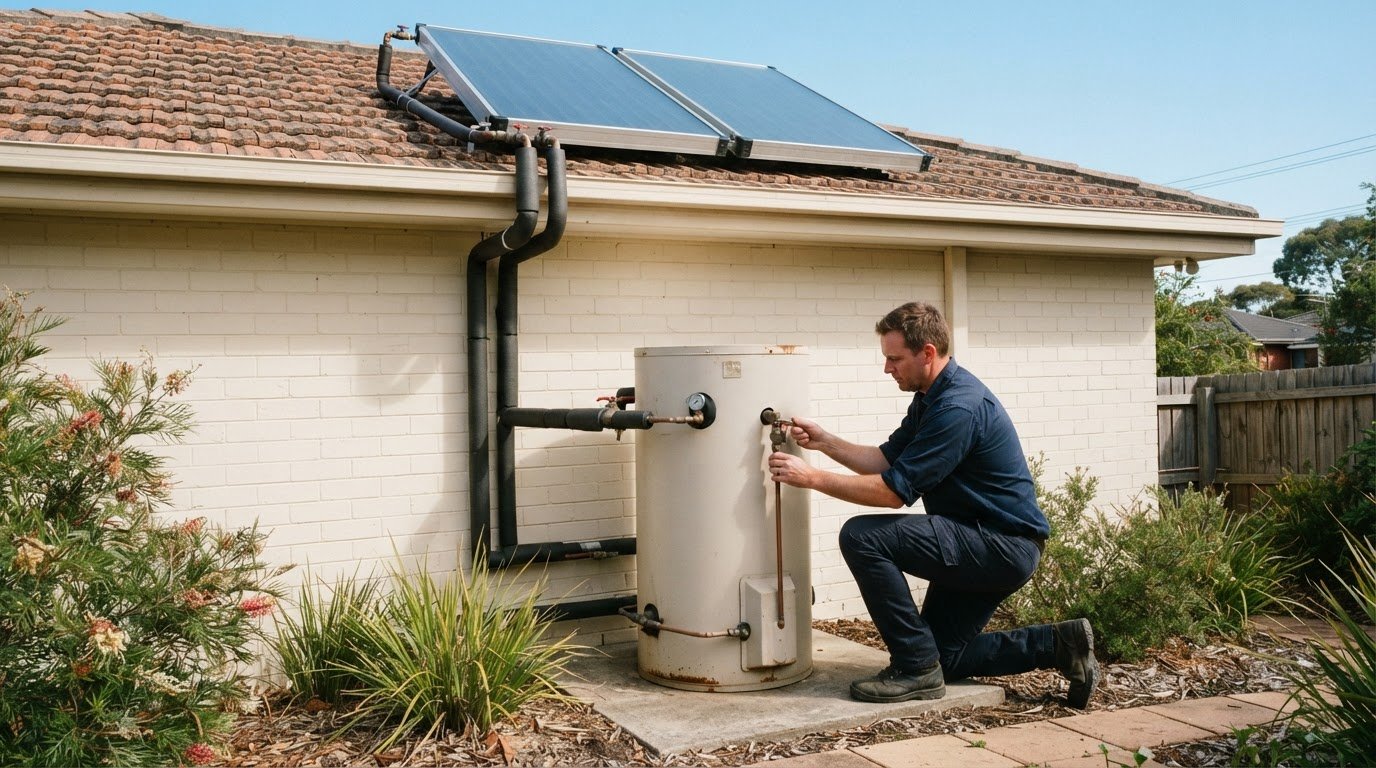
A solar hot water system can typically pay for itself in 5-7 years in Australia. That solar hot water system payback period depends on how much energy your household uses to heat water, what fuel your current system relies on, and how much sunlight the system can use. Maintenance also matters because it affects the savings you keep over time.
Look beyond the initial outlay: a system suited to your hot water needs and energy use may deliver a different return from one that is poorly matched to your home. Maintenance, backup heating and local conditions all affect the calculation.
This article explains how to estimate the solar hot water system payback period, what can shorten or extend it, and how solar thermal compares with rooftop solar PV and heat pump water heaters. You’ll get a practical way to weigh potential bill savings against ongoing costs and assess whether the figures make sense for your household.
Key Takeaways
- Base your estimate on your household’s hot water demand and the system you’re replacing, as these shape the energy savings available.
- Allow for upkeep when comparing long-term savings; inspection and maintenance costs affect the net benefit over time.
- Compare solar thermal, rooftop PV and heat pumps against your hot water habits and existing setup to see which approach fits best.
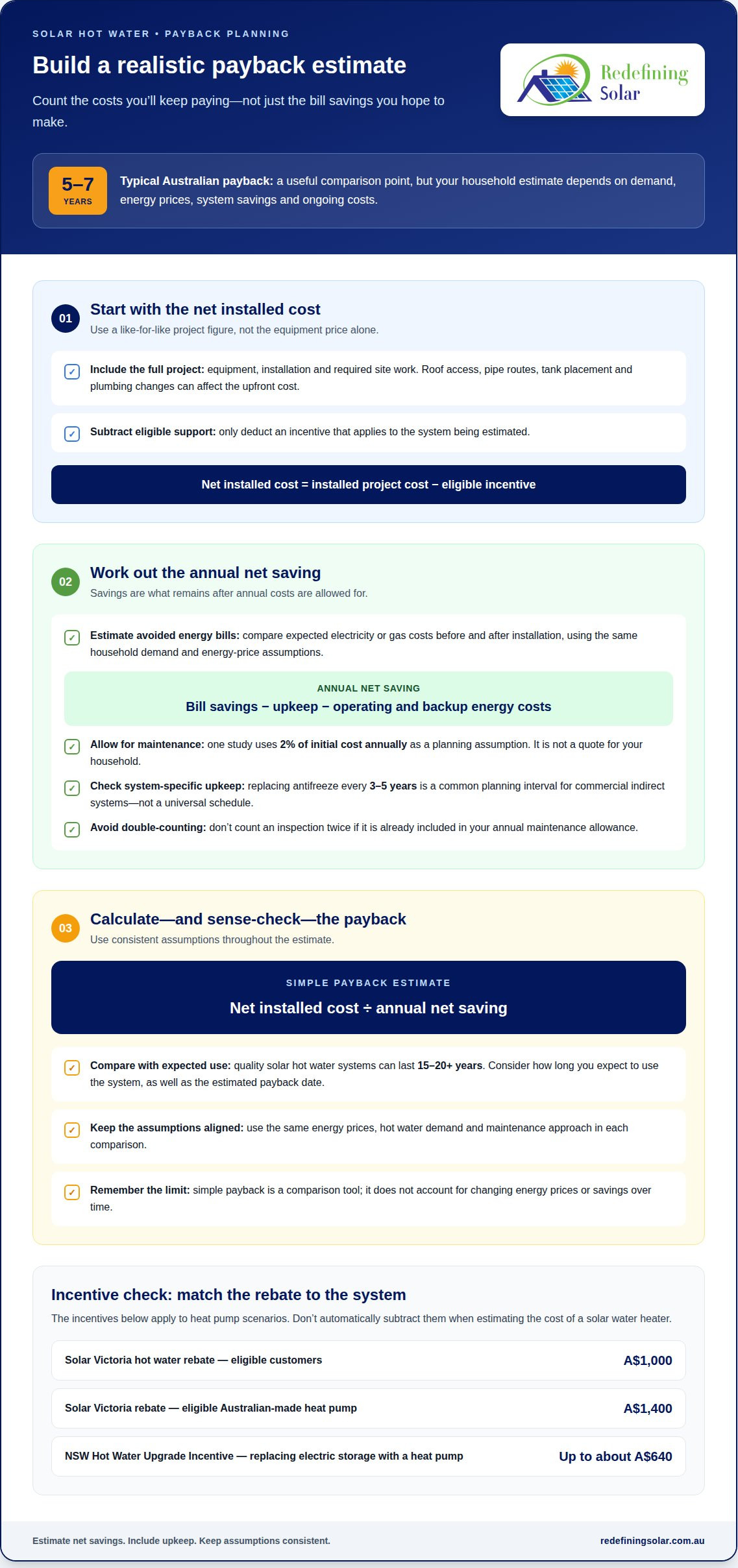
- Solar Victoria’s hot water rebate contributes A$1,000 for eligible customers, or A$1,400 for an eligible Australian-made heat pump.
Maintenance costs in payback calculations
Payback depends on net savings, not the initial bill alone. Include the installed project cost, subtract any eligible incentive, then account for annual upkeep and operating costs. A study’s planning assumption sets solar water heater maintenance at 2% of initial cost annually. Treat that as an estimate for modelling, not a quote for your household’s actual maintenance.
Installation complexity affects the upfront cost. Roof access, pipe routes, tank placement and changes needed to connect with existing plumbing can all affect the work involved. A straightforward replacement will differ from a project that needs extensive modifications. Compare quotes on the same basis, including equipment, installation and required site work, rather than comparing equipment prices alone.
Eligible grants and incentives can reduce the amount you need to recover through bill savings. For a clear estimate, start with the net cost after eligible support, then subtract annual maintenance and operating costs from the expected energy-bill savings. This gives the annual net saving. Divide the net installed cost by that figure for a simple payback estimate.
Maintenance assumptions also depend on system type. For commercial indirect systems, replacing antifreeze every 3-5 years is a common planning interval. These are planning figures, not a universal schedule, so avoid counting the same inspection twice if your annual allowance already includes it.
Look beyond the payback date, too. Quality solar hot water systems can last 15-20+ years, so compare the estimated payback with the period you expect to use the system. For example, a model that includes annual maintenance may produce a more realistic result than one that counts energy savings but ignores upkeep. Keep replacement components, servicing and backup energy in view, since each affects the savings retained. An accurate estimate needs consistent assumptions: use the same energy prices, household hot water demand and maintenance approach throughout the calculation.
What is the typical payback period of a solar water heater?
In Australia, a solar hot water system’s payback period is typically 5-7 years. Your estimate depends on hot water demand, climate, energy prices and the system’s annual savings. The solar hot water system payback period is a useful comparison point, but your own calculation should reflect how your property uses hot water.
Hot water demand and thermal load
Thermal load is the heat needed to raise water to its required temperature. It matters because steady demand can make better use of a solar collector. For example, a commercial load of 5,000 litres daily with a 40 °C temperature rise needs about 232.6 kWh of thermal energy daily, or 84,883 kWh annually. Household demand and local climate also shape system sizing and the likely contribution from solar.
Simple payback calculations
Simple payback divides the initial project cost by expected annual bill savings. Use the installed cost after eligible grants, then divide by the estimated yearly savings on electricity or gas. Greater annual savings mean a shorter estimated payback if the other assumptions remain the same. This calculation is useful for comparisons, but it does not account for changing energy prices or savings over time. Include maintenance and backup energy costs when estimating net savings.
Energy price changes
Energy price changes affect the value of the electricity or gas a solar heater displaces. A calculation using flat prices can differ from one that allows prices to rise. Some illustrative scenarios assume energy prices increase by 4% per year. Treat that as a modelling assumption, not a fixed forecast, and compare it with a calculation using unchanged prices. This helps show how sensitive the solar hot water system payback period may be to your assumptions.
Annual bill savings
Annual bill savings measure the electricity or gas costs avoided after installation. Solar hot water can reduce hot water bills by 65-80% compared with standard electric systems. Your household’s result depends on its existing heater, hot water use and available solar heat. To discuss how solar thermal could suit your hot water needs, explore solar thermal water heating.
Factors affecting payback period
A solar thermal system may collect less useful heat during winter or cloudy weather. Backup heating can supply heat when solar input does not meet demand, but more frequent use can reduce bill savings.
Climate and collector exposure affect how much solar heat reaches the stored water. Shading, roof orientation, hot water use and the required water temperature all influence how much energy the system can displace. A household with higher hot water use may benefit more, provided the system is sized to match that demand. A mismatch can leave heat unused or increase reliance on backup heating.
Incentives can lower the amount included in a payback calculation. Solar Victoria’s hot water rebate contributes A$1,000 for eligible customers, or A$1,400 for an eligible Australian-made heat pump. The NSW Government’s Hot Water Upgrade Incentive provides a discount of up to about A$640 when replacing an electric storage hot water system with a heat pump. These incentives apply to heat pump scenarios, so don’t automatically subtract them when estimating a solar water heater’s cost.
Your existing water heater also matters. Replacing an electric heater affects avoided energy costs differently from replacing a gas one, because each uses a different energy source and tariff. Compare current bills with expected costs after installation, including backup heating. For a fair comparison, use consistent assumptions about household demand and energy prices.
System sizing is another key factor. The right collector and storage arrangement depends on hot water demand, available sunlight and the required temperature. A design aimed at covering every need with solar may not offer the best balance between initial cost and savings. Compare the expected contribution from solar with the backup energy needed across the year. If your calculation points to a typical payback near 7 years, changes to incentives, usage or energy prices can shift the result. Each assumption affects how quickly savings recover the net project cost.
How much can a solar hot water system save on electricity or gas bills per year?
Annual savings depend on how much purchased energy solar heat replaces. A commercial example uses a 55% solar fraction, meaning solar provides that share of the hot water energy demand. The remaining load still needs another heat source. This distinction matters because the solar fraction describes heat supplied, not the percentage reduction in the whole energy bill. Fuel prices and backup heating affect the financial result.
In that illustrative commercial scenario, solar hot water saves about A$3,295 per year against gas heating. Against electric-resistance heating, the estimated saving is about A$5,602 per year. The difference reflects the energy costs displaced in each comparison. These figures show why the existing heater matters: an identical solar contribution can produce different dollar savings when it replaces different fuels.
To estimate household savings, compare water-heating energy bills before and after installation. Where possible, separate hot water from other household electricity or gas use, then account for backup heating in the new system. Use the same billing period and tariff assumptions for both figures. A calculation that counts solar heat but ignores energy used by the backup heater will overstate the bill reduction.
Use the annual net saving in your payback calculation, rather than the solar contribution alone. Subtract ongoing operating and maintenance costs from the expected bill reduction, then compare the result with the net installed cost. For commercial sites, stable, high-volume hot water demand can make annual savings easier to assess because the load is more consistent. For homes, changing occupancy, hot water habits and seasonal sunlight can shift the result. A sound comparison records the existing fuel, energy tariff, backup use and solar share. To discuss how solar thermal could suit your hot water needs, explore solar hot water options.
Redefining Solar: Battery Ready & Upgrades
Redefining Solar can help you consider how your hot water plans fit alongside a solar setup for your home or business. When comparing solar thermal with rooftop solar PV, consider how each option matches your energy use and existing equipment instead of assessing hot water savings in isolation.
If you’re planning a broader energy upgrade, Battery Ready & Upgrades can prepare an existing solar system for future storage. Residential Solar Systems and Commercial Solar Systems address different property needs, while Solar Panel Sales / Supply Only is an option for sourcing panels separately. The right approach depends on your project and how hot water fits into your energy use.
Contact Redefining Solar to discuss your solar plans and arrange a free solar assessment for your property.
Make your next energy decision with confidence
Treat the solar hot water system payback period as a decision-making tool, not a promise of future savings. Use it to compare options against your priorities, whether that’s reducing reliance on grid energy, planning upgrades over time or matching equipment to your property’s energy use. The result depends on your household or business circumstances.
Before deciding, consider how hot water fits into your wider energy plans. A system that works well on its own may also need to suit future changes to your property or energy use. Redefining Solar can help you explore your solar options and understand how they fit your plans.
Contact Redefining Solar today to discuss your next step. A clear conversation can help you move forward with a plan that feels right for your property.
Frequently Asked Questions
How do you calculate your own payback?
Start with records that separate hot water energy from other household use. Compare bills across seasons, note the current fuel and tariff, and account for changes in household occupancy. Then include the proposed system’s operating assumptions, including backup heating and maintenance. This gives your solar hot water system payback period estimate a sounder basis than relying on one unusually high or low bill.
What is the average solar hot water system installation cost in Australia?
There is no single installation cost that applies to every Australian property. The design, collector and tank arrangement, roof access, pipework and plumbing changes all affect the project scope. Ask for an itemised quote that separates equipment, installation and site work. This makes it easier to compare systems with different layouts without treating a straightforward installation as equivalent to a more involved one.
How long is the typical solar hot water payback period in Australia?
In Australia, payback is generally measured in years rather than months, but one estimate will not suit every property. Compare the proposed system with the heater it replaces and consider how much of your hot water demand it can meet. Your solar hot water system payback period estimate should also reflect the relevant tariff and backup arrangement.
How do solar hot water running costs and payback compare with heat pump hot water systems?
Solar thermal collectors use sunlight directly to heat water, while heat pumps use electricity to move heat from ambient air. Heat pumps typically have a coefficient of performance (COP) from 3 to 6, meaning they deliver several units of heat per unit of electricity. Compare both systems using your tariff, backup needs and hot water pattern, rather than equipment type alone.
How do household size, hot water use and climate affect solar hot water payback?
Household patterns can change, so consider more than the number of people living at home today. Changes in occupancy, working from home or guest visits can shift when hot water is used. Reviewing bills across different seasons can help reveal those patterns. This context helps match the system’s storage and solar contribution to actual use rather than a temporary routine.
What Australian rebates or incentives are available for solar hot water systems?
Australian support depends on the state and the technology being installed. Federal Small-scale Technology Certificates and state programs may apply to eligible hot water upgrades, particularly heat pumps. Their rules do not automatically apply to solar thermal systems. Before including an incentive in a comparison, identify the exact technology and replacement type covered by the scheme, then include only support that applies to that installation.