Yes, you can finance a commercial solar system for leased premises, but the time remaining on your property lease can affect your options. Some finance companies require the lease to last at least as long as the finance term. When comparing commercial solar financing options, consider your occupancy plans alongside your energy needs.
It’s understandable to want to reduce electricity costs without tying up capital in a property you don’t own. A business loan or chattel mortgage can let you own the system while making repayments. A power purchase agreement (PPA) can avoid buying the system upfront, with payments based on the solar electricity generated.
This guide compares loans, PPAs and solar leases, including who owns the equipment and how a leased site affects your choices. It also explains how energy use, site suitability, available capital and the time you expect to remain at the premises can help you weigh the options.
Key Takeaways
- Match the finance term to the time you expect to remain at the premises, and compare green loans, sustainability bonds and ESG-linked finance against your ownership goals.
- With a power purchase agreement, focus on who owns and maintains the system, how electricity is charged and what the contract means for your flexibility.
- Use your energy use, site suitability and available capital to narrow the options before weighing repayments against potential bill savings.
- Redefining Solar’s commercial solar systems and battery-ready upgrades can help you plan a system around your business site and energy needs.
Can I get Commercial Solar Finance when I lease my new premises?
Yes, a business can finance solar for leased premises, but the remaining lease term can affect approval. Some finance companies require the property lease to run at least as long as the finance agreement.
Green loans and sustainability bonds
Green loans finance eligible environmental projects, including rooftop solar panels, while sustainability bonds and ESG-linked investments can fund broader business sustainability activity. These products were identified as business solar financing options in 2025, but their structure and eligibility differ. Green personal loans can have comparison rates around 6.5%, while some charge more than 20%; personal loan terms generally run from 1 to 10 years.
Business solar loans and asset finance
A business solar loan or asset finance arrangement spreads the system cost over time and may include a battery. Commercial solar loans in Australia are commonly repaid over two to ten years, with approval subject to credit assessment. For leased premises, compare the proposed finance term with the time left on your lease. If the lease ends sooner, your finance commitment could continue after your right to occupy the site ends.
Bank loans and chattel mortgages
A bank loan provides borrowed funds for the system. With a chattel mortgage, the business owns the equipment from purchase, while the financier registers an interest in it until the contract is completed. Businesses may be able to claim depreciation and interest expenses, depending on their circumstances. As a commercial solar loan requires credit approval, compare repayments, total borrowing costs and ownership terms before committing.
Before financing, check the agreement for repayment amounts, rate type, fees, early-exit conditions and what happens if you leave the premises. Lease and finance terms may need to match. The contract also determines whether you can keep, remove or transfer the system.
| Option | Ownership | Typical term | Key consideration |
|---|---|---|---|
| Green personal loan | Business owns system | 1 to 10 years | Rates vary |
| Commercial solar loan | Business owns system | Two to ten years | Credit approval |
| Chattel mortgage | Business owns equipment | Finance agreement term | Financier registers interest |
Choose by comparing the remaining lease term, expected energy use, borrowing capacity and how important system ownership is to your business.
Power purchase agreements
A power purchase agreement (PPA) lets your business use solar power without paying upfront for the solar system. A third party owns the equipment, and your business pays for the electricity it generates. Commercial solar PPAs commonly run for 10 to 20 years, so the agreement can shape your costs and flexibility for the long term.
Under a PPA, the system owner handles maintenance. Check how the agreement sets electricity charges, equipment ownership, maintenance coverage and performance measurement. It should also spell out warranty responsibilities, rate changes, minimum purchase obligations and buyout terms. Together, these details show how the agreement affects ongoing expenses, potential savings and your ability to respond to a move or change in business needs.
Upfront and ongoing costs depend on the arrangement: a PPA avoids upfront system capital, while a cash purchase requires payment for installation and equipment. The price of a purchased system depends on its size, design, site conditions and components, and is provided after a quote request. With a PPA, compare the electricity rate and contract obligations with your current energy costs.
Ownership affects the overall cost and potential savings. A business that buys a system owns the asset immediately and avoids ongoing finance costs or interest. A PPA generally delivers smaller savings than owning the system. Under a lease, the business pays a fixed monthly fee while the finance company retains ownership until the agreement ends. The total lease cost may exceed the cost of purchasing.
Chattel mortgages, finance leases and hire purchase agreements offer different payment structures. With a chattel mortgage, the business owns the equipment while the financier holds an interest in it. A finance lease can have fixed payments and a residual or balloon payment. For hire purchase, review the title-transfer and end-of-term conditions closely before signing.
For example, compare the PPA rate against grid electricity, then account for escalation and minimum purchase terms across the full contract. That makes the trade-off clearer: lower upfront capital versus ownership and potentially greater savings. If you’re planning a system around your site and energy use, explore commercial solar systems as another route to ownership.
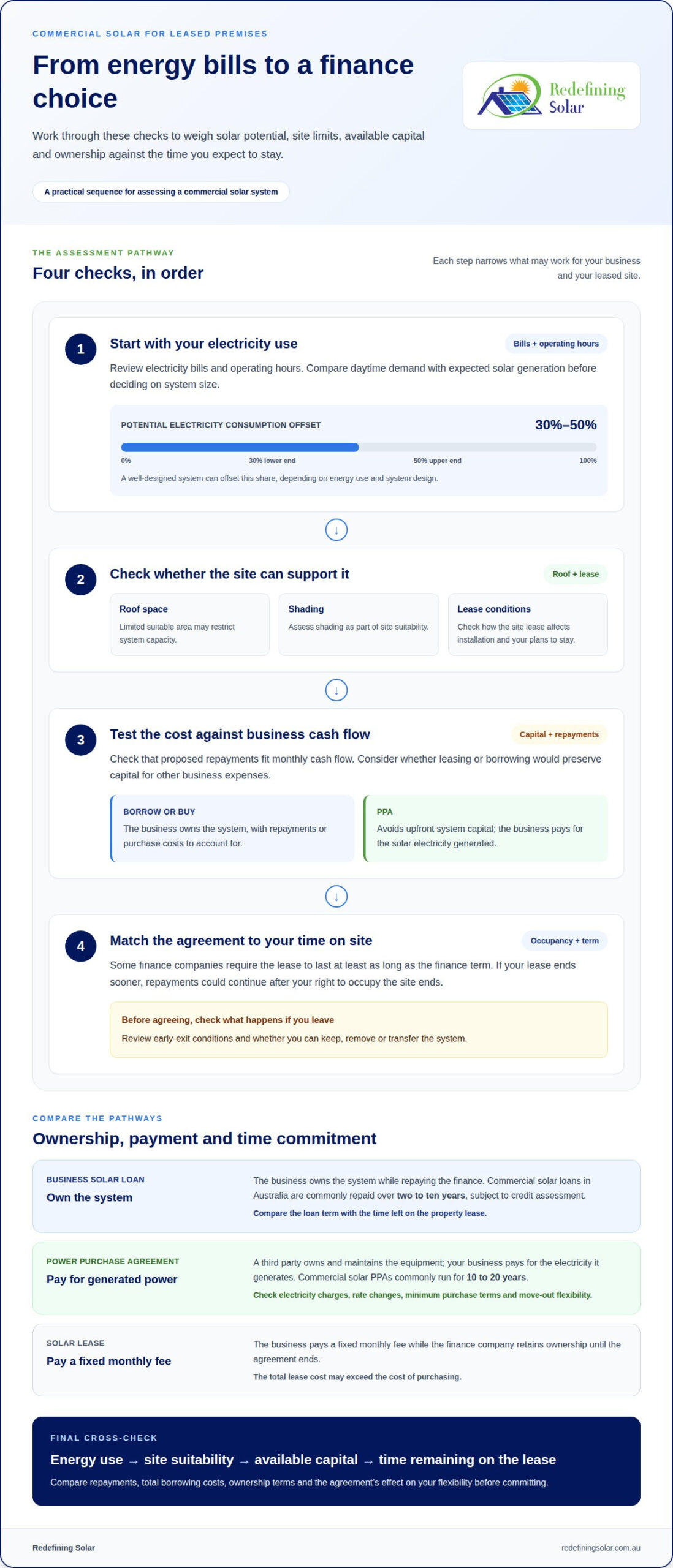
Assessing energy use, site suitability and business capital
Start with electricity bills and operating hours, then assess roof space, shading and lease conditions. A well-designed commercial solar system can offset 30% to 50% of a business’s electricity consumption, depending on its usage and system design.
Compare daytime demand with expected solar generation before deciding on system size. A business using electricity during daylight can use more of its solar power directly, while limited suitable roof space may restrict system capacity. Check that proposed repayments fit monthly cash flow, and consider whether leasing or borrowing would preserve capital for other business expenses.
Depreciation and interest expense claims depend on the business’s circumstances. Instant asset write-off treatment is subject to current tax rules and eligibility criteria. Depreciation may apply when the system is treated as a depreciating business asset.
Brokered business and commercial finance
A finance broker can present a business’s application to lenders and compare available finance structures. Applying directly to one bank means the assessment is based on that lender’s criteria. Finance costs can depend on the business’s trading history, assets and borrowing needs. Compare interest, fees, repayment timing and the effect on working capital.
Incentive and credit eligibility
Commercial solar loans require credit approval. Lenders may consider the business’s trading history, available assets, borrowing needs and ability to make repayments. Government incentives for business renewable energy depend on system size. The Clean Energy Regulator says businesses can receive an upfront discount by assigning their right to claim STCs to a registered agent. Factor eligible incentives into the amount you plan to finance, rather than treating them as guaranteed cash savings.
Follow a practical sequence: review electricity bills, assess site suitability, estimate a system size, then compare finance repayments with available capital. This ties the decision to actual energy use and the business’s capacity to fund a renewable energy investment.
Solar finance companies in Australia
Australian businesses can access solar finance through banks, specialist finance companies, brokers and PPA providers. Commercial solar financing options include business loans, asset finance, chattel mortgages, leases and PPAs. Environmental upgrade agreements are another pathway where available. Each arrangement affects who owns the system, how payments are made and the impact on business cash flow.
A bank or specialist lender may finance equipment through a loan or asset finance. Commercial solar loans are commonly repaid over two to ten years. A broker can compare lending structures across finance providers, while a PPA provider owns the system and sells the business its generated electricity. PPAs commonly run for 10 to 20 years, so contract length matters.
Environmental upgrade agreements involve a finance provider, building owner and participating local government. Availability and project eligibility vary across Australia. The arrangement may allow a building owner to pass some project costs on to tenants who benefit from lower electricity bills. Legislation is designed to ensure tenants don’t pay more as a result. The effect of a property sale on any remaining loan liability depends on the agreement.
Compare the full arrangement, not just the advertised payment. Review:
- Whether payments are fixed, and how interest or rate escalation changes them.
- Who owns the equipment, arranges maintenance and holds any applicable incentives.
- What happens at the end of the term, on early exit or when premises change.
- How minimum purchase obligations under a PPA affect expected electricity use and cash flow.
A useful comparison starts with your business’s energy use and time at the premises. Then weigh available capital against repayment commitments, ownership preferences and flexibility. A long PPA may suit a business seeking to avoid upfront capital, while a loan can suit one prioritising ownership. Discuss your commercial solar requirements as you assess system suitability and finance structures.
Redefining Solar: Battery Ready & Upgrades
Redefining Solar can assess a commercial solar system for your premises and consider how battery-ready planning fits your energy needs. Once you’ve compared finance structures, a free solar assessment is a practical next step to discuss site suitability, energy use and whether storage may suit your plans.
Redefining Solar’s commercial solar systems and Battery Ready & Upgrades can support different project needs. When weighing a system purchase against finance, clear information about the proposed setup can help you compare ownership, repayments and expected electricity use. Redefining Solar also offers solar panel sales and supply only.
Contact Redefining Solar to arrange a free solar assessment for a commercial solar system or battery-ready upgrade.
Turn your solar decision into a clear next step
Before committing, define what a workable solar project needs to achieve for your business. Note your priorities for cash flow, system ownership and future plans for the premises. This gives you a practical basis for comparing commercial solar financing options and weighing the trade-offs against your operational needs.
Redefining Solar provides commercial and residential solar systems, along with Battery Ready & Upgrades. If you’re moving from finance research to system planning, arrange a free solar assessment to discuss your site and energy needs. This helps you explore a suitable solar solution while keeping your business priorities in view.
Contact Redefining Solar to discuss your options and take the next step with confidence.
Frequently Asked Questions
How Does Solar Finance Work for a Business?
Solar finance spreads the cost of a business system through repayments or an electricity purchase arrangement. To prepare, gather recent electricity bills, note the premises’ operating hours and record how long remains on the property lease. These details help you assess system size and finance fit. Then compare the payment structure with available cash flow, ownership preferences and the business’s plans for the site.
How do commercial solar loans, leases, and power purchase agreements compare in Australia?
A loan or chattel mortgage generally lets the business own the system, while a lease or PPA keeps ownership with the financier or another party during the contract. Ownership can affect who claims applicable incentives: businesses that own a system through a loan or chattel mortgage receive the rebate, while the financier claims it under a lease or PPA. Compare ownership, payment terms, end-of-contract conditions and incentive treatment together.
Are Australian government grants, rebates, or tax incentives available for commercial solar?
Incentives can apply, but eligibility depends on the system and business circumstances. According to the Clean Energy Regulator, a business can receive an upfront discount by assigning its right to claim Small-scale Technology Certificates to a registered agent. Large-scale Generation Certificates and the solar battery rebate may also benefit some outright purchases. Tax treatment differs by arrangement, so include an accountant when assessing depreciation, GST and interest expenses.
What are the steps to arrange commercial solar financing in Australia?
Start by collecting electricity bills and documenting operating hours, site conditions and the remaining lease term. Use this information to size a suitable system, then decide whether ownership or avoiding upfront capital matters more. Compare finance terms, total payments, fees, maintenance responsibilities and exit conditions. Finally, prepare the business information needed for a credit assessment and ask an accountant to consider the tax treatment before you sign.
How can businesses compare solar finance quotes and estimate payback and savings?
Compare quotes using the same system capacity, equipment scope and installation assumptions, and separate upfront contributions from ongoing repayments. Estimate the value of electricity the business uses directly, plus any value from exported power, against current bills. For a financed system, include repayments and fees when assessing cash-flow impact. A simple payback estimate divides the net system cost by estimated annual bill savings. Apply the same assumptions across quotes.