A 6.6 kW solar system is typically adequate for an average Australian home, but your electricity use and when you use it matter too. A solar power cost calculator for Australia can help you estimate a suitable system size and potential bill savings from your own usage. Treat the result as a starting point, not a one-size-fits-all answer.
It makes sense to want a clear estimate before deciding. Your electricity bill shows how much power you use, while your daily routine helps reveal how much solar electricity you could use as it is generated. The right system depends on both.
This guide explains how to estimate system size and potential savings from your electricity bill, and what can affect installation costs. It also covers how roof space, local conditions and daytime electricity use shape the result.
Key Takeaways
- Use your electricity use and daytime habits to estimate a system size that suits your household, rather than choosing by roof space alone.
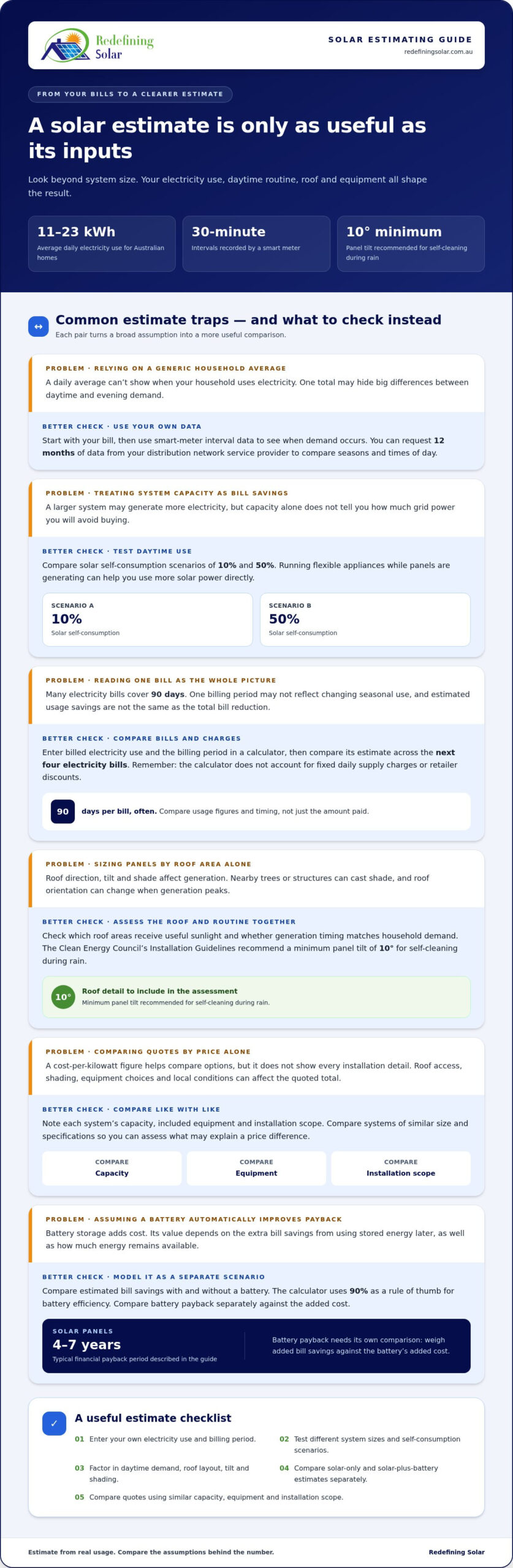
- Compare solar self-consumption scenarios of 10% and 50% to see how using more power while panels are generating could affect savings.
- Check your bill and meter data to build a clearer picture of your usage, then weigh roof layout, equipment and installation requirements when considering costs.
- The Clean Energy Council’s Installation Guidelines recommend a minimum panel tilt of 10° for self-cleaning during rain, one roof detail to consider in a system assessment.
What size solar system do I need?
The right system size depends on your electricity use, roof layout and how much power you use during daylight. Start with your bills, then consider how panels could fit your home and daily routine.
To compare system costs, look at the cost per kilowatt alongside the full system size. A per-kilowatt figure helps compare options, but it doesn’t show every installation detail. State and territory prices can differ with local installation conditions, available incentives and system specifications. Larger systems need more panels, while roof access, shading and equipment choices also affect the quoted total.
For a useful comparison, note each system’s capacity, included equipment and installation scope. Compare systems of similar size and specifications to understand whether a price difference reflects capacity, roof complexity or equipment, rather than relying on an average figure.
Bill savings by system size
Estimate savings by comparing the electricity your panels could supply with the power your household currently buys. A 6.6 kW system may generate more electricity than a smaller system, but the bill benefit depends on how much you use while it’s being produced. Review your usage over the same billing period and account for exported power separately.
For a practical estimate, compare your current bill with expected solar generation and daytime electricity use. A solar calculator can help you test different system sizes against those inputs, rather than treating capacity as a direct measure of savings.
Panel orientation and system size
Roof direction, tilt and shading affect how much electricity panels produce, so assess them alongside system size. The Clean Energy Council’s Installation Guidelines recommend a minimum panel tilt of 10° for self-cleaning during rain. Roof orientation can change when generation peaks, which matters if household demand is concentrated in the morning or afternoon.
Check which roof areas receive useful sunlight and whether nearby trees or structures cast shade. A suitable system design can make practical use of the available roof space, rather than sizing panels without considering their placement.
How Do I Calculate How Much Solar Power I Need?
Start with your electricity use, then test how solar generation and battery storage could match it. Australian homes use an average of 11-23 kWh of electricity per day, so your own bills and meter data are more useful than a generic household estimate. A solar power cost calculator for Australia can help compare system and battery scenarios, but its result depends on the details entered.
Use these steps to make the estimate more relevant:
- Enter your daily electricity use and the system size you want to compare.
- Test solar self-consumption scenarios of 10% and 50% to see how using more generated power at home changes the model.
- Add battery storage as a separate scenario, then compare estimated bill savings with and without it.
A smart meter can record electricity use in 30-minute intervals. That data helps show when demand occurs and whether a battery could store surplus daytime generation for later use. A calculator’s estimate becomes more accurate when it reflects your actual usage patterns, rather than relying only on an average daily total.
Solar and battery calculators can help you explore off-grid setups, where the system must meet household demand without grid electricity. Consider when you use power, how much storage you need and how generation changes with the weather. An off-grid design must balance supply and demand across different conditions.
To assess potential savings, compare the calculator’s bill estimate across solar-only and solar-plus-battery scenarios. Battery efficiency affects how much stored energy is available later; the calculator uses 90% as a rule of thumb. Review any government rebate shown as a separate input and include it only when you meet its eligibility requirements. Quotes can then be compared against the same system assumptions.
Solar households typically recover the cost of solar panels through financial payback in 4-7 years. Battery payback needs its own comparison: weigh the extra bill savings from stored energy against the battery’s added cost. If you’re planning storage now or later, explore battery-ready solar upgrades.
Using current electricity bills to estimate savings
Your electricity bill is a useful starting point for estimating solar savings. Compare the usage figures with when your household uses electricity, not just the amount you paid.
Solar savings calculator and assessment
Many Australian electricity bills cover a 90-day period. Enter the billed electricity use and billing period into a solar savings calculator, then compare the estimate across the next four electricity bills. The calculator does not account for fixed daily supply charges or retailer discounts, so your total bill may not fall by the same amount as your usage charges.
If you have a smart or interval meter, you can request 12 months of interval data from your distribution network service provider. Use these records to see how demand changes across seasons and times of day. A full year offers a more useful view than one bill alone.
Daytime electricity use affects how much solar power you use directly. Running appliances while panels are generating can reduce the electricity you buy from the grid. Compare your usage pattern with your bill data, then consider whether shifting flexible tasks to daylight hours could make better use of solar generation.
Estimated savings, payback and emissions
Solar calculators estimate bill savings from generation, household use and exported electricity. Australian households typically recover the cost of solar panels through financial payback in 4-7 years. Treat that period as a comparison point: actual savings depend on how much generated power you use and your electricity tariff.
For an annual estimate, compare potential savings with the system’s upfront cost and the electricity you would still buy. Using solar power at home can reduce grid electricity use and help estimate avoided emissions. Base that estimate on the electricity displaced, rather than assuming every kilowatt-hour generated has the same financial or emissions benefit.
For a clearer assessment, align your bill period, meter data and daytime usage before comparing calculator results. This makes it easier to see which assumptions shape projected savings and payback, and how changes to your energy habits could affect the estimate.
Factors affecting solar installation costs
Rebates and Small-scale Technology Certificates (STCs) can reduce the upfront amount payable for an eligible solar installation. The federal STC rebate normally equates to about 30-35% of the system price.
Feed-in tariffs and installation costs
A feed-in tariff pays for eligible solar energy exported to the grid, affecting savings rather than the installation itself. Compare that rate with the value of using solar energy at home, and model a 0-cent tariff as a worst-case scenario.
Your retailer, location and export arrangements influence the tariff used in an estimate. A lower feed-in rate makes daytime self-consumption more important to the household’s overall return.
Additional installation costs
Installation requirements depend on your property and chosen equipment. Roof access, panel layout, shading, wiring and electrical work can all affect the scope. Battery storage adds equipment and installation requirements, so compare a solar-only system with a solar-and-battery option.
Battery efficiency also affects usable stored energy. A calculator uses 90% as a rule-of-thumb figure, so compare the energy stored with what can later supply household demand.
Rebates and STCs reducing upfront costs
STCs provide a discount that lowers the upfront amount, while state programs may offer additional support. In Victoria, eligible residents may receive a government solar rebate of up to A$1,400. Households must use a Solar Victoria-authorised retailer to qualify for a Solar Homes Program rebate or loan.
Eligibility and system design determine which rebate may apply. Include a rebate in your estimate only after accounting for its conditions.
Retail electricity rates influence the value of solar power used at home. Compare the rate with export credits to assess whether using or exporting generated electricity is more valuable.
Review the installation factors together before comparing system options, then discuss your solar system requirements.
Redefining Solar: Battery Ready & Upgrades
Redefining Solar can help turn your estimates into a solar plan suited to your property and energy use. If you are considering a battery now or want to plan for one later, Battery Ready & Upgrades can help shape your next steps.
For a new installation, Residential Solar Systems suit household energy needs, while Commercial Solar Systems are designed for business properties. Solar Panel Sales / Supply Only is another option if you are sourcing panels separately. The right choice depends on your goals, available roof space and electricity use.
Share your usage patterns and priorities with Redefining Solar to discuss a suitable next step.
Turn your estimate into a practical next step
A calculator is most useful when it helps you decide what to explore next, rather than making the decision for you. Use your estimate to set priorities, such as matching a system to your property, planning for battery storage or understanding how solar could support your home or business.
A solar power cost calculator for Australia can provide a starting estimate. A project-specific discussion can then connect it with your property and energy goals. Redefining Solar offers Residential Solar Systems, Commercial Solar Systems and Battery Ready & Upgrades to help you consider an option that fits how you use electricity.
Bring your estimate and the questions it raised into your next conversation. Contact Redefining Solar to discuss your solar plans and take the next step with confidence.
Frequently Asked Questions
How much will solar panels save me?
Your savings depend on how much solar electricity you use instead of buying power from the grid. A solar power cost calculator in Australia can estimate the difference using your usage and tariff details. For a clearer comparison, separate usage charges from daily supply charges, which may remain on your bill. Export credits also affect the result and depend on your retailer’s feed-in tariff.
How can I maximise my solar savings?
Where your routine allows, use more electricity while your panels are generating. For example, run the dishwasher or washing machine during daylight rather than in the evening. Check whether your retailer’s feed-in tariff makes exported electricity less valuable than using it at home. If your household regularly uses power after sunset, compare the potential value of storing excess generation with the added system cost.
Want a better return on investment?
Compare the expected bill reduction with the system’s upfront cost, then assess how long savings could take to offset it. Include ongoing electricity purchases and equipment choices that affect system performance. A battery may suit households that use more electricity after dark, while a simpler setup may better match daytime demand. Redefining Solar offers a free solar assessment to help you consider your requirements.
How much does a 6.6 kW solar system cost in Australia in 2026?
The price of a 6.6 kW system depends on its equipment, roof access, design and installation requirements. A case-specific price is provided after a quote request, with those factors shaping the total. Compare quotes for systems with similar specifications and installation scope, rather than relying on capacity alone. This makes differences between proposed setups easier to understand before deciding.
What is the average cost per watt for residential solar in Australia?
There is no single per-watt figure for every residential installation. To compare quotes, divide each quoted total by the system’s rated capacity in watts, then check that both cover comparable equipment and installation work. Roof layout, access and system design can change the total, so use the per-watt comparison alongside the full work scope.
How much does a home battery add to solar installation costs in Australia?
The added cost depends on battery capacity, the existing inverter setup and the work needed to connect storage to your solar system. A new installation and a retrofit can involve different equipment and installation requirements. Compare the battery’s usable stored energy with your evening electricity use, then consider how much grid electricity it could replace. This helps you assess whether storage suits your household’s needs.