Whether your solar project qualifies for small-scale technology certificates (STCs) depends on the system and the scheme’s eligibility rules. The small-scale technology certificates STC value is not a single fixed amount: the number of certificates depends on factors such as your system’s location and deemed generation, while open-market prices can change daily.
It’s easy to assume that the certificate value is simply a set discount, but the calculation and the way certificates are sold both affect what they’re worth to you. STCs are electronic certificates created under the Small-scale Renewable Energy Scheme, which forms part of the national Renewable Energy Target, according to the Clean Energy Regulator.
This guide explains which projects may qualify, how solar and battery STCs are calculated, and why open-market and Clearing House prices differ. You’ll also see how certificates can affect a solar project’s upfront cost, helping you understand the figures in your proposal.
Key Takeaways
- Assess eligibility by looking at system type, capacity, location and expected generation, rather than assuming all solar projects qualify.
- Compare how the variable open-market price and the fixed-price Clearing House can affect the value and timing of selling certificates.
- Allow for the scheme’s phase-out when considering installation timing, as the calculation changes over time.
- For battery systems, usable capacity and the applicable calculation factor shape the certificate total.
How are STCs calculated for solar systems?
In Australia, one Small-scale Technology Certificate represents 1 MWh of renewable electricity generated or displaced by an installed system. The Clean Energy Regulator says STCs are electronic certificates created under the Small-scale Renewable Energy Scheme, part of the national Renewable Energy Target. The value of small-scale technology certificates (STCs) can reduce eligible installation costs when certificates are assigned or sold.
The certificate total depends on system type, capacity, location and deemed generation. Solar PV systems up to 1 MW may generate STCs. The calculation uses the system’s location, electricity generated or displaced, and years remaining until the scheme ends in 2030. It is based on deemed generation, not actual measured output.
Location affects the total: a 6.6 kW system in a higher-sunlight zone may create more STCs than the same-sized system in a lower-irradiance zone. Eligible small-scale solar, hydro and wind systems installed in 2026 have a 5-year deeming period. That period reduces by one year each January, making installation timing relevant.
To calculate the STC discount in a solar quote, the certificate count is multiplied by the value applied to each certificate, then shown as a discount. The small-scale technology certificates (STC) value in the quote depends on the system’s deemed generation and location, as well as the certificate price used.
Homeowners can assign STCs to an installer or agent, who may sell them on the owner’s behalf or provide an upfront discount in exchange. The Clean Energy Regulator says STCs must be claimed within 12 months of installation.
When comparing quotes, check the certificate count, price per certificate, discount and any separately itemised fees. Confirm that the system details and calculation align. Different certificate counts or prices can change the discount, so compare the assumptions behind each quote rather than the discount alone.
Battery STCs use a separate calculation. The Cheaper Home Batteries Program covers no more than the first 50 kWh of usable capacity. The Australian Government purchased and surrendered 98,769,427 STCs under the program in 2025-26.
STC market value and the role of supply and demand
Your STC return depends on the certificate count, applicable deeming period and sale price. Australian open-market prices shift with supply and demand, while the Clearing House price is capped.
Supply and demand effects
Supply and demand influence open-market STC prices through the number of certificates available and buyers’ interest. When supply exceeds demand, sellers may accept a lower price to find a buyer; when demand is stronger, buyers compete for available certificates. Certificates can change hands more than once before surrender, so trading activity also affects market conditions. This means the number of STCs alone does not determine the discount in your quote.
Clearing House and open-market pricing
The Clearing House offers a capped certificate price, while open-market sales depend on negotiation between buyers and sellers. Open-market prices respond to supply and demand and can change daily, so the amount offered may differ from the cap. Buyers and sellers arrange payment through a contract, and a sale may proceed quickly once a buyer is found. Clearing House sellers, however, are not guaranteed a sale timeframe, as price competition affects the queue. Comparing sale routes helps explain why quotes may apply different upfront STC discounts.
Factors affecting STC value
The deeming period affects how many certificates a system creates, while the certificate price determines their monetary value. A shorter deeming period can mean fewer certificates for an eligible system; a changing market price affects the value of each certificate separately. Keep these factors distinct when reviewing a quote. Check whether the discount reflects the certificate count, sale route and price used, rather than treating one figure as the whole STC value.
If you’re reviewing a solar proposal, solar project requirements can help you connect certificate assumptions with the system being considered.
STC scheme phase-out
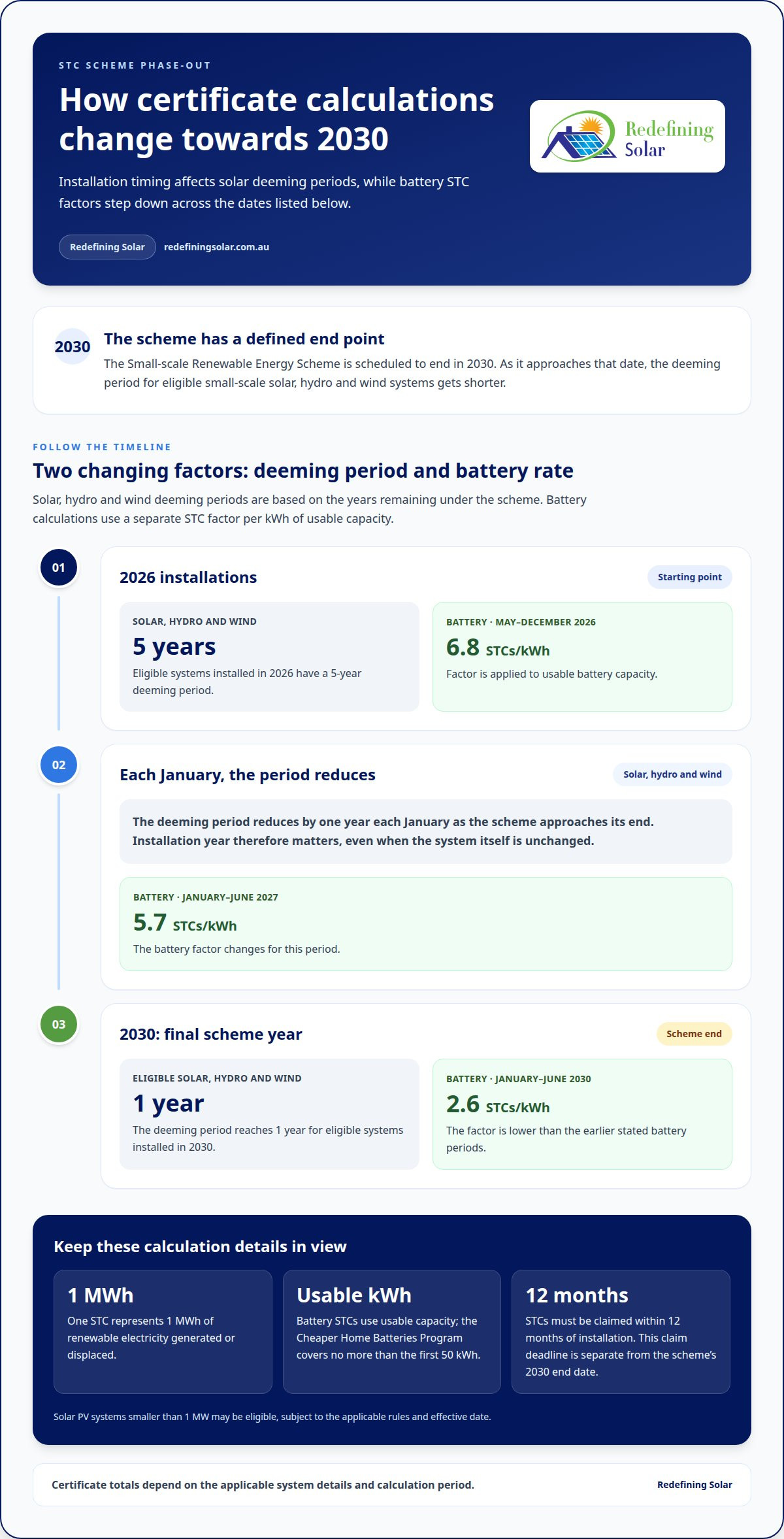
Australia’s Small-scale Renewable Energy Scheme is scheduled to end in 2030, so the remaining time affects the certificates eligible systems can create. For small-scale solar PV, hydro and wind, the deeming period gets shorter as the scheme approaches its end. This means installation timing can affect the STC total, even when the system itself is unchanged.
Eligible small-scale solar, hydro and wind systems installed in 2026 have a 5-year deeming period. The period reduces by one year each January, reaching 1 year for eligible systems installed in 2030. In practice, the calculation accounts for the years remaining under the scheme, rather than treating each installation year alike. Solar PV systems smaller than 1 MW may be eligible, subject to the applicable effective date.
Battery certificate factors also decline over time. Solar battery systems receive 6.8 STCs per kWh of usable capacity from May to December 2026, then 5.7 STCs per kWh from January to June 2027. The factor falls to 2.6 STCs per kWh from January to June 2030. These changing rates mean battery installation timing and usable capacity both shape the certificate calculation.
The phase-out also matters for owners planning a future installation or upgrade. STCs must be claimed within 12 months of installation, according to the Clean Energy Regulator, so the claim deadline is separate from the scheme’s 2030 end date. Liable parties surrender certificates each quarter, supporting their ongoing role in Australia’s clean energy scheme.
For a quote, compare the installation date, system type and certificate calculation together. A small-scale solar system installed in 2026 uses a different deeming period from one installed in 2030; battery calculations also use the factor that applies to the relevant period. The phase-out does not make every project ineligible, but it changes the calculation as the scheme moves towards 2030. Include those timing effects when assessing the expected STC discount against the system’s installation costs.
The fixed STC Clearing House price
The certificate count and how the certificates are assigned shape the upfront reduction applied to an eligible installation.
Australia’s fixed STC price was legislated in 2010. It gives sellers a defined alternative to negotiating an open-market sale, where prices depend on supply and demand. Comparing both routes helps explain why certificate estimates may translate into different discounts.
There is a practical difference between a fixed price and a guaranteed sale time. Clearing House sellers are not guaranteed a sale timeframe because price competition affects the queue. Buyers pay into the seller’s nominated bank account for certificates purchased through the Clearing House. Consider the amount and timing shown in a quote separately.
For an eligible system, the STC total is calculated first; the sale price then determines its gross certificate value. A retailer or installer may sell certificates on the system owner’s behalf or provide an upfront discount in exchange. Read the quote to see whether it states the certificate count, price per certificate and resulting discount.
The Clearing House is part of the Australian Small-scale Renewable Energy Scheme, but its fixed price does not determine how much renewable generation an eligible system is deemed to produce. System type, capacity and location inform the certificate total; the cap sets the maximum price through this sale route. Keeping the calculation and pricing steps separate clarifies what the discount represents.
Planning a solar installation? Discuss your solar project and how its certificate assumptions fit the proposal.
Redefining Solar: Battery Ready & Upgrades
Redefining Solar can help plan a solar project around your energy needs and the certificate assumptions in your proposal. If you’re adding storage to an existing setup, Battery Ready & Upgrades may suit your next step. For a new project, residential and commercial solar systems are available.
Clear system details matter when assessing potential STCs. Redefining Solar can discuss your project requirements, including whether solar panel supply only suits your plans. This is a practical starting point for weighing system options alongside certificate calculations, without treating an estimated discount as the only factor in your decision.
For help planning your solar project, contact Redefining Solar.
Make your next solar decision with confidence
Your decision is not simply whether a certificate appears in a proposal. Consider whether the overall solar plan suits your property, energy use and priorities. Treat small-scale technology certificate (STC) value as one part of the decision, alongside the system design and assumptions behind the quote.
Before moving ahead, consider what you want your system to achieve and which details need clarification. A clear discussion about your project can help you understand how the proposal fits your priorities, without letting one discount figure make the decision for you. Choose a next step that leaves you comfortable with the system and the details set out in the quote.
For a practical conversation about your plans, contact Redefining Solar to discuss your project. Take the next step when you’re ready.
Frequently Asked Questions
Is my project eligible for STCs?
Your project may qualify if it uses an eligible small-scale renewable system, but system type and installation details matter. Eligible categories include rooftop solar PV, small wind, hydro and solar water heaters. Solar PV systems below 1 MW may be eligible, subject to the applicable effective date. The system’s products and installation must also meet the scheme’s requirements for a valid certificate claim.
What are Small-Scale Technology Certificates?
Small-Scale Technology Certificates are electronic certificates created under Australia’s Small-scale Renewable Energy Scheme, according to the Clean Energy Regulator. Each certificate represents 1 MWh of calculated renewable electricity generated or displaced. They form part of the national Renewable Energy Target and give eligible system owners a certificate that can be assigned or sold, rather than a payment for each unit of electricity their system exports.
How do STCs work?
STCs are created for an eligible system using its deemed renewable electricity generation or displacement. An owner can assign the certificates to an installer or agent in exchange for an upfront discount, or arrange for them to be sold on the owner’s behalf. The Clean Energy Regulator says certificates must be claimed within 12 months of installation, so the claim process has a defined window.
Do STCs require energy metering to be created?
No. STC calculations use deemed generation, not actual metered electricity output, so a meter reading of your system’s production is not the basis for creating certificates. This differs from measuring electricity exported to the grid, which is separate. The STC calculation relies on scheme factors such as system type, location and the applicable deeming period.
How much are STCs worth?
The amount shown in an installation quote can therefore depend on the sale route and the price applied to the certificate total, rather than the cap alone.
How much can you save with STCs?
Your discount depends on how many certificates your eligible system creates and the value applied to each one. A system’s capacity and location can affect its certificate count, while the chosen sale route affects the price used. For a useful comparison, consider the STC discount alongside the full installation quote and system design, rather than treating it as a guaranteed cash saving.