A bigger advertised rebate doesn’t automatically make a commercial solar project the better investment. For businesses weighing up commercial solar rebates Australia 2026, the value depends on the project’s system size, eligibility and how the incentive is applied to the quote.
It’s understandable to want a clear answer before committing, particularly when federal and state programs have different rules and certificate processes. Federal eligibility changed on 1 October 2026, when the Small-scale Renewable Energy Scheme expanded to include eligible solar PV systems up to 1 MW. That doesn’t mean every system qualifies, or that certificate value is paid directly to your business as cash.
This guide explains the main federal and state incentive pathways, the checks that can affect eligibility, and how solar or battery design can shape a project’s value. It also covers what to compare across quotes, including system assumptions and how any incentive is shown. With project-specific design and careful planning, you can assess the potential benefit before making a decision instead of relying on a headline rebate figure.
Key Takeaways
- Use this guide to identify which commercial solar rebates Australia 2026 pathways may suit your project, without assuming every incentive applies.
- Understand how STCs and LGCs differ, and why system capacity and certificate-claiming arrangements matter when assessing value.
- Check state and territory programs against your business, system design and project timing before including an incentive in your budget.
- Compare quotes using consistent assumptions for system capacity, generation estimates, installation scope and any incentive discount.
- Prepare energy bills, project details and installation records to support eligibility checks and informed decisions.
2026 Commercial Solar Rebates: What Businesses Need to Know
The term “commercial solar rebate” can refer to several types of support, not one standard payment. Depending on the program, a business might receive a grant or point-of-sale discount, benefit from certificates created by an eligible system, access financing support, or receive tax treatment under applicable rules. These mechanisms work differently, so identify how a benefit is delivered before including it in your project budget.
Australia’s renewable energy policies form part of a broader mix of measures supporting clean energy. For background, see this overview of Renewable energy in Australia. For a commercial project, the practical questions are which current program applies to your system and how the benefit reaches your business.
What does a commercial solar rebate actually mean?
A rebate is a direct grant or discount that reduces an eligible project’s cost, while a certificate-based benefit comes from creating or assigning tradable certificates under a scheme. A grant may be paid to an eligible business by a program administrator, while a discount may be applied to the purchase price. With a certificate arrangement, the certificates may be assigned to another party, such as an installer, in return for an upfront reduction in the quoted price. The business may not receive a cash payment directly.
Financing support is different: it may affect how a project is funded rather than reduce its price. Tax treatment depends on the applicable rules and the business’s circumstances, so don’t treat it as a rebate or assume it in a project estimate without appropriate advice. An incentive can reduce effective project costs, but only when the project and the way the benefit is claimed meet the relevant rules.
Why commercial project size changes the answer
System capacity and expected annual generation can influence which incentive pathway applies. From 1 October 2026, the federal Small-scale Renewable Energy Scheme includes eligible solar PV systems up to 1 MW. This may open a certificate-based pathway to some larger commercial projects, but it doesn’t make every system eligible or guarantee a particular benefit.
For a business planning a system to meet daytime energy use, the design capacity, expected generation, installation timing and certificate-claiming arrangements all matter. Thresholds and definitions can change, so check current official guidance against the proposed system and installation date rather than assuming household rules apply. A project-specific design also helps connect eligibility checks with the business’s energy needs and site conditions.
Federal commercial solar incentives: compare STCs and LGCs
For commercial solar rebates Australia 2026, two federal certificate pathways are relevant: Small-scale Technology Certificates (STCs) under the Small-scale Renewable Energy Scheme (SRES), and Large-scale Generation Certificates (LGCs) under the Large-scale Renewable Energy Target (LRET). They aren’t interchangeable. The applicable pathway depends on scheme rules and project details, while certificate value can change with market conditions and the way certificates are claimed.
System capacity alone may not determine eligibility. The project’s design, installation timing, generation and scheme requirements can also affect which pathway applies. Before relying on a threshold, check the current Clean Energy Regulator guidance for the proposed system and its installation date.
When might the Small-scale Renewable Energy Scheme apply?
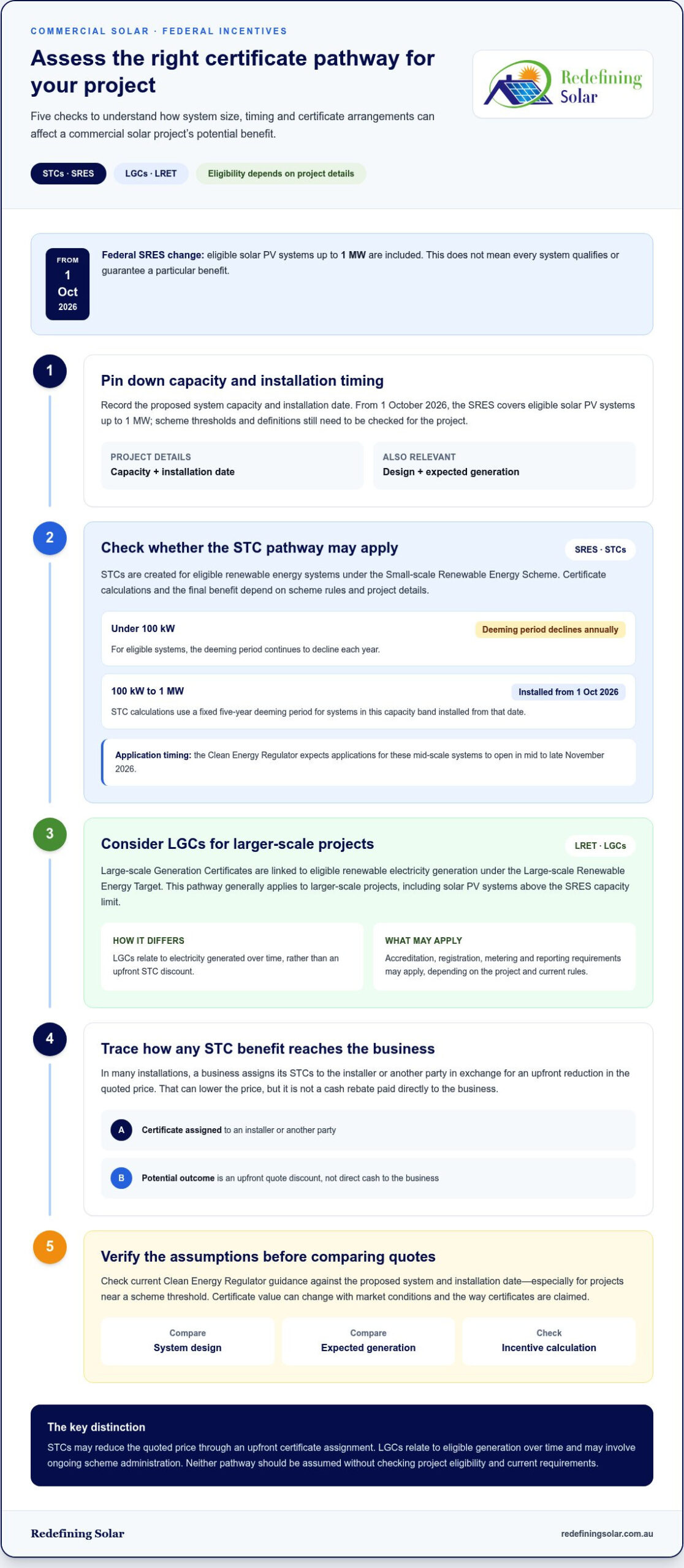
STCs are created for eligible renewable energy systems under the Small-scale Renewable Energy Scheme. From 1 October 2026, the SRES includes eligible solar PV systems up to 1 MW. Systems between 100 kW and 1 MW installed from that date use a fixed five-year deeming period for STC calculations. The Clean Energy Regulator expects applications for these mid-scale systems to open in mid to late November 2026.
For eligible systems under 100 kW, the deeming period continues to decline annually. Certificate calculations and the final benefit depend on scheme rules and project details. In many installations, the business assigns its STCs to the installer or another party in exchange for an upfront discount. This can lower the quoted price, but it isn’t a cash rebate paid directly to the business. Check whether the quote includes an STC benefit and how that discount has been calculated and applied.
How do Large-scale Generation Certificates differ?
LGCs are linked to eligible renewable electricity generation under the LRET. This pathway generally applies to larger-scale projects, including solar PV systems above the SRES capacity limit. Unlike an upfront STC discount, LGCs relate to electricity generated and involve scheme administration over time. Accreditation, registration, metering and reporting requirements may apply, depending on the project and current rules.
That ongoing administration can affect whether LGCs suit a business’s project and operating arrangements. For a system near a scheme threshold, compare its design and expected generation with current Clean Energy Regulator requirements before including certificate income in the financial case. Project-specific commercial solar design can help bring those assumptions together. Explore commercial solar design and installation when planning a system around your business’s energy use and site.
State and territory incentives for commercial solar in 2026
State and territory support adds another layer to the federal incentive picture, but programs vary and their rules can change during the year. A scheme advertised as a “solar rebate” may set limits on eligible businesses, system capacity, technology, funding or application timing. For commercial solar rebates Australia 2026, assess each state program separately rather than assuming it provides an automatic extra discount.
Residential offers don’t automatically apply to business premises. Check the official program rules to see whether they expressly include your business, proposed system and intended use. For example, Victoria’s Victorian Energy Upgrades program includes a discount for businesses installing eligible solar PV systems between 30 kW and 200 kW. The capacity range is specific and shouldn’t be assumed to cover systems outside it.
How to check your state or territory’s current programs
Use the relevant state or territory government’s official energy and business program pages, then note the details that affect your project. This checklist can keep the review focused:
- Status: Is the program open, paused, closed or subject to available funding?
- Applicant: Does it include your type of business and the site where the system will be installed?
- Technology and scale: Does it cover solar PV, batteries or both, and are there capacity limits?
- Timing: When does the application window close, and must approval be received before you sign, buy or install?
- Claim process: Who applies, what evidence is required, and how is the benefit delivered?
These checks help prevent an incentive being included in your project budget before your business and system meet the program’s requirements. Keep a record of the guidance and dates you relied on, along with any application or approval documents.
Do battery or business-upgrade incentives apply too?
Assess battery support separately from solar PV incentives. In New South Wales, an incentive introduced from 1 September 2026 covers eligible commercial and industrial batteries from 20 kWh to 30 MWh. Federal support through the Cheaper Home Batteries Program is also available to businesses for eligible battery systems between 5 kWh and 100 kWh. These capacity ranges don’t establish eligibility by themselves. Check the current rules for business use, equipment and system configuration.
Keep solar-specific incentives distinct from broader business tax treatment or energy-efficiency support, as they may have different rules and application steps. Confirm each program’s status and approval sequence before committing to a purchase or installation. Then base your system design on business energy use and site conditions as well as any potential incentive.
How to assess eligibility and compare commercial solar quotes
Use the same project information and incentive assumptions across every quote. This makes it easier to see whether a lower net figure reflects a different system design, a different certificate estimate or a genuine difference in project scope. For commercial solar rebates Australia 2026, treat an incentive shown in a quote as an estimate until eligibility and the claiming process are established.
What project details and documents should you prepare?
Start with recent electricity bills, site details, business operating hours and the energy use you want the system to cover. Ask each proposal to state the proposed system capacity, expected generation, equipment and installation scope. These details make it easier to compare proposals like for like and assess whether the design aligns with your energy use.
Use this five-step process:
- Define the project. Record the site, energy needs, intended system size and whether battery storage is part of the plan.
- Check the rules. Match the proposed project to current federal and relevant state or territory program requirements.
- Confirm timing. Note the installation date, application window and any approval steps that must happen before purchase or installation.
- Compare assumptions. Review each quote’s system design, generation estimate, scope and treatment of any incentive on the same basis.
- Retain evidence. Keep energy bills, scheme correspondence, invoices, certificate records and commissioning documents, as applicable.
How can you compare incentive assumptions fairly?
Separate the gross project scope, estimated incentive and resulting net amount. First check whether each quote includes the same equipment and installation work. Then identify who handles certificate creation or assignment and what the quoted discount assumes. A projected certificate value is not the same as confirmed eligibility or guaranteed savings.
If system eligibility, installation timing or incentive value is still conditional, compare the project with and without that benefit. This gives you a clearer view of the underlying investment and reduces the risk of relying on an incentive that may not apply as expected. Keep the assumptions with the quote so you can revisit them if project details or scheme rules change.
For broader guidance on system selection and planning, read our commercial solar buying guide. To put these checks into a project-specific plan, plan your commercial solar system with Redefining Solar.
Plan a compliant commercial solar project and take the next step
A sound project starts with your business’s energy use, site conditions and operating requirements, not with the largest advertised incentive. These factors help shape a system that suits your business and give you a clear basis for assessing which commercial solar rebates Australia 2026 may apply.
What should happen before installation begins?
Work through the project in sequence so the design, eligibility checks and records stay aligned:
- Assess energy use and the site. Review electricity bills, operating patterns and site conditions to understand when and where solar generation can be used.
- Develop the system design. Set out the proposed capacity, equipment, expected generation and installation scope. The design should suit the business load and site, not be enlarged solely to pursue an incentive.
- Review scheme conditions. Check current requirements for the relevant federal or state program, including equipment, installer credentials and any application steps.
- Confirm timing and assumptions. Establish the required application sequence before purchase or installation, and document assumptions behind generation estimates and incentive treatment.
- Complete installation and retain records. Keep relevant scheme correspondence, invoices, certificates and commissioning records to support the project and any applicable claim.
These steps keep the financial comparison grounded. An incentive estimate remains an estimate until the project meets the program rules and the required claim process is completed.
How Redefining Solar can help with the project
Redefining Solar designs and installs commercial solar systems for Australian businesses. The project scope, energy use and site conditions inform the system recommendation, with incentive assumptions considered alongside the design rather than treated as a standalone saving. This helps show how system performance and potential support fit into the wider project decision.
If battery-ready planning is part of your longer-term approach, see the solar system battery upgrade guide for related considerations. Battery incentives and eligibility should still be assessed separately against current rules and the proposed configuration.
Have a commercial project in mind? Discuss your commercial solar project with Redefining Solar to explore a design suited to your business and consider incentive assumptions as part of the planning process.
Make your commercial solar decision with confidence
To assess commercial solar rebates Australia 2026, match current incentive rules to your project and compare quotes using consistent system and eligibility assumptions. Federal certificates and state or territory programs work differently, and an advertised benefit isn’t necessarily a cash payment or confirmed entitlement.
Start with your business’s energy use and site needs. A well-planned system should suit your operations first, with any eligible incentive assessed as part of the project’s overall value. Keep the design, timing, claim assumptions and supporting records clear before proceeding.
Redefining Solar is Australian owned and operated, directed by a licensed electrician, and provides commercial solar design, installation, maintenance and repairs for businesses across Australia. For project-specific guidance, discuss your commercial solar project with Redefining Solar. Start with a clear plan for your business’s energy needs and potential incentives.
Frequently Asked Questions
Are there commercial solar rebates in Australia in 2026?
Yes. Eligible businesses may access federal certificate benefits and, depending on the project and applicable program, state or territory support. The commercial solar rebates Australia 2026 landscape includes the Small-scale Renewable Energy Scheme, which covers eligible solar PV systems up to 1 MW from 1 October 2026. The benefit is often applied as an upfront discount through assigned certificates rather than paid as cash. Check current eligibility and claim rules before including an incentive in your project budget.
Can a business claim Small-scale Technology Certificates for commercial solar?
Yes, an eligible commercial solar system may create Small-scale Technology Certificates (STCs) under the Small-scale Renewable Energy Scheme. From 1 October 2026, eligible solar PV systems up to 1 MW can qualify, subject to the scheme’s requirements. In many projects, the business assigns the certificates to the installer in exchange for an upfront discount rather than receiving the certificate value directly. System details, installation timing and the certificate claim process affect eligibility and value.
What is the difference between STCs and LGCs for commercial solar?
STCs are created for eligible systems under the Small-scale Renewable Energy Scheme and are commonly assigned to reduce the purchase price upfront. Large-scale Generation Certificates (LGCs) are a separate pathway linked to eligible renewable electricity generation under the Large-scale Renewable Energy Target. LGCs involve ongoing scheme administration, and project scale and generation matter. The appropriate pathway depends on current rules and project details, so check the Clean Energy Regulator requirements before relying on either benefit.
Do state or territory solar rebates apply to businesses in 2026?
Some state programs may include businesses, but eligibility and availability differ across Australia and can change during the year. For example, Victoria’s Victorian Energy Upgrades program offers a discount for eligible business solar PV systems between 30 kW and 200 kW. Don’t assume a residential rebate applies to a commercial site. Check the relevant government program’s current status, eligible applicants, system requirements, funding conditions and application timing before committing to a purchase or installation.
Can a commercial business get a rebate for solar batteries as well?
Potentially, but battery support has separate eligibility rules from solar PV incentives. Federal support through the Cheaper Home Batteries Program includes businesses with eligible battery systems between 5 kWh and 100 kWh. From 1 September 2026, New South Wales also offers support for eligible commercial and industrial batteries from 20 kWh to 30 MWh. These ranges alone don’t confirm eligibility. Check current scheme rules for business use, system configuration and application requirements.
How do I compare commercial solar quotes that include rebates?
Compare each quote’s full installation scope, proposed system capacity and expected generation before looking at the net figure. Check how the incentive is estimated, whether certificate assignment is assumed, and who handles the relevant claim steps. Make sure each quote uses the same assumptions. An estimated incentive isn’t guaranteed savings or proof of entitlement, so assess the project with and without the benefit if eligibility, timing or certificate value remains conditional.
Can a business claim a solar incentive after installation?
Sometimes, but the process and timing depend on the scheme. Some state programs require an application or approval before purchase or installation, while certificate pathways may involve steps after installation. For eligible solar systems between 100 kW and 1 MW installed from 1 October 2026, applications for STCs are expected to open in mid to late November 2026. Check the applicable rules before work begins and retain invoices, certificates and commissioning records.