
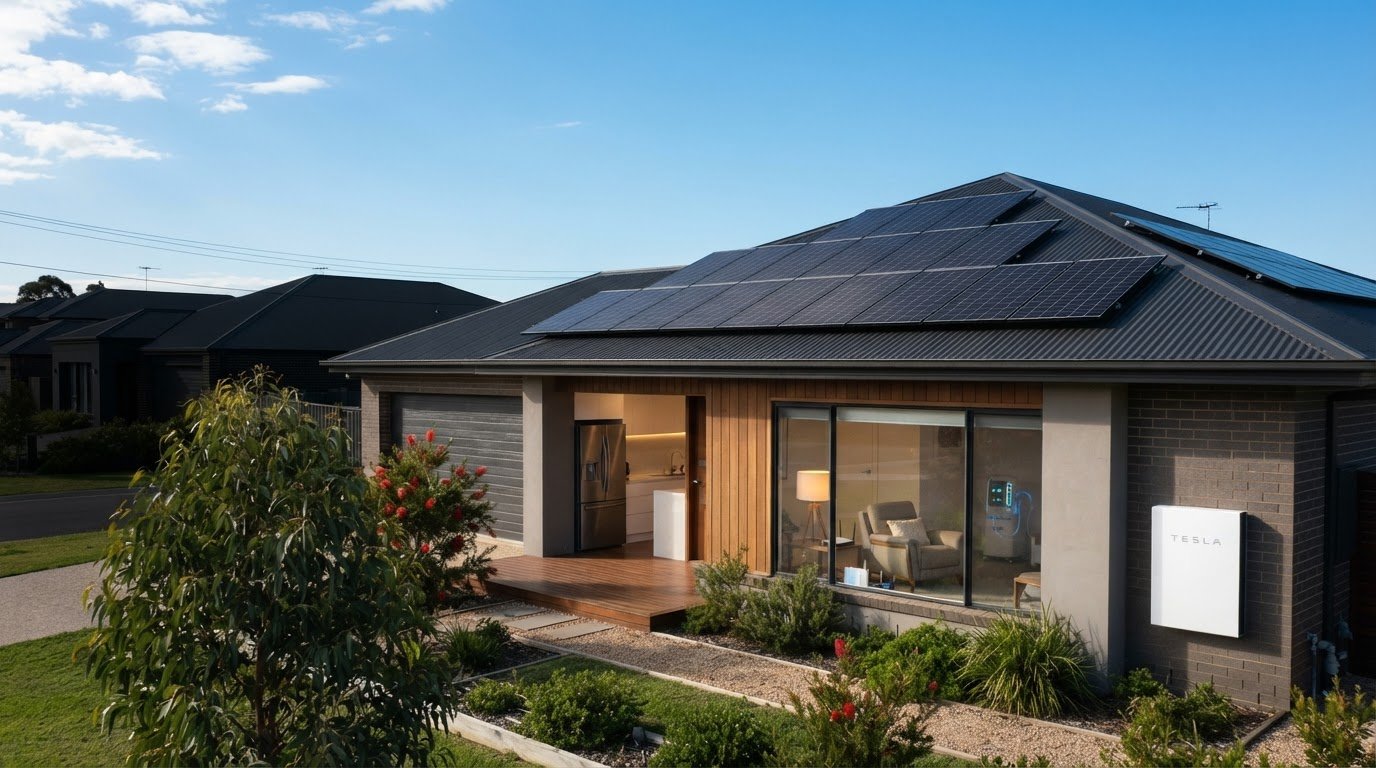
If your rooftop solar is generating power during a blackout, will your home still have electricity? Not necessarily. A standard grid-connected solar system will usually switch off when the grid fails, and adding a battery doesn’t automatically mean every appliance can keep running. A battery backup system for power outages needs suitable equipment and selected circuits to supply power safely.
Before choosing a system, work out what you need to keep running, such as your fridge, lights, internet connection or medical equipment, and for how long. The answer depends on energy use, the battery’s usable capacity, inverter compatibility and how the system changes over to backup power.
This guide explains the difference between storing solar energy and having an outage-ready setup. You’ll learn how to prioritise essential loads, estimate their energy needs and understand why backup circuits matter. We’ll also cover what to check about your existing solar equipment, safe changeover and installation, so you can ask informed questions before committing to a battery or upgrade.
Key Takeaways
- A battery backup system for power outages relies on compatible equipment and selected circuits, not storage capacity alone.
- Compare essential-circuit and broader-home backup to find the right balance of coverage and energy use for your household.
- Estimate appliance demand and likely running time separately before deciding how much usable battery energy you need.
- Check how your existing solar and inverter equipment will work with a battery, as compatibility and backup features vary.
- Before installation, ask how circuits are protected, how changeover works and what testing and handover will include.
What does a battery backup system for power outages actually do?
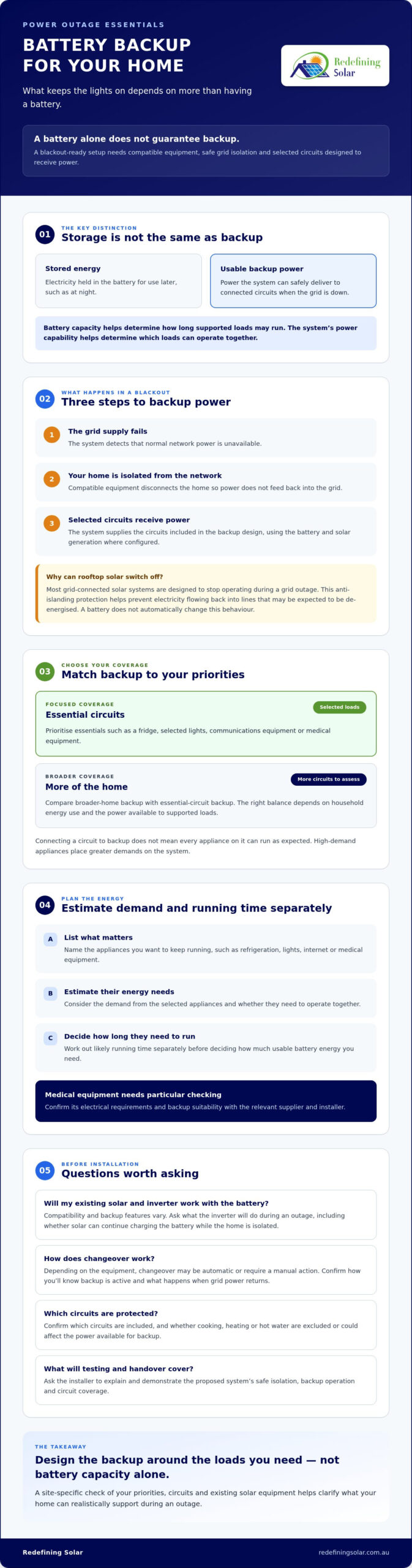
A battery backup system for power outages combines stored energy, suitable equipment and selected electrical circuits to keep chosen parts of your home running when the grid fails. That’s different from having a battery that stores excess rooftop solar for use at night. For backup, the system must be able to safely disconnect from the grid and supply power to your home.
Backup doesn’t always mean the whole house stays on. A system might support essentials such as refrigeration, selected lights, communications equipment or medical equipment, while other circuits remain without power. Which appliances can run depends on the system’s design, their power demand and the circuits connected to backup.
Why can rooftop solar switch off during a grid outage?
Most grid-connected solar systems are designed to stop operating when the network goes down. This anti-islanding protection helps prevent electricity from flowing back into lines that network workers may expect to be de-energised, and helps protect equipment. A solar battery won’t necessarily change this behaviour. The system needs suitable equipment and configuration to isolate from the grid and provide backup.
Ask your installer to explain what your inverter will do during an outage, including whether solar can continue charging the battery while your home is isolated. Behaviour varies between systems, so check the proposed setup rather than relying on assumptions or a general product description.
What can a home battery backup keep running?
Backup circuits are selected to match your priorities. You might nominate a fridge, a few lights and communications equipment, for example. Medical equipment may also need consideration, but confirm its electrical requirements and backup suitability with the relevant supplier and installer. High-demand appliances place greater demands on a system, so connecting a circuit to backup doesn’t automatically mean every appliance on it can run as expected.
Stored energy is the electricity held in the battery; usable backup power is what the system can safely deliver to connected circuits at the time you need it. The amount stored affects how long supported loads may run, while the system’s ability to supply power affects which loads can operate together. A uninterruptible power supply (UPS) is a useful reference for the basic idea of maintaining power when the main supply fails. A home battery system’s changeover behaviour, however, depends on its equipment and configuration.
Before choosing a setup, list the appliances you’d prioritise and ask for a site-specific check of the circuits and existing solar equipment. This gives you a clearer picture of what backup can realistically support.
How a battery backup system works when the power goes out
A blackout backup system has to do more than draw on stored electricity. It must separate your home from the electricity network, then supply power to the circuits included in the backup design. The equipment varies, but the process generally follows this sequence:
- The grid supply fails. The system detects that normal network power is unavailable.
- Your home is isolated from the network. A suitable inverter and backup interface, or other compatible equipment, prevent power from feeding back into the grid.
- Backup circuits receive power. The system supplies the circuits included in its design, drawing on the battery and, where configured, solar generation.
The inverter helps manage electricity flow between the battery, solar panels and household circuits. A backup interface or equivalent equipment coordinates disconnection and supply, but systems don’t all use the same hardware or operate in the same way. That’s why a battery backup system for power outages needs to be assessed as a complete setup, not by battery capacity alone.
What happens during changeover and grid disconnection?
Safe isolation comes first. Depending on the equipment, changeover may happen automatically or require a manual action. Don’t assume which applies to your home. Ask the installer to demonstrate what happens when the grid fails, how you’ll know backup is active and which circuits will remain supplied. Confirm whether circuits such as cooking, heating or hot water are excluded or could affect the power available for backup.
Also ask what happens when grid power returns and whether the system resumes normal operation without input from you. The answer should relate to the proposed equipment and its settings.
Can rooftop solar recharge a battery during a blackout?
Solar charging during an outage requires a compatible, configured system. Panels alone don’t ensure that solar will operate while the home is disconnected from the grid. If the setup supports it, available charging can still vary with daylight, weather, household demand and system settings. Ask whether solar can recharge the battery during an outage and what happens when generation is low or demand is high.
Check two limits with your installer. Available power is how much the system can supply at once, which affects the appliances that can run together. Available energy is how much electricity is usable over time, which affects how long supported loads may run. Both matter during an extended outage.
For broader guidance on installing a battery system, the Australian Government’s YourHome resource is a useful reference. For a practical discussion of your existing inverter and backup options, you can also explore battery and inverter options.
Compare battery backup setups for different outage needs
The right setup depends on what you want to keep running, the circuits involved and how your existing solar equipment can work with a battery. Use this comparison to guide a conversation with an installer, rather than as a promise that one setup will suit every home.
| Setup | Likely use and circuit coverage | Key checks | Limitations |
|---|---|---|---|
| Essential-circuit backup | Prioritises selected circuits, such as refrigeration, lighting and communications. | Confirm which circuits are backed up and whether their combined demand is within the system’s capability. | Other circuits won’t necessarily have power during an outage. |
| Broader-home backup | Aims to supply more of the home’s circuits. | Check inverter and battery capability, circuit design and which appliances may run at the same time. | Broader coverage doesn’t guarantee every appliance can operate together or for the duration you want. |
Essential circuits or whole-home backup: which suits your household?
If your priority is keeping food cold, maintaining basic lighting and staying connected, essential-circuit backup may be a practical fit. A broader setup may suit households wanting more circuits covered, but it needs a careful assessment of appliances running at the same time. Don’t assume “whole-home” means every load will work as usual. Ask the installer to confirm the circuits, equipment and operating limits in writing.
A battery-ready system isn’t automatically outage-ready. It may be prepared for storage, but blackout operation can also require compatible inverter equipment, a suitable backup interface and correctly configured circuits. The design needs to account for each of these parts.
Adding backup to existing solar versus planning a new system
A new solar-and-battery installation can be designed around your outage priorities from the outset. Adding a battery to existing solar may also be possible, but having panels, or knowing the system’s age, doesn’t confirm compatibility. Ask for the full setup to be checked, including:
- the existing inverter and its battery and backup functions
- the battery’s compatibility with the system
- switchboard layout and the circuits you want backed up
- whether a backup interface or other equipment is needed
This assessment helps establish whether an existing system can support a battery backup system for power outages or needs an upgrade. If you’re considering adding storage, a guide to upgrading home solar to battery storage can help you prepare questions before discussing options with an installer.
Plan battery capacity around the loads you need during an outage
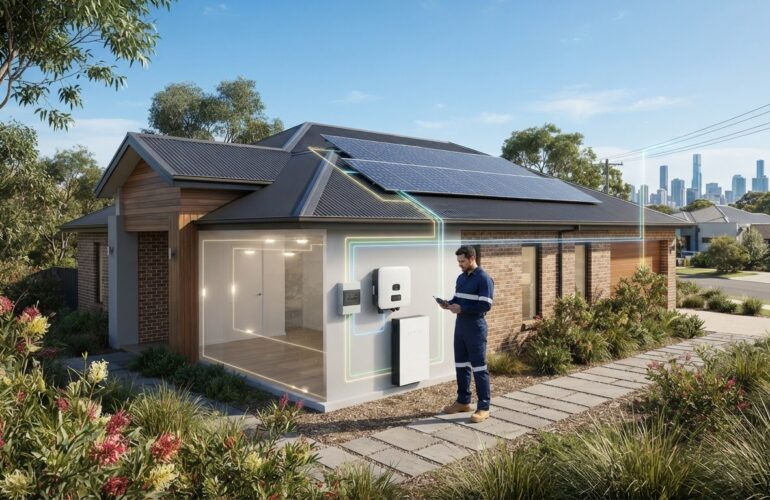
Start with what you need to keep running, not a battery size chosen in isolation. A useful backup plan matches your essential loads and expected outage duration to the system’s usable energy and power capability. That gives you a sound basis for discussing a setup suited to your household, rather than relying on a generic capacity recommendation.
Which appliances should you prioritise for backup?
Make two lists: must-run appliances and optional ones. Refrigeration, selected lights and communications may be priorities. Consider essential medical equipment separately. Check its backup requirements with your provider, then ask the installer whether the proposed system can support its demand.
For each appliance, note its power demand from the label or manufacturer’s information, and estimate how many hours you’d use it during an outage. Ask the installer to check start-up surges for relevant appliances, as some briefly draw more power when switching on. Also discuss which appliances might run at the same time. Their combined demand can matter as much as each appliance’s individual rating.
How do you estimate how long backup power may last?
Use this simple worksheet to prepare for a conversation with an installer:
- Appliance: List each essential load.
- Demand: Record its power use from reliable appliance information.
- Expected use: Estimate the hours it may run during an outage, including whether it cycles on and off.
- Energy estimate: For a steady load, multiply power in kilowatts by hours of use to estimate energy in kilowatt-hours. Repeat for each appliance and add the results.
- System check: Compare the estimate with the battery’s usable stored energy, then ask whether the inverter can supply the expected combined demand.
This is a planning estimate, not a runtime promise. Actual duration can vary with system settings, operating conditions, battery availability and which household loads are running together. Solar may contribute during an outage only if the system is designed and configured to operate that way, so don’t count on it without confirmation.
Ask the installer to explain both limits: power, which affects what can run at once, and usable energy, which affects how long those loads may be supplied. A site-specific assessment can check your appliance list against the circuits and equipment already at your home.
For a discussion about outage priorities and battery options, request a battery system assessment.
Choose and install an outage-ready battery system with confidence
A clear assessment connects your outage priorities to your home’s circuits and equipment. Before choosing a battery backup system for power outages, ask for a design that explains what will work, what won’t and how the system will be checked after installation.
What should you ask an installer before choosing a system?
Use these questions to understand the proposed setup before work begins:
- Assessment: Which circuits can be backed up, and which household appliances are priorities?
- Compatibility: Can the proposed battery and backup equipment work with your existing solar, inverter and switchboard?
- System limits: What happens if the combined demand from running appliances exceeds the system’s capability?
- Changeover and solar: How will the home disconnect from the grid, and can rooftop solar operate during an outage with this design?
- Compliance: Which Australian standards and state or territory requirements apply? Ask how the installer’s current accreditation and any relevant battery endorsement can be verified.
Ask for the answers to be reflected in the system design, including the circuits covered and any operating limitations. This makes it easier to compare proposals based on what they’ll actually provide, rather than battery capacity alone.
What should commissioning and handover cover?
Before the installer leaves, ask for a demonstration of outage operation. Confirm whether changeover is automatic or requires a manual step, how you can tell backup is active and what to do if demand is too high. Check that the agreed backup circuits, solar operation and monitoring have been tested and explained.
Your handover should also make clear where to find system documentation, shutdown instructions and information about maintenance responsibilities. Ask who to contact for system maintenance or repairs, and what monitoring can show about battery status and operation.
A practical checklist covers the full job:
- Assessment: Review existing solar equipment, the switchboard and priority loads.
- Design: Confirm equipment compatibility, backup circuits, changeover behaviour and system limits.
- Installation: Confirm the proposed work and applicable compliance requirements.
- Testing and handover: Check outage operation, solar response, monitoring, documentation and maintenance guidance.
Redefining Solar offers solar batteries, battery-ready upgrades, inverter solutions and system maintenance. For a practical discussion about your existing equipment and backup priorities, discuss a solar battery backup assessment with Redefining Solar.
Make your blackout backup plan practical
A reliable battery backup system for power outages depends on more than stored energy. The right equipment must isolate safely from the grid and supply the circuits you’ve chosen. Start by deciding which appliances matter most, then check their power needs and how long you may need them to run.
Battery capacity, the power available at once and the circuits connected to backup are separate parts of the design. If you already have rooftop solar, have the inverter and other equipment assessed rather than assuming they’re compatible with outage backup. Clear answers about changeover, solar operation and testing can help you choose a setup with realistic expectations.
Redefining Solar is Australian-owned and operated, and directed by a licensed electrician. Its relevant options include solar battery installation, battery-ready upgrades, inverter solutions and system maintenance. With the right checks and a design matched to your needs, you can make a considered plan for keeping essential power available during an outage.
To discuss your home’s equipment and backup priorities, contact Redefining Solar about a solar battery backup assessment.
Frequently Asked Questions
Can solar panels work during a power outage?
Solar panels may work during an outage, but only if the system is designed and configured for it. Many grid-connected systems shut down when grid power fails to protect network workers and equipment. Suitable battery and backup equipment may allow solar to operate while your home is isolated from the grid. Ask your installer to confirm your system’s behaviour, supported circuits and whether it can recharge the battery during a blackout.
Will a home battery automatically provide power during a blackout?
No. Having a battery doesn’t automatically mean your home will have backup power. The system needs compatible equipment, safe grid isolation, suitable settings and circuits connected to the backup supply. Before choosing a battery backup system for power outages, ask the installer to explain and demonstrate what happens when grid power fails. Confirm which appliances will remain powered and whether changeover happens automatically or requires you to take action.
How long can a battery backup system power a house?
There’s no single runtime that applies to every home. Backup duration depends on usable stored energy and the power demands and running patterns of connected appliances. Supporting a few essential circuits may use energy differently from supplying broader parts of the home. Ask for an estimate based on your actual loads and expected outage use. Battery capacity alone can’t tell you how long your chosen appliances will run.
What appliances should I connect to battery backup?
Start with the appliances you most need during an outage, such as a fridge, selected lights, communications equipment or essential medical devices. Then check each load’s power demand, start-up requirements and expected use with your installer. You don’t necessarily need backup on every circuit, and too many connected loads can affect system operation. Confirm medical equipment requirements with your provider as well as your installer before finalising the design.
Do I need a special inverter for battery backup during outages?
Your inverter must be compatible with the battery and the intended backup operation, but the required setup varies. Some existing solar systems may need different equipment or a suitable backup interface before they can supply selected circuits during an outage. Ask an appropriately qualified installer to assess the inverter model, switchboard and solar system together. Confirm compatibility and the applicable installation requirements for your specific equipment before proceeding.
Can I add a battery backup system to my existing solar panels?
It may be possible, but compatibility needs to be checked for your particular system. The inverter, solar configuration, switchboard and circuits you want backed up all influence the options. Ask an installer whether your existing equipment supports both battery storage and outage backup, or whether upgrades are needed. Having solar panels, or a battery-ready system, doesn’t by itself confirm that your home can receive power during a blackout.

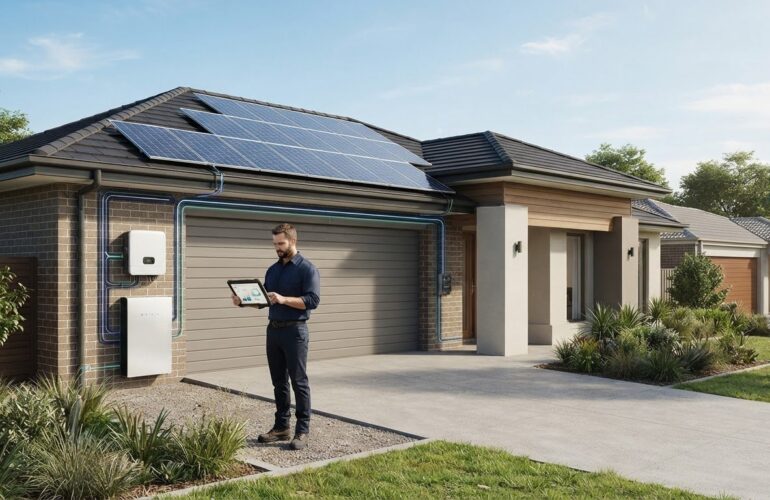
[…] Before agreeing to a design, ask which circuits will remain powered, how the system behaves during an outage, and whether solar can recharge the battery while the grid is down. Get the backup scope confirmed for the proposed equipment. Don’t assume that a hybrid label means every appliance will keep running. For more on essential loads, backup circuits and safe changeover, see this guide to a battery backup system for power outages. […]