There isn’t one standard installed price for a solar battery in Australia in 2026. The total depends on the battery’s capacity, whether the system needs an additional inverter, and the installation requirements at your property. Whether storage is worthwhile also comes down to how much excess solar you can store and use later.
It’s reasonable to want a clear cost before deciding, especially when battery options and system set-ups can be difficult to compare. The solar battery cost in Australia in 2026 is easier to understand when you separate battery-only installations from systems that include an inverter, then consider what affects the final installed price.
This article explains those differences, the factors that shape system costs, and how battery size relates to your household’s solar generation and electricity use. You’ll have a clearer basis for weighing the upfront cost against the value of storing solar power for use after the sun goes down.
Key Takeaways
- See how installed battery costs vary with usable capacity, and why the advertised battery price isn’t the full system cost.
- Understand when an existing inverter may suit a battery-only installation and when a system may need an additional inverter.
- Compare battery chemistry, warranty and usable capacity to weigh long-term performance alongside upfront cost.
- Learn how your solar generation and electricity use can guide battery sizing, and where Battery Ready & Upgrades may fit.
Average solar battery costs in Australia for 2026
Installed battery costs vary with usable capacity, equipment configuration and the work required at your property. For a fair comparison, focus on usable capacity and how the Cheaper Home Batteries Program’s support changes across capacity tiers.
Installed Costs Across Usable Capacities
Usable capacity is the stored energy available to power your home, measured in kilowatt-hours (kWh). It matters because a larger battery can store more solar energy, but its installed cost also depends on system design and installation requirements.
Australian systems commonly fall into capacity examples such as 5-6 kWh, 9-10 kWh and 13.5-15 kWh; modular systems can reach 20 kWh or more. Comparing these sizes helps you see how the system scale changes, rather than treating every battery as an equivalent purchase.
Hardware is only part of an installed system. Configuration and site-specific installation work also affect the final cost, so a capacity label alone cannot show what you’ll pay.
Price and Support Changes by Capacity
The Cheaper Home Batteries Program applies different support rates across battery capacity tiers. It matters because the eligible capacity is not treated at one uniform rate when calculating support.
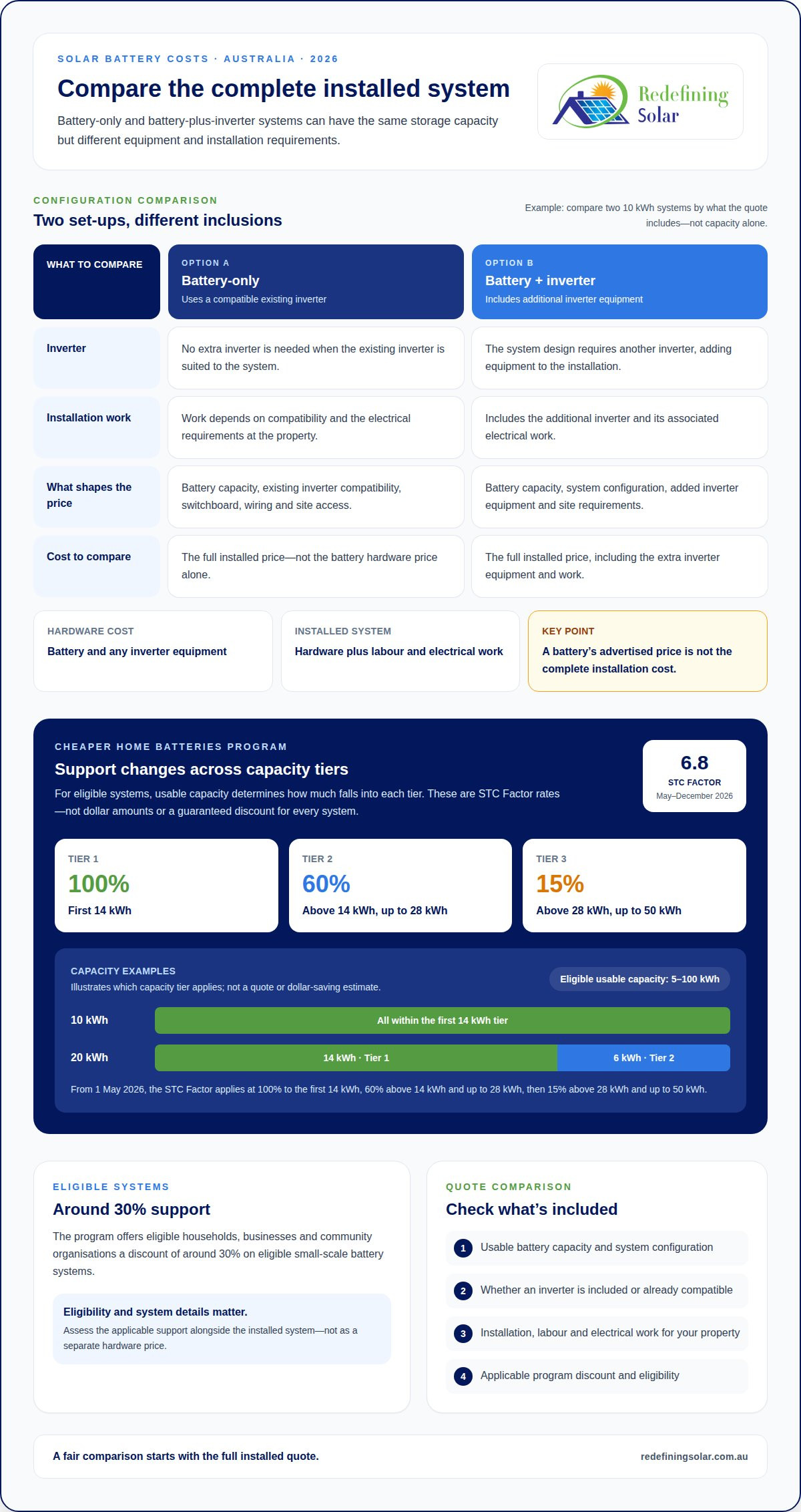
Eligible systems can have usable capacity from 5 kWh to 100 kWh. From 1 May 2026, the STC Factor applies at 100% to the first 14 kWh, 60% above 14 kWh and up to 28 kWh, then 15% above 28 kWh and up to 50 kWh.
For eligible batteries installed from May to December 2026, the STC Factor is 6.8. The applicable factor depends on the installation date, while usable capacity determines how much capacity falls within each tier.
As a practical example, a 10 kWh battery sits within the first capacity tier, while a 20 kWh system spans the first two tiers. This tiered calculation means extra capacity does not receive the same support rate throughout the system.
When assessing an installed quote, consider usable capacity, configuration and the support calculation together. That gives you a clearer comparison than battery size alone.
Battery-only versus battery-plus-inverter installation costs
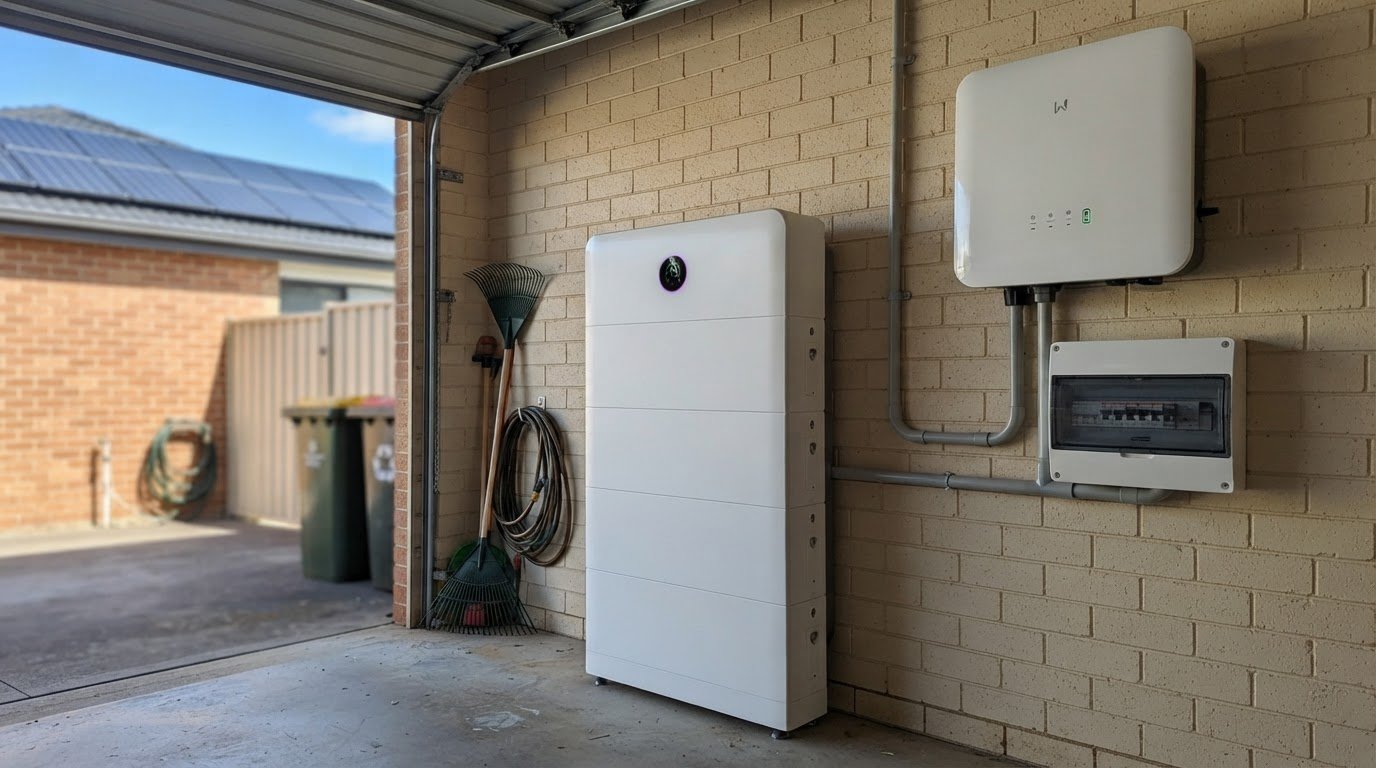
A battery-only installation uses an inverter already suited to the system; a battery-plus-inverter installation includes additional inverter equipment. The difference affects both system design and installation work.
Hardware Prices and Installed Costs
Hardware cost covers the battery and any inverter equipment, while an installed system also includes labour and electrical work. A battery’s hardware price therefore doesn’t represent the complete installation cost.
For example, a home with a compatible existing inverter may not need another one. A different system design may require extra inverter equipment, so compare what each quote includes.
Battery capacity, configuration and site requirements all shape the final installed cost. A 10 kWh battery-only set-up and a 10 kWh system with an additional inverter aren’t identical installations, even when their storage capacity matches.
Upfront Costs and Discounts
The Australian Cheaper Home Batteries Program offers eligible households, businesses and community organisations a discount of around 30% on eligible small-scale battery systems. This support can reduce the upfront amount, but eligibility and system details matter.
Assess the discount alongside the installed system, not as a separate hardware price. Battery capacity and inverter configuration affect what’s included in the installation, while the program’s support applies to eligible systems.
For a useful comparison, check whether each quote includes an inverter, installation and the applicable discount. This makes the upfront cost clearer and avoids confusing equipment prices with the complete system cost.
Installation and Retrofit Costs
A retrofit adds a battery to an existing solar system, so compatibility and electrical work shape the installation. The existing inverter, switchboard and wiring affect the work involved.
A battery-only option may suit an existing set-up with a compatible inverter. If the system needs another inverter, the installation includes that equipment and its associated electrical work.
Your installed price depends on battery capacity, inverter compatibility, switchboard work, wiring and site access. A quote sets out the cost for your property.
For a clearer view of how your existing solar set-up affects battery planning, explore battery system planning.
Battery chemistry, warranties and specifications
Battery chemistry describes the materials used to store and release electricity. Lithium-ion is common in Australian residential systems, but chemistry alone doesn’t show whether a battery suits your home. Compare the specifications, warranty terms and expected service life together. For example, two lithium-ion batteries may differ in usable capacity, power output and operating limits, so the chemistry label isn’t enough to compare them.
Many residential lithium-ion batteries offer warranties of around 10 years. A warranty describes the conditions under which the manufacturer covers the battery, so read its coverage alongside the advertised term. Check how the document describes performance over time and what conditions apply. A 10-year warranty gives you a useful comparison point, but the wording matters as much as the headline duration.
Lithium-ion residential batteries typically have an expected lifespan of around 10 to 15 years. That estimate helps frame the period over which you may use the system, but it isn’t the same as a warranty. For instance, a battery’s expected service life may extend beyond its warranty period. Consider both when weighing the purchase against your household’s longer-term energy plans.
Specifications explain what a battery can deliver, not just how much energy it stores. Usable capacity indicates available stored energy, while power output describes how much electricity the battery can supply at once. Capacity relates to how long stored energy may support your use; output relates to which loads can run together. Compare both with the appliances you want to use.
Other useful details include charging limits, operating conditions and the warranty’s stated performance measures. These can distinguish batteries with similar capacity labels. If evening use is your priority, for example, check how usable capacity and power output align with that pattern. Comparing chemistry, specifications and warranty terms gives you a clearer view of long-term value.
Battery system size and eligibility
The right battery size depends on how much solar energy your home can generate and use. A larger unit can store more electricity, but extra capacity only helps if your household can charge and draw on it. Match storage to your energy pattern rather than choosing the biggest battery your roof can support.
As a guide, a 5 kW rooftop solar system may suit a battery in the 5-8 kWh range. The fit depends on household electricity use and solar generation. A home that uses more power after sunset may benefit from more storage than one that consumes most solar electricity during daylight hours.
Eligibility also depends on usable capacity, not simply a battery’s advertised total capacity. The Australian Cheaper Home Batteries Program supports eligible systems with 5-100 kWh of usable capacity. Usable capacity is also used to calculate how many small-scale technology certificates a battery may be registered for, according to the Clean Energy Regulator.
Consider your daily pattern before choosing a size. Note whether major electricity use happens during sunny hours or in the evening. A battery is most relevant when surplus solar generation can be stored for later use. If solar production rarely exceeds daytime demand, less excess energy may be available to charge it.
System size can affect both upfront spending and the energy available after sunset. A smaller system may suit modest evening demand, while a larger household may need more usable capacity. Compare solar generation, when electricity is used and how much stored energy you can reasonably use.
For help matching storage to your existing solar system, discuss battery sizing and upgrades.
Redefining Solar: Battery Ready & Upgrades
Redefining Solar provides Battery Ready & Upgrades for households planning battery storage or updating an existing solar system. This can be a useful next step if you’re weighing battery size against your current solar set-up and want the upgrade to suit your energy needs.
For a new installation, Redefining Solar also provides Residential Solar Systems, while businesses can explore Commercial Solar Systems. The right approach depends on whether you’re adding storage to an existing system or planning solar and battery components together. A clear picture of your electricity use and solar generation helps shape the design.
If you’re considering a battery-ready upgrade or a new solar system, contact Redefining Solar to discuss your requirements.
Plan your next step with confidence
Treat storage as part of your broader energy plan, not a stand-alone purchase. Consider how your electricity use may change, whether you expect to add major appliances and how long you plan to stay in your property. These factors can help you decide whether a battery fits your priorities now or later.
The solar battery cost in Australia in 2026 gives you a starting point, but your decision should also reflect how you want to use solar power day to day. A system that suits your current routine may need a different size or configuration if household demand changes. Redefining Solar can help you consider the next step for your existing set-up or planned solar project.
For advice tailored to your circumstances, contact Redefining Solar. A clear conversation can help you decide what to explore next. Take that step when you’re ready, with a plan that suits your home and energy goals.
Frequently Asked Questions
So is battery storage worth it?
Battery storage is most useful when you can charge it with surplus solar power and use that electricity later. A household that uses more power in the evening, for example, may benefit more than one that uses most electricity during sunny hours. Consider your daily usage pattern, solar generation and the value of power you otherwise export before deciding.
What Factors Affect the Total Cost of a Solar Battery Installation?
The solar battery cost in Australia in 2026 depends on battery capacity, inverter requirements and the electrical work at your property. For example, a switchboard that needs changes or a difficult battery location can affect installation work. Battery specifications and system configuration also shape the quote. Compare what each proposed system includes, rather than looking only at the battery hardware.
What is the average cost of a home solar battery in Australia in 2026?
There isn’t one installed average that applies to every Australian home. The solar battery cost in Australia in 2026 varies with the battery and installation. A system using an existing compatible inverter can differ from one requiring additional equipment. Site access and electrical work also affect the quote. Compare usable capacity and included installation work alongside the total quoted amount.
How much do 5 kWh, 10 kWh, 13.5 kWh and 20 kWh solar batteries cost installed in Australia?
Installed costs differ across 5 kWh, 10 kWh, 13.5 kWh and 20 kWh systems, and capacity alone doesn’t determine the final amount. Inverter configuration and installation requirements also matter. A 20 kWh option provides more storage than a 5 kWh battery, but that extra capacity is useful only if your solar generation and household demand can make use of it.
What Australian rebates, subsidies or incentives reduce home battery costs in 2026?
The Australian Cheaper Home Batteries Program provides support for eligible battery systems. Small-scale technology certificates (STCs) can contribute to an upfront discount, but they’re optional. If assigned or sold on the open market, their value changes daily with supply and demand; the Clearing House price is capped. The installation date and eligible usable capacity affect the applicable battery support calculation.
How long does a solar battery take to pay for itself in Australia, and what affects the payback period?
Some Australian solar battery systems have an indicative payback period of 9-13 years. The result depends on how much stored solar electricity you use, your electricity rates, export value and the system’s upfront cost after applicable support. Regularly using stored energy at home can affect savings differently from exporting that energy. Consider payback alongside expected battery use and system life.