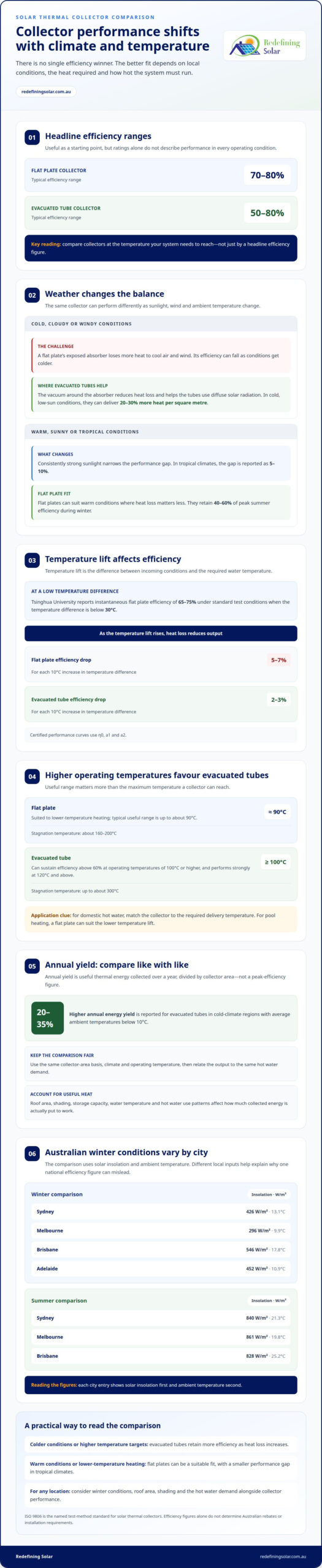
The evacuated tube vs flat plate collector efficiency comparison has no single winner: flat plate collectors typically rate around 70-80% efficient, while evacuated tube collectors typically reach 50-80%. In cold, low-sun conditions, evacuated tubes can deliver 20-30% more heat per square metre. The better fit depends on your climate, hot water needs and the temperatures your system must reach.
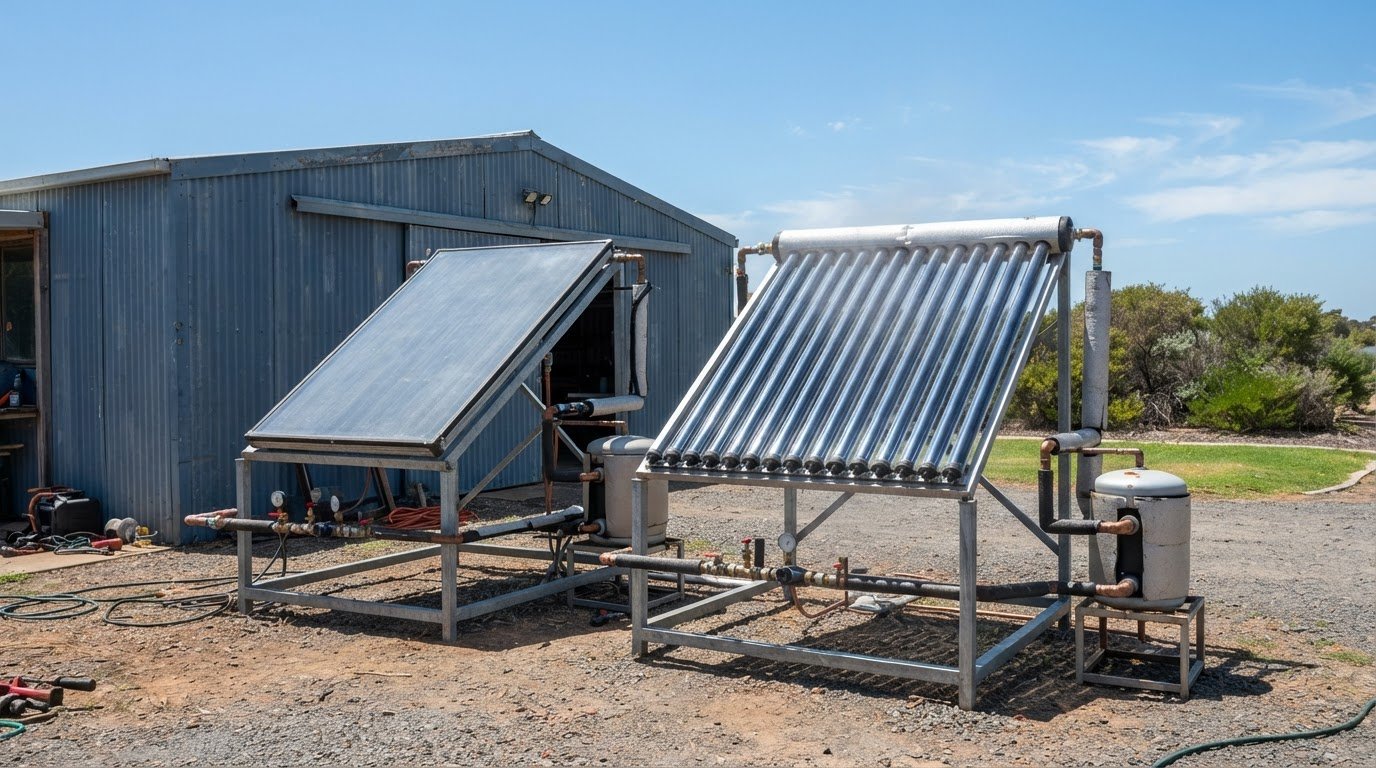
Efficiency figures are useful, but they do not tell the whole story. A flat plate collector uses a dark absorber beneath a transparent cover to capture sunlight and transfer heat to a fluid. An evacuated tube design reduces heat loss around its absorber.
This comparison explains how flat plate collectors work, outlines the factors that affect efficiency and annual energy yield per square metre, and considers how Australian climate and operating conditions can shift the balance. Use it to frame a practical decision for your property.
Key Takeaways
- Understand how a flat plate collector captures sunlight and why weather conditions affect the heat it delivers.
- Compare collector performance at different operating temperatures, not just by a headline efficiency rating.
- See how location, season and roof area shape annual thermal energy yield in Australian conditions.
- Use the efficiency ranges and practical trade-offs to narrow down which collector type better suits your hot water needs.
How does a flat plate collector work?
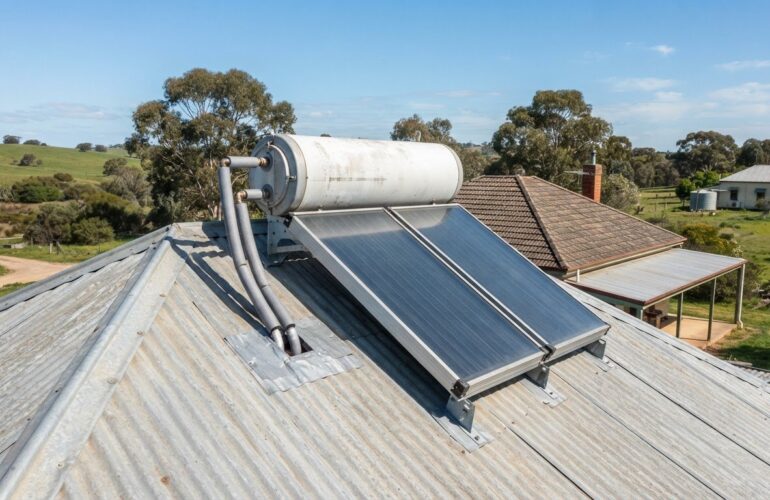
A flat plate collector captures sunlight with a dark absorber beneath a transparent cover. The absorber transfers heat to fluid flowing through pipes, and the system carries that heat to water storage. Insulated backing and the cover limit heat loss, but performance still varies with sunlight, wind and the required water temperature.
ISO 9806 is the test-method standard named for solar thermal collectors. Efficiency figures alone don’t determine Australian rebates or installation requirements, so treat those as separate considerations rather than assuming a collector type automatically qualifies.
In cold, cloudy weather, evacuated tubes generally make better use of diffuse solar radiation. Their vacuum reduces heat loss, while a flat plate’s exposed absorber loses more heat to cool air and wind. Flat plates retain 40-60% of peak summer efficiency during winter. In tropical climates, consistently strong sunlight narrows the performance gap to 5-10%, and flat plates can suit warm conditions where heat loss matters less.
Australian city comparisons illustrate why location matters. The winter comparison uses solar insolation of 426 W/m2 and 13.1°C ambient temperature for Sydney, versus 296 W/m2 and 9.9°C for Melbourne. Brisbane’s winter figures are 546 W/m2 and 17.8°C; Adelaide’s are 452 W/m2 and 10.9°C. Summer comparisons are Sydney, 840 W/m2 and 21.3°C; Melbourne, 861 W/m2 and 19.8°C; and Brisbane, 828 W/m2 and 25.2°C. These inputs show why a single national efficiency figure can mislead.
| Collector option | Cold or cloudy conditions | Warm-climate comparison |
|---|---|---|
| Flat plate | Greater heat loss in cold, windy weather | Often suits warm conditions |
| Evacuated tube | Uses diffuse sunlight; vacuum limits heat loss | Smaller performance advantage in the tropics |
For a practical comparison, consider your local winter conditions and hot water demand alongside the collector’s expected operating environment.
Which collector type is more efficient?
Efficiency depends on the temperature lift: the difference between incoming conditions and the required water temperature. Compare collector performance at that operating point, rather than relying on a rating alone.
Efficiency at Different Temperature Differences
At a low temperature difference, a flat plate collector can perform strongly. Tsinghua University reports instantaneous flat plate efficiency of 65-75% under standard test conditions when the temperature difference is below 30°C. As the temperature lift rises, heat loss reduces its output more quickly. Tsinghua University reports efficiency drops of 5-7% per 10°C increase for flat plates, compared with 2-3% for evacuated tubes. Certified curves use η0, a1 and a2.
Efficiency Across Operating Temperatures
Operating temperature changes how much useful heat reaches your storage. Flat plates suit lower-temperature heating, while evacuated tubes retain more efficiency as the collector runs hotter. Evacuated tube collectors can sustain efficiency above 60% at operating temperatures of 100°C or higher. Their insulation helps limit heat loss as the temperature difference between the absorber and surrounding air grows.
High-Temperature Water Production
For high-temperature water, evacuated tubes have the advantage: they perform strongly at 120°C and above, while flat plates have a typical useful range up to about 90°C. Stagnation temperatures are about 160-200°C for flat plates and up to about 300°C for evacuated tubes. For domestic hot water, choose around the required delivery temperature; for pool heating, a flat plate can suit the lower temperature lift.
Useful Temperature Range
A collector’s useful range is the point where it can transfer heat effectively, not simply reach a high maximum temperature. Quality flat plate collectors are typically 25-30-year assets. Evacuated tube collectors can last up to 25 years or more with minimal maintenance; a damaged tube can usually be replaced individually, while flat plate damage often calls for panel repair or replacement. This construction difference also shapes maintenance planning.
If you’re weighing a solar thermal system for your property, explore solar thermal water heating options alongside the temperature your application needs.
Annual energy yield per square metre
Annual yield is the useful thermal energy collected over a year, divided by collector area. It answers a different question from peak efficiency: how much heat reaches storage across changing seasons and weather? A per-square-metre comparison is meaningful only when both collectors are assessed on the same area basis and for the same water-heating demand. Temperature targets matter too, because heating water to a higher temperature requires more energy.
In colder climates, evacuated tubes generally produce more annual thermal energy per roof area. Tsinghua University reports 20-35% higher annual energy yield in cold-climate regions with average ambient temperatures below 10°C. The vacuum around each tube reduces heat loss, helping preserve useful output when ambient air is cold. That advantage can add up across winter and overcast periods, rather than appearing only during a short peak-sun test.
Climate affects the comparison. In colder southern and elevated inland areas, evacuated tubes may deliver stronger winter performance and annual hot water production. In warmer regions, the performance advantage may be smaller, narrowing the difference in annual yield. Roof area, shading and the required hot water temperature also affect how much collected heat is useful.
To compare annual yield, use the same collector area basis, then compare output for the same climate and operating temperature. Finally, relate that output to your household’s or building’s hot water demand. A rated figure per square metre does not automatically represent heat you will use: storage capacity and hot water use patterns affect how much collected energy is put to work.
For example, a home with substantial winter hot water use may value the stronger cold-season contribution evacuated tubes can provide. In a warmer climate, reliable output in warm conditions may matter more. A useful annual comparison considers year-round heat that can be used, not just one day’s sunlight or a collector’s maximum rating.
Flat plate and evacuated tube efficiency ranges
Published efficiency ranges need context. Optical efficiency describes how well a collector captures incoming solar radiation, while thermal efficiency reflects useful heat output under operating conditions. Flat plate collectors typically rate around 70-80% efficient, and evacuated tubes typically achieve 50-80%. The evacuated tube vs flat plate collector efficiency comparison therefore has overlapping ranges, not one universal winner.
Optical figures show a different comparison. Quality flat plate collectors have certified optical efficiencies of 0.75-0.82. Evacuated tube collectors measure roughly 0.60-0.75 on gross area. Gross area includes the collector’s full footprint, rather than only the absorber surface. Comparing figures based on different area definitions can mislead, so use the same basis and test conditions for both options.
A selective coating helps both designs capture sunlight. It absorbs over 95% of solar radiation and re-emits less than 5% as infrared loss. The absorber turns captured radiation into heat; insulation and collector construction influence how much heat escapes before reaching the water. In evacuated tubes, a vacuum limits heat loss around each tube. Flat plates use an insulated panel structure beneath a cover.
Thermal performance changes with operating conditions. Flat plate collectors can reach 40-70% thermal efficiency under optimal conditions, while evacuated tube collectors commonly fall within a 50-80% range. These figures reflect different conditions, so they aren’t a direct head-to-head test. For an evacuated tube vs flat plate collector efficiency comparison, match the temperature difference, radiation conditions and area basis using certified efficiency curves. A high optical figure alone doesn’t show useful heat produced across a year.
Flat plates can be competitive under favourable conditions; evacuated tubes’ insulation helps limit heat loss as operating temperatures rise. Choose according to climate and hot water needs, rather than one headline percentage. To apply these factors to your property, discuss a solar thermal system.
Redefining Solar
Redefining Solar supplies and installs solar thermal water heating systems, alongside residential and commercial solar systems. Its team can help you consider how hot water needs, site conditions and broader energy use fit into a solar plan. For a wider upgrade, battery-ready options can also form part of the discussion.
If you’re planning a solar project, Redefining Solar can help with solar panel sales and design, installation, and battery-ready upgrades. The team also sells solar panels for supply-only projects. Contact Redefining Solar to discuss your requirements.
Plan your next solar decision
Before choosing equipment, decide what you need your solar setup to do alongside hot water. You might be planning a broader home energy upgrade, reviewing a commercial building’s energy needs or considering how future changes could affect the system. Setting those priorities first gives the collector comparison a practical purpose.
The evacuated tube vs flat plate collector efficiency question is most useful when it informs a whole-property decision, rather than standing alone as a percentage comparison. Consider your site, energy use and plans together, then discuss how they shape a suitable solar approach.
Redefining Solar offers Battery Ready & Upgrades, Residential Solar Systems and Commercial Solar Systems to support different project needs. Contact Redefining Solar to talk through your plans and take a clear next step.
Frequently Asked Questions
How does an evacuated tube solar hot water collector work?
Each evacuated tube contains an absorber inside a glass tube, with a vacuum between the walls to reduce heat loss. The absorber warms a working fluid, which transfers heat to a manifold and then to stored water. Some systems use direct-flow tubes; others use heat pipes to move warmth into the manifold. The arrangement varies, but both designs capture solar heat for water heating.
Are evacuated tubes always more efficient because vacuum insulation is better?
No. Vacuum insulation helps limit heat loss, but it does not make evacuated tubes the most efficient choice in every setting. Shading, operating temperature and the area basis used for a rating all affect the comparison. Unshaded tubes can continue collecting heat when part of an array is shaded. Compare performance under matching conditions, rather than judging by insulation alone.
Do evacuated tubes work better in winter?
Often, particularly in winter when the air is cold and wind increases heat loss. The vacuum helps limit heat loss, while the tubes’ rounded shape can collect useful radiation across a broader range of sun angles. This may extend useful collection earlier and later in the day, which can matter for households that use hot water throughout winter.
Flat plate vs evacuated tube: which is better?
Neither is best for every property. A flat plate may suit a warm site where straightforward construction and resistance to physical impacts matter. Evacuated tubes may be worth considering when partial shade or higher required water temperatures affect the design. Flat plates are generally more resistant to hail, while unshaded tubes can continue collecting heat in a partly shaded array. Roof exposure and hot water use help guide the choice.
Which is better in a cold climate?
Evacuated tubes generally suit cold climates because their vacuum reduces heat loss from the collector. This matters in a demanding example such as −10°C outdoor air while heating water to 60°C. The large temperature lift makes retaining heat important. Wind exposure and winter sunlight also affect how much collected heat remains useful, so include those site conditions in the comparison.
Which should you choose?
Choose by matching collector performance data to the heat your property needs. Compare certified efficiency curves using η0, a1 and a2, then weigh local weather, hot water demand and roof area together. Flat plate and evacuated tube collectors shouldn’t share a controller and pump because their efficiency curves and flow characteristics differ. A properly matched system design is part of making the collector choice work well.