A smaller solar system may be the better-value choice, even when a 10kW setup seems like the obvious upgrade. For how much a 10kW solar system costs in 2026, there isn’t one price that fits every Australian property: the total depends on whether you include a battery, your location, the equipment selected and the work your site requires. Pricing is tailored to the property and provided after a quote request.
It’s understandable to focus on the upfront cost, especially when comparing a solar-only system with one that stores electricity for later use. This guide explains the factors that shape the price, how battery options affect the comparison, why costs can vary between Australian cities and what may influence future prices. You’ll also see how a 10kW setup compares with smaller systems, so you can weigh system size against your household’s energy use and make a more informed decision.
Key Takeaways
- Compare costs by city and consider how roof type, access and electrical work can affect the final system design.
- Panel choice, inverter capacity and any switchboard or phase-supply work all shape what a suitable installation involves.
- A smaller system may be a better fit if it matches your household’s energy use; compare system size with when you use electricity.
- Check how your distributor’s export limits affect a 10kW system, especially if your home has a single-phase connection.
Installed 10kW solar system costs by Australian city
Installed costs vary between Australian cities, even for the same 10kW system size. Your quote also reflects the roof, equipment, rebate and electrical work involved.
City-by-city installed cost differences
City-by-city variation means location affects the installed price, alongside the property itself. October 2026 market estimates place Perth, Adelaide, Canberra, Sydney, Melbourne and Brisbane in a lower-cost group than Hobart and Darwin. These differences matter when comparing quotes: an installer’s local conditions, travel and supply logistics can shape the total. Regional and remote jobs can also cost more than equivalent metropolitan installations, so a city estimate may not reflect your address.
Exclusions and additional installation costs
A headline installation estimate may exclude electrical or site work beyond standard installation. Check what the quote covers, particularly if your home needs changes before the system can be connected.
System size is only one factor. Roof type and access, panel and inverter selection, cable distance, and whether you add a battery all affect the design and final quote. A battery stores solar power for later use; export settings and your electricity tariff influence how useful that stored energy may be.
For New South Wales installations, on-site work typically takes one to two days. Maintenance planning matters too: a system inspection may be scheduled every five years, while a clean and inspection can be annual. The price depends on the property, equipment and installation requirements; a quote provides the figure for your project.
What about solar panel costs in the future?
Future system pricing reflects more than panel prices: inverter choice, roof layout and electrical supply also matter. For a 10kW solar system, compare the hardware and site requirements together.
Panel and inverter cost trends
Panel and inverter prices are separate parts of the system’s total cost, and the federal discount also affects the upfront amount. The federal STC rebate steps down each year and is scheduled to phase out completely in 2030, changing the discount available over time.
Inverter choice is another cost variable. These are component estimates, not a forecast of future prices; the inverter type depends on the system design and electrical supply.
Panel count and wattage
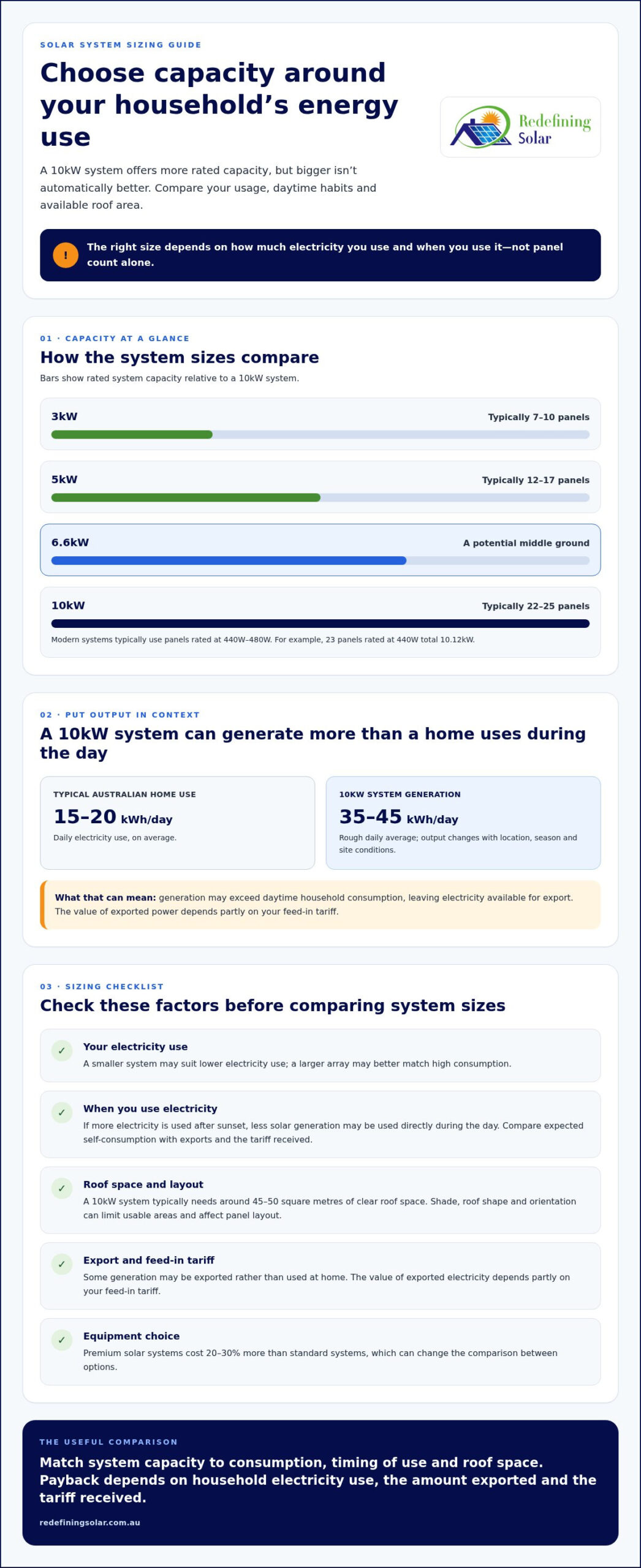
Panel wattage determines how many modules make up the array. Modern Australian 10kW systems typically use 22 to 25 panels rated at 440W to 480W. For example, 23 panels rated at 440W total 10.12kW. Higher-wattage panels can reduce the panel count, but the chosen system still needs to suit the household’s consumption and available roof area.
Roof space affects which panel layout can fit. A 10kW system typically needs around 45 to 50 square metres of clear roof space. Shade, roof shape and orientation can limit usable areas, so the same panel count may need arranging across different roof faces.
Phase supply matters as well as roof dimensions. A three-phase inverter costs more than a single-phase option in the estimates above, and a three-phase supply upgrade for a 10kW system in New South Wales is estimated at A$2,000-A$4,500. These factors help explain why a panel-only price cannot show the full cost of an installed system.
Comparing 10kW systems with smaller systems
A 10kW system offers more rated capacity than a 6.6kW system, but bigger isn’t automatically better. Compare the system with your electricity use, daytime habits and available roof area.
For context, a typical Australian home uses about 15 to 20kWh of electricity per day. A 10kW solar system generates roughly 35 to 45kWh daily on average, though output changes with location, season and site conditions. That can exceed a household’s daytime consumption, leaving electricity available for export. The value of exported power depends partly on your feed-in tariff, so system size alone doesn’t determine savings.
Smaller systems can suit owners with lower electricity use or less roof space. A 3kW system typically uses 7 to 10 panels, while a 5kW system uses 12 to 17. These examples show how capacity and panel quantity scale, but the right size also depends on when appliances run. A household using more electricity after sunset may use less of its solar generation directly during the day.
A 6.6kW system can be a useful middle ground between smaller arrays and 10kW capacity. If electricity consumption is high, a larger array may better match demand; if usage is modest, some output could be exported instead of used at home. Premium equipment can also affect the comparison, since premium solar systems cost 20-30% more than standard systems.
Payback depends on your household’s electricity use, the amount exported and the tariff received. Compare expected self-consumption as well as system capacity, rather than choosing by panel count alone. The installed price depends on system size, equipment, roof layout and electrical work. A quote gives the figure for your project.
What approvals, standards and grid connection rules apply to a 10kW solar system in Australia?
A 10kW solar system’s connection depends on your home’s supply and local electricity distributor requirements. In particular, inverter capacity and export limits can affect how much solar electricity flows back to the grid.
For a single-phase home, the permitted inverter capacity depends on the distributor. Some Australian homes may be allowed up to 5kW of inverter capacity with full export, with additional capacity possible under an export limit. Some homes may be able to install up to 10kW of inverter capacity if exports are limited. These options aren’t universal, so the distributor’s rules for your connection matter.
That distinction helps explain why a 10kW panel array doesn’t automatically mean 10kW of export to the grid. Inverter capacity governs the system’s conversion of panel output, while an export limit controls how much electricity can be sent out. Many Australian network operators restrict single-phase homes to a 5kW solar export limit. A larger array may still be possible, but its connection settings affect how surplus generation is managed.
Before installation, the design needs to account for your supply type, proposed inverter capacity and distributor export settings. For example, a single-phase property may need an export limit, while a different supply arrangement may have different connection conditions. The relevant distributor’s requirements determine the connection pathway, so don’t assume settings in one city apply across Australia.
These connection details can affect equipment selection and the system’s expected use of solar electricity. If you’re planning a 10kW installation, discuss your solar system design in light of your supply and export needs. That conversation can help align the array, inverter and connection settings before the installation is planned.
Redefining Solar: Battery Ready & Upgrades
Redefining Solar offers Battery Ready & Upgrades for property owners considering a battery now or planning for one later. This option is relevant if you’re comparing solar-only and battery-inclusive systems, or adapting an existing setup to your energy needs.
For a new project, Redefining Solar’s Residential Solar Systems and Commercial Solar Systems can match the system type to your property. If you’re sourcing panels separately, Solar Panel Sales / Supply Only is another option. The right choice depends on whether you’re starting from scratch, upgrading an existing system or planning for future battery use.
Share your project details and priorities with Redefining Solar to discuss a suitable next step. Contact Redefining Solar to talk through your solar plans.
Make your next solar decision with confidence
Knowing how much a 10kW solar system costs in 2026 is only part of planning a system that fits your property. The next step is to turn your priorities into a design: consider how you use electricity, whether battery storage matters to you, and how your system may need to adapt over time. A clear plan can help you weigh today’s requirements against future changes without choosing more capacity than you need.
Redefining Solar’s Battery Ready & Upgrades, Residential Solar Systems and Commercial Solar Systems support different stages of planning, from a new installation to preparing for a future battery. Share what you want your system to do and discuss the options that suit your property.
Start a conversation with Redefining Solar and take a considered next step towards solar that works for you.
Frequently Asked Questions
How much do solar panels cost in Australia in 2026?
If you’re asking how much a 10kW solar system costs in 2026, remember that panel prices cover only one component, not an installed system. A higher-wattage panel may mean fewer modules are needed, while the complete installation also involves an inverter, mounting equipment, wiring and labour.
How long before a 10kW solar system pays for itself?
A 10kW solar system costing A$9,000 has an estimated payback period of roughly 3 to 5 years. Your result depends on how much solar electricity you use directly, how much you export, and the value of your electricity tariff. For example, shifting appliance use into sunny hours can increase the share of generation used at home rather than exported.
How much does a premium solar system cost?
A premium system generally costs more than a standard-tier option because the equipment differs. The final price depends on panel and inverter brands, system capacity, roof layout and installation requirements. Treat equipment tier as one factor in the comparison, not a guarantee of higher savings. Your quote reflects your property and system choices.
How much does a 10kW solar system cost by Australian state and territory?
These are city estimates, not state-wide averages.
What is included in a 10kW solar installation quote, and what costs extra?
Compare the quote’s stated equipment, installation work, GST and any STC discount, then check which site-specific items are separate. Switchboard or meter changes, three-phase work, difficult access and long cable runs can add costs. Ask for these items to be listed separately so you can compare like-for-like totals and see whether export limiting or battery equipment is included.
How do 10kW solar system prices vary by panel and inverter brands?
Brand choice affects the equipment component, but wattage and inverter design also shape a system’s price. For example, a 10kW array using 440W panels needs about 23 modules, while higher-wattage panels can change the quantity. Inverter type and capacity must suit the system and electrical supply. Compare the specified models and equipment tiers, not just brand names or headline totals.