
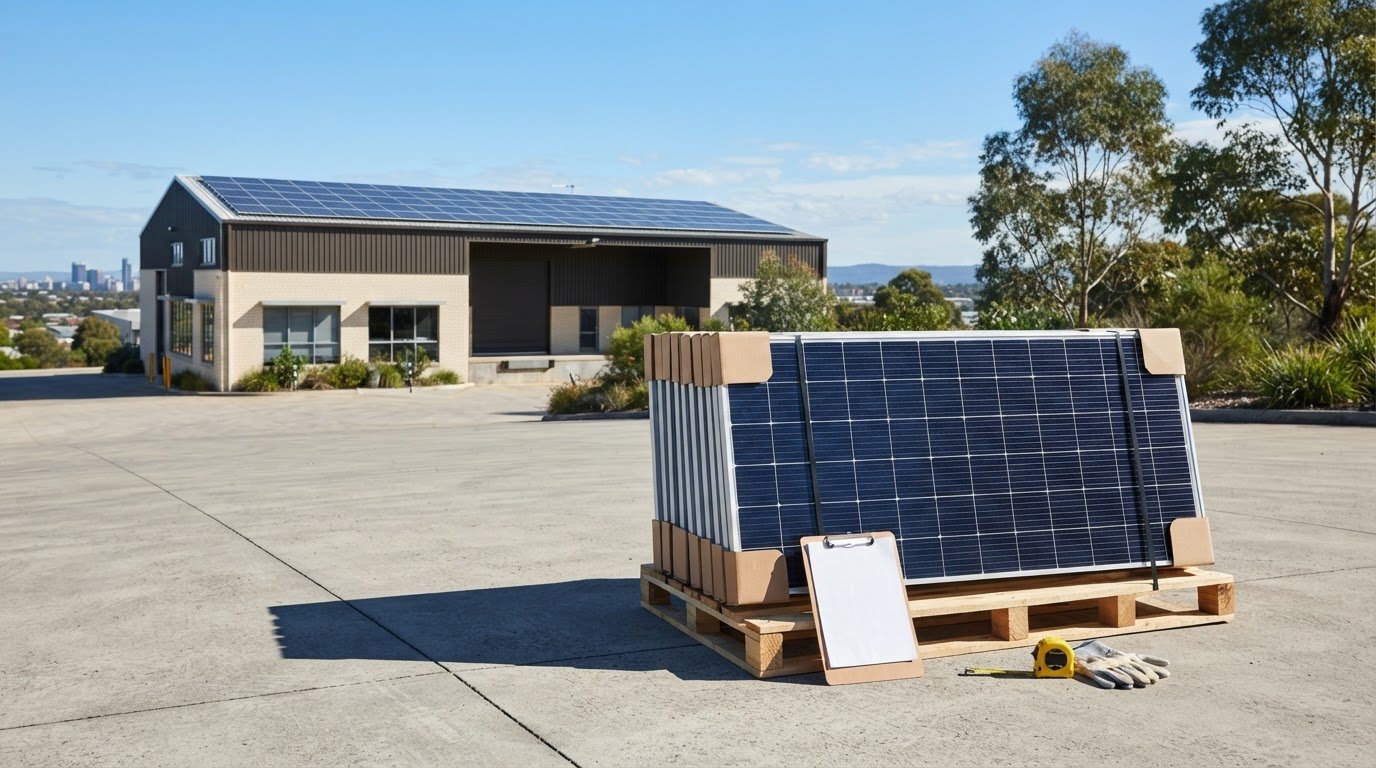
The lowest panel price isn’t always the lowest-risk buy. Supply-only solar panels in Australia can cost less upfront than a complete installed system because you’re buying panels, not the full system and installation. If a panel arrives damaged, document the damage before installation and contact the seller promptly.
It makes sense to compare prices closely, especially for a trade project or DIY system. But a sound decision also depends on whether the panel specifications suit your setup, what the product and performance warranties cover, and how the panel compares with lower-cost and premium options.
This guide explains how to compare supply-only panel costs with installed-system pricing without confusing the two. You’ll also learn what to check in panel dimensions and electrical specifications, how to read warranty terms, and what to do if a delivery arrives damaged, so you can make your next decision with confidence.
Key Takeaways
- Compare panel-only pricing with the full cost of an installed system, as the two cover different parts of a solar project.
- Inspect deliveries promptly and photograph any damage before panels are installed.
- Read product and performance warranties separately; they cover different aspects of a panel’s long-term use.
- Match panel dimensions and electrical specifications to your available roof space and system design.
- Weigh budget and premium options by their specifications, warranty terms and suitability, not just the upfront panel cost.
Hardware-only panel prices versus installed system prices
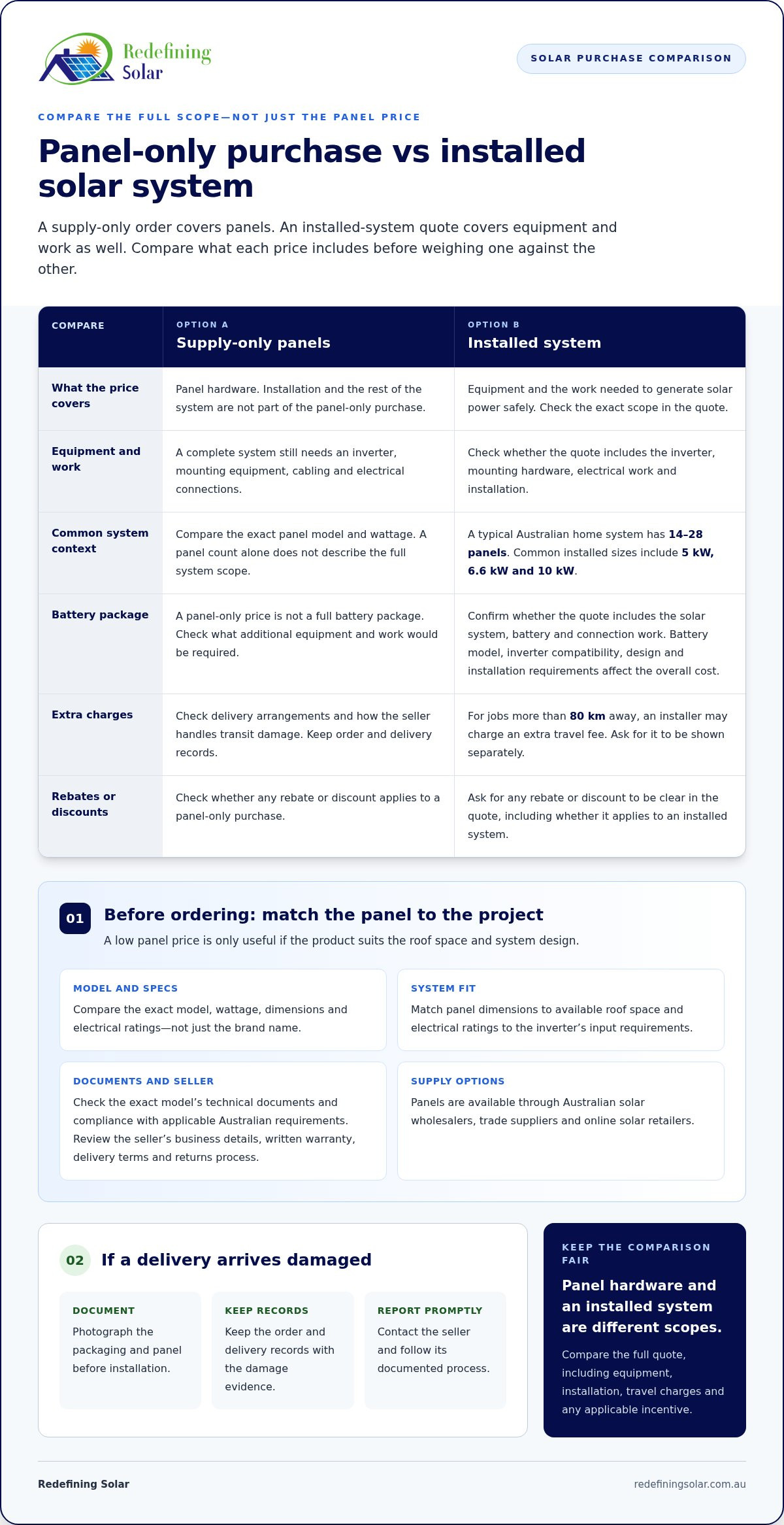
A panel-only purchase covers hardware, while an installed solar system includes the equipment and work needed to generate solar power safely. Compare the full scope of each quote, including any battery, travel charge and applicable incentive.
Buying Panels Without Installation
You can buy panels without installation through Australian solar wholesalers, trade suppliers and online solar retailers. For a supply-only purchase, compare the exact model, wattage, warranty terms and delivery arrangements rather than relying on a brand name alone. Check how the seller handles transit damage, and keep your order and delivery records.
Installed prices vary by system size and project scope. A typical Australian home system has 14-28 panels, while common installed-system sizes include 5 kW, 6.6 kW and 10 kW. An installed quote covers more than panels, so compare the inverter, mounting hardware, electrical work and installation scope before weighing it against a hardware-only order.
For a battery package, check whether the quote includes the solar system, battery and connection work. The battery model, inverter compatibility, system design and installation requirements all affect the overall cost. Any payback estimate also depends on how much solar power you use at home and your electricity tariff.
Solar installers may charge an extra travel fee for jobs more than 80 km away. Ask for the quote to show the travel charge separately from equipment and installation costs. Any rebate or discount should also be clear in the quote, so you can tell whether it applies to an installed system or your panel-only purchase.
Equipment, Compatibility and Purchase Risks
A complete solar system needs more than panels: it also requires an inverter, mounting equipment, cabling and electrical connections. A battery adds storage equipment and must suit the system design. Before ordering, match panel dimensions and electrical ratings to the available roof space and the inverter’s input requirements.
For standards and certification, choose a panel model with documentation showing compliance with applicable Australian requirements. Check the exact model and its technical documents, rather than relying on the manufacturer’s name or a broad certification claim.
You can buy panels yourself, but a licensed electrician should carry out the electrical connection and commissioning of a grid-connected solar system. Solar Accreditation Australia administers installer accreditation in Australia; accreditation and electrical licensing are separate matters.
Supply-only purchases carry practical risks: panels can arrive damaged, specifications may not match the inverter, and a panel warranty won’t cover every installation issue. Check the seller’s business details, written warranty, delivery terms and returns process. Inspect the shipment and record visible damage before installation.
Product and workmanship warranties
Yes, supply-only solar panels can come with manufacturer product and performance warranties. For a claim, keep your invoice, model details, serial numbers and delivery records, then follow the claim process set out in the warranty document.
Solar panel product warranties are commonly 25 years or more. A separate performance warranty typically guarantees about 80% of the claimed power rating after 25 years. These warranties cover different things: product terms address faults in the panel, while performance terms relate to its output over time.
Read the conditions before purchase. Check when coverage starts, what evidence a claim requires, and whether the remedy is repair, replacement or another outcome. Confirm how the warranty handles transport damage, installation, removal and return freight. A performance warranty is not a promise that your system will produce a set amount of solar power each day.
Manufacturer warranties usually apply to a named panel model, so match the paperwork to the product label and invoice. Keep a copy of the technical datasheet and record each panel’s serial number on delivery. If a panel arrives damaged, photograph the packaging and panel before installation, then report the issue promptly through the seller’s documented process.
Workmanship cover is separate. With a supply-only purchase, installation workmanship isn’t included in the panel warranty. If an installer fits the panels, their workmanship terms cover the work they perform, while the manufacturer’s warranty applies to the panel itself. Keep both sets of terms so you know whom to approach about a product fault or installation issue.
Check exclusions closely. Incorrect handling, unsuitable installation or use outside the manufacturer’s instructions may affect a claim. Ask what evidence is required and whether the warranty is transferable if the property changes hands. A written response is more useful than a broad sales statement, particularly if the panel’s efficiency or output later becomes a concern.
A solar inverter has its own warranty, separate from the panels; inverter warranties typically last five years, with some lasting 10 years or more. Keep the inverter model and warranty document with your panel records. Government rebate paperwork is separate from warranty coverage, so file each document under its own purpose.
If you’re comparing options, review the warranty documents alongside the panel specifications before buying. You can explore solar panel supply options as part of that comparison.
Panel dimensions and electrical specifications
A panel’s wattage is only one part of the fit. Compare its dimensions, electrical ratings and roof layout before ordering, then match those details to the inverter and system design. A mismatch can affect panel layout and system operation.
For a concrete example, the Jinko 475W Tiger Neo III Black Frame Solar Panel measures 1762 mm long by 1134 mm wide. Use those measurements to map the panel footprint against usable roof space, allowing for roof obstructions and the planned mounting arrangement. Count the available panel positions before choosing a quantity.
Electrical figures matter just as much. That Jinko panel has a maximum open-circuit voltage of 36.42 V and a maximum short-circuit current of 15.86 A. Compare both values with the inverter datasheet and the proposed string design. The solar inverter’s limits influence which panels can be connected and how the system is configured.
Rated power also needs context. The Trina VERTEX TSM-500DE18M(II) is rated at 500 watts and described as having 150 cells. Solar panels commonly have an efficiency of about 19% to 22%. Efficiency can help compare power output relative to panel area, but it doesn’t tell you the actual electricity a roof will generate by itself.
For a practical check, make a simple comparison before buying:
- Record each model’s length, width, wattage, voltage and current from its datasheet.
- Measure usable roof space and mark obstructions, roof edges and planned panel positions.
- Compare the panel’s electrical ratings with the inverter specifications and system design.
- Keep the exact model number on your quote and delivery paperwork.
Across Australia, roof direction, shading and local conditions influence actual solar generation. These factors can change the electricity available for household use, even when two panels have the same wattage rating. A feed-in tariff determines the export credit for surplus power; it doesn’t change a panel’s dimensions or electrical compatibility.
Likewise, a rebate or discount affects the purchase economics, not a panel’s physical fit. Keep the calculations separate: first establish that the model suits the roof and inverter, then assess how any applicable credit or discount affects the overall decision. This helps prevent a low purchase price from distracting from essential specification checks.
To relate specifications to household needs, a 1kW system produces between 3.5kWh and 5kWh daily as a general rule, while a typical Australian home uses 15-20kWh daily.
Budget versus premium solar panels
Budget and premium panels differ in more than their place in a quote. Compare specifications, efficiency, warranty terms and suitability for your system capacity.
Budget and Premium Panel Options
Budget panels may suit projects where upfront spending matters, while premium options may prioritise higher efficiency. Compare the datasheets for exact models rather than assuming every panel in either category performs alike. A premium panel’s efficiency can matter where roof space is limited; a budget panel may suit a layout with more usable area.
For a fair comparison, use the same project requirements for both options. Check output, dimensions, electrical ratings and warranty conditions, then assess how each panel fits your inverter and future battery plans. Solar installers can explain how panel selection affects system design, while the model’s documented specifications provide a useful basis for comparing quotes.
Solar Panel Brands in Australia
Australian buyers can compare brands including Jinko, Trina, REC, Seraphim, Aiko, SunPower and Tindo. There isn’t one best brand for every roof or project; the right choice depends on model specifications, available roof space and system requirements. Compare specific models, not just brand names, because capacity and features vary across product ranges.
Review the datasheet and warranty for the exact model in each quote. Check stated efficiency, rated output, dimensions and electrical ratings against your system design. Warranty terms matter too: confirm what product and performance coverage address, and how claims are handled. A brand name alone doesn’t show whether a particular panel suits your project.
Panel selection also depends on how you’ll use the system. A household planning to add batteries may value compatibility with the broader system design, while a trade buyer may prioritise consistent specifications across a larger order. Ask solar installers how the proposed panel choice supports the planned capacity and inverter arrangement.
Keep quotes comparable by listing the exact panel model and quantity, along with the inverter and any other included equipment. Check that each quote uses the same assumptions about roof layout and system capacity. This helps distinguish panel selection from overall scope, so you can judge each option on its merits rather than relying on a budget or premium label alone.
Finally, assess the panel against your priorities: available space, desired system capacity, future batteries and documented warranty coverage. Roof conditions and household energy needs vary, so a model that suits one project may not suit another. Comparing specifications against project requirements is more practical than choosing solely by brand reputation.
Where can I buy solar panels without installation in Australia?
Australian buyers can source panels through solar wholesalers, trade suppliers and online solar retailers. Choose a channel that suits your order size and collection needs, then compare the exact model and quantity across written quotes. A trade buyer ordering several matching panels may value consistent stock, while a DIY buyer may prioritise clear product details and delivery arrangements.
Before paying, make the order specific. Include the manufacturer, full model code, wattage and number of panels, and request an itemised record. Check whether the quote includes mounting hardware, an inverter or delivery. A panel-only order and a complete solar system are different purchases, so make sure the written scope matches what you intend to buy.
Use this purchase sequence to reduce avoidable errors:
- Write down the exact panel model and quantity your system design requires.
- Compare the datasheet and warranty terms with the quote and order confirmation.
- Clarify collection or delivery arrangements, packaging and the process for reporting transit damage.
- Keep the invoice, correspondence and product documents together after purchase.
Pay particular attention to delivery. Arrange a suitable place to receive the panels and inspect the packaging as soon as the shipment arrives. Photograph visible damage before moving or unpacking affected panels, then contact the seller with your order details. Record the model labels and serial numbers to help identify affected items.
For a trade account or larger project, ask for a written quote showing the model, quantity, delivery terms and exclusions. For a smaller DIY order, check that the retailer provides product documentation and a clear returns process. In either case, keep the model code consistent across the quote, invoice and delivered goods.
Seller reputation is easier to assess through practical evidence than broad claims. Look for complete business details, readable product documentation, written warranty conditions and a clear way to report order problems. Compare these points across sellers, and don’t rely on a product photo alone. The exact model code should match the listing, datasheet and paperwork.
Before ordering, compare the proposed panel with your roof plan and inverter specifications. Confirm the dimensions fit the available layout and that the electrical ratings suit the intended system design. If you’re ready to discuss panel requirements, talk through a supply-only panel order.
Redefining Solar: Battery Ready & Upgrades
Redefining Solar offers Battery Ready & Upgrades for people planning how their solar setup may support future battery use. If you’re comparing panel-only purchases with a complete system, its Solar Panel Sales / Supply Only service offers a relevant next step. Residential and commercial solar systems are also available for a broader project rather than a panel-only purchase.
Turn to Redefining Solar to discuss your project, whether you’re sourcing panels or considering a battery-ready upgrade. The right option depends on what you plan to install and how the panels fit into the overall system.
For a straightforward conversation about your solar plans, contact Redefining Solar.
Plan your next solar step with confidence
If you’re considering supply-only solar panels in Australia, look beyond the purchase and decide how the system should serve your property over time. Your priorities may change as energy use shifts, a business grows or you consider adding battery storage. A clear plan can help connect future choices to the system you’re building.
Redefining Solar offers Battery Ready & Upgrades, Residential Solar Systems and Commercial Solar Systems. These options let you discuss a broader project when panel supply alone doesn’t suit your plans. The next step is to outline what you want your solar setup to do, then explore the option that best matches your goals.
Whether you’re planning for a home or a business, you can start a practical conversation about your solar requirements. Contact Redefining Solar about panel supply and take the next step when you’re ready.
Frequently Asked Questions
What if my panels arrive damaged?
Keep affected panels separate and contact the seller with your order details. Save the packaging and delivery docket, and take clear photos of the damage, labels and surrounding packaging. Note how many panels are affected so the seller can identify them against your order. Don’t dispose of damaged packaging until you receive instructions about the claim. Keep copies of all messages and responses about replacement or refund arrangements.
How much do panels actually cost?
There isn’t one fixed panel price: the exact model, wattage, quantity and supply arrangements affect the quote. A panel order also differs from a complete solar system, which includes other equipment and installation. For a useful comparison, request an itemised quote naming each panel model and quantity. Check whether delivery and other equipment are included, rather than comparing a panel-only figure with a whole-system total.
What does supply-only solar panels mean in Australia?
Supply-only means purchasing solar panels without installation as part of the order. The written scope should identify the panel models and quantities, and state whether delivery or other equipment is included. A panel-only invoice, for example, doesn’t describe the full system design or installation work. If you arrange installation separately, keep the product documentation with your project records so the installer can work from the exact model details.
Can Australian homeowners claim solar rebates when buying panels supply-only?
A panel-only purchase doesn’t, by itself, show how a rebate applies to the completed solar project. The STC discount is associated with eligible solar systems and can affect an installed system’s quoted total. If you’re buying panels separately, have the installer explain how the completed system’s rebate treatment appears in the paperwork. Keep the panel invoice and installation documents together to clearly identify the equipment and completed project.
How do supply-only solar panel prices compare with supply-and-install quotes in Australia?
A supply-only quote covers the panels and any explicitly included supply items; a supply-and-install quote covers a broader project. Compare like with like: check whether each quote includes the inverter, mounting equipment, electrical work, installation and any applicable discount. Ask for an itemised scope, then separate panel costs from the remaining project components. This makes the difference between the totals easier to understand.
What are the Australian standards and certification requirements for solar panels?
Choose a panel model with documentation showing compliance with applicable Australian requirements. Check the exact model and its technical documents rather than relying on the manufacturer’s name or a broad certification claim.
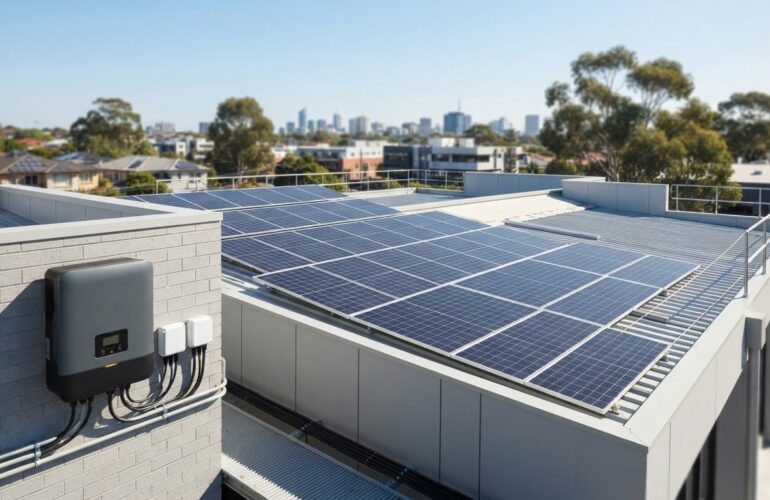
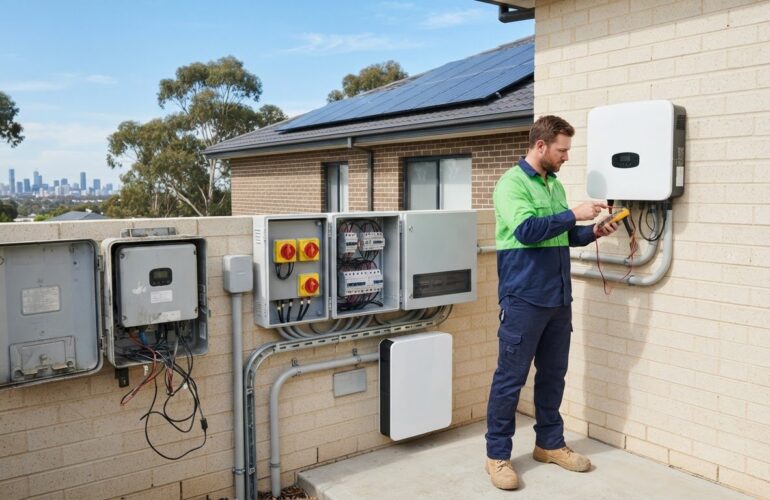
[…] solar inverter converts the direct current (DC) produced by solar panels into alternating current (AC), the form of electricity used by household appliances. It connects […]