The biggest solar system isn’t automatically the best choice for your business. A strong business case for commercial solar installation starts with how much electricity your premises use during daylight hours, alongside roof suitability and the way your energy costs are structured.
It’s reasonable to want clear numbers before committing to a long-term investment. The value of commercial solar comes from the electricity you use on site, while exported power, system size and upfront costs all shape the financial case.
This guide explains how to assess whether solar suits your premises, compare an upfront purchase with loans, leases and power purchase agreements, and understand what influences savings and payback. It also outlines Australian incentives that may apply, helping you weigh the practical and financial trade-offs.
Key Takeaways
- Match system size to your daytime electricity use so more of the solar power you generate can be used on site.
- Compare buying upfront with loans, leases and power purchase agreements to understand how each option affects cash flow and ownership.
- Estimate savings and payback using your energy use and tariff, rather than relying on a single example from another business.
- The Cheaper Home Batteries Program can provide eligible businesses and community organisations a discount on small-scale battery systems from 5 kWh to 100 kWh, according to the Clean Energy Regulator.
Should I install solar on my commercial premises?
A business case for commercial solar installation starts with your daytime electricity demand and how much solar power you can use on site. The key question is whether a suitably sized system fits your premises, energy profile and plans.
Energy use and system sizing
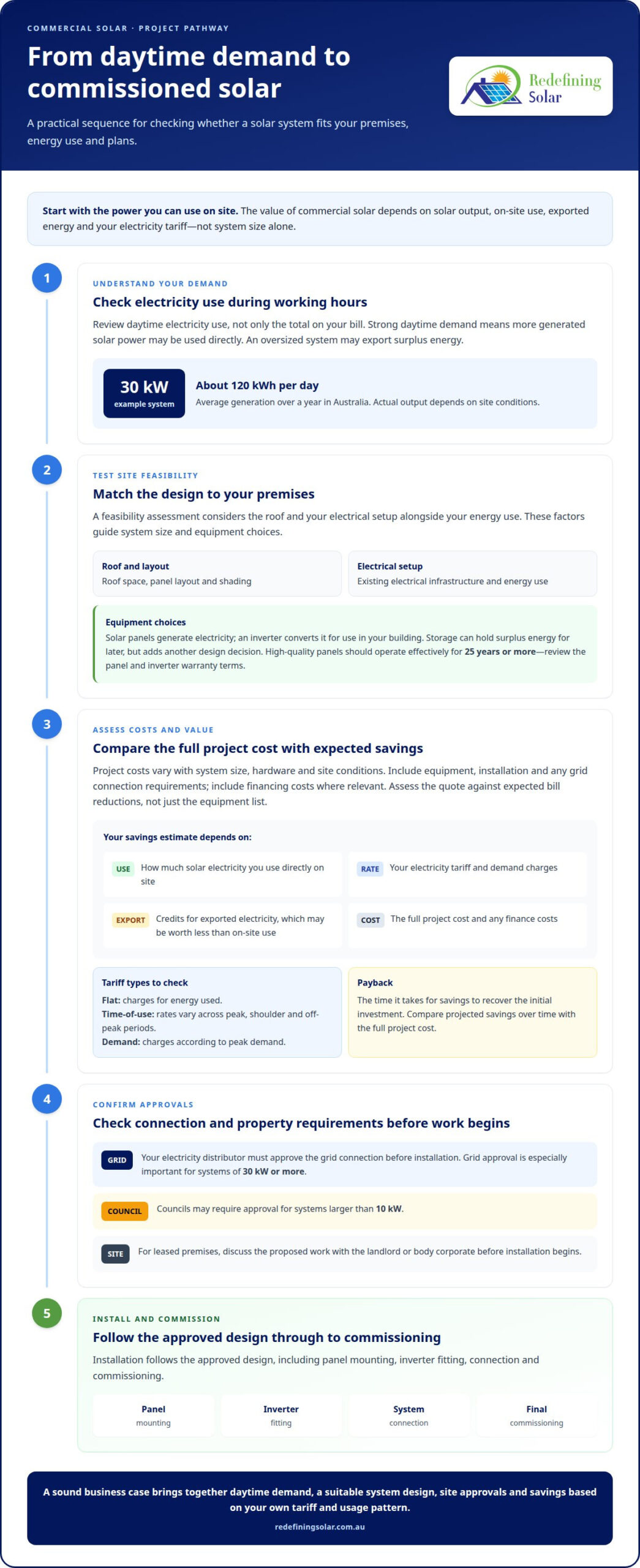
Look at electricity use during working hours, not only the total on your bill. Businesses with strong daytime demand can use more solar power directly, while an oversized system may export surplus energy. A 30 kW system generates about 120 kWh per day on average over a year in Australia. Treat this as an example, since site conditions affect actual output.
System design and feasibility
Design and feasibility work considers roof space, panel layout, shading, electrical infrastructure and your energy use. Together, these factors guide the system size and equipment choices. Solar panels generate electricity, and an inverter converts it for use in your building. Storage can hold surplus energy for later, but it adds another design decision. High-quality solar panels should operate effectively for 25 years or more, so review warranty terms for panels and the inverter.
Quotes and return on investment
To build a business case for commercial solar installation, assess a quote against expected savings, not just the equipment list. Project costs vary with system size, hardware and site conditions. Your return also depends on how much power you use directly and your electricity tariff.
Installation and approvals
In Australia, your electricity distributor must approve grid connection before installation. Councils may require approval for systems larger than 10 kW, while grid approval is especially important for systems of 30 kW or more. The installation follows the approved design, including panel mounting, inverter fitting, connection and commissioning. For leased premises, discuss the proposed work with the landlord or body corporate before installation begins.
Solar financing options, including CAPEX, OPEX, PPAs and loans
Commercial solar can be funded with upfront capital, borrowing or an operating arrangement. The right structure depends on your cash flow, ownership preferences and contract terms.
Lease finance and cashflow
A lease spreads payments over time, helping preserve working capital while the business uses solar electricity. Commercial solar lease finance is typically taken over a 4-to-5-year period. Once it’s paid off, electricity bill savings can flow to the business’s bottom line for 20-25 years. Compare lease payments with expected bill reductions across the contract, not just the first year.
With a power purchase agreement (PPA), the business buys the solar electricity under agreed contract terms rather than paying the full system cost upfront. Leasing and PPAs usually apply to contracts valued at more than A$10,000. Check the price mechanism and escalation clause: a PPA price may escalate at 5% per year, compounded.
Financing and upfront costs
CAPEX means using business funds to purchase the system, so your business owns the equipment and benefits from the electricity it uses. A loan also funds a purchase, but repayments and interest affect cash flow. Small businesses can also consider power purchase agreements or operating leases. Compare each option with expected bill savings and the proposed system size.
OPEX arrangements, such as leases and PPAs, reduce the need for a large upfront payment but create ongoing contractual costs. Environmental Upgrade Agreements usually apply to large contracts valued at over A$250,000. Building Upgrade Finance is available in South Australia, Victoria and New South Wales.
Staying on grid avoids committing to a solar system, but leaves your electricity purchases subject to your retailer’s plan. Solar can reduce the electricity you draw from the grid. Battery storage can shift some generated power for later use, but adds upfront cost and may lengthen payback compared with solar PV alone. Compare your demand profile, contract payments and expected bill savings together.
For a tailored system and equipment discussion, explore commercial solar system options.
Commercial solar project savings and payback periods
A business case for commercial solar installation should compare the full project cost with the value of the electricity it generates. Savings depend on solar output, on-site use, exported energy and your electricity tariff.
Estimating project costs
Estimate the complete project cost, including equipment, installation and any grid connection requirements. System size, hardware choices and site conditions all affect the estimate. Include financing costs where relevant, then compare the total with expected bill reductions. This gives you a sounder basis for assessing returns than a price-per-panel comparison, which can omit installation and site-specific requirements.
Savings and payback estimates
Solar power used directly at your premises reduces the electricity you need to buy from the grid. These examples show how savings and payback can vary with system scale and energy use.
Return on investment
To assess the business case for commercial solar installation, compare projected savings over time with the full project cost. Payback is the time it takes for savings to recover the initial investment. After that point, ongoing savings contribute to the project’s longer-term return.
Tariffs and solar savings
Your electricity tariff affects the value of each unit of solar energy. A flat rate charges for energy used, while a time-of-use tariff varies across peak, shoulder and off-peak periods. Demand tariffs charge according to peak demand. Feed-in tariffs determine credits for exported electricity, which may be worth less than using solar power on site. Compare your tariff, demand charges and export credits with your usage pattern to estimate savings more accurately.
Australian government rebates and incentives
Australian incentives may reduce the upfront cost of eligible solar or battery projects. The scheme, system size and premises location determine which support may apply.
Australian government incentives
From 1 October 2026, the expanded Small-scale Renewable Energy Scheme covers eligible commercial, industrial and agricultural rooftop solar systems up to 1 MW, increased from the previous 100 kW cap. The Australian Government estimates eligible systems can receive an upfront installation-cost reduction of roughly 20 per cent.
These figures illustrate potential support, not a fixed rebate for every project. Eligibility and the applicable certificate value depend on the system and its expected generation.
Commercial solar incentives
Solar incentives can affect the project budget before you calculate savings. Include any eligible certificate value in your financial assessment, then compare the revised upfront amount with expected electricity savings. Larger systems may have different certificate arrangements, so system capacity matters when identifying the relevant pathway.
Battery support is separate from rooftop solar incentives. The Cheaper Home Batteries Program can provide eligible businesses and community organisations a discount on small-scale battery systems from 5 kWh to 100 kWh, according to the Clean Energy Regulator. This may help reduce battery costs, but does not by itself establish whether storage suits your operating needs.
State-based solar incentives
State and territory support can vary, making location an important part of an incentive review. Building Upgrade Finance is available in South Australia, Victoria and New South Wales. Consider whether this financing pathway fits the project alongside Australian Government certificates, rather than assuming one replaces the other.
To assess how solar generation and battery options fit your premises, discuss a commercial solar project. Check each program’s eligibility conditions, supported system type and application process when building your project budget. A clear comparison helps separate potential upfront assistance from the ongoing value of solar generation and helps keep the financial assessment grounded in your business’s needs.
Redefining Solar: Commercial Solar Systems
Redefining Solar can help assess a commercial solar system when your premises’ energy use, roof and project goals point towards on-site generation. Its Commercial Solar Systems are designed around a business’s electricity needs and site conditions.
If you’re planning for future storage, Battery Ready & Upgrades can support a staged approach. You can also consider Solar Panel Sales / Supply Only if you only need the equipment. Discuss your premises, energy use and priorities with Redefining Solar to assess system design against your business case.
Contact Redefining Solar to discuss commercial solar for your premises.
Turn your assessment into a practical next step
A commercial solar decision is also an operational choice. Consider how your premises may change, whether electricity demand could shift and how much flexibility you want for future upgrades. These details help shape a system approach that fits the way your business works, rather than treating solar as a standalone purchase.
Use your assessment to set out your priorities: energy use, ownership, cash flow and storage plans. This gives the project discussion a clear starting point and keeps decisions grounded in your business’s needs. A business case for commercial solar installation is more useful when it connects the financial picture with practical site requirements.
Redefining Solar can discuss commercial solar options and battery-ready planning for your premises. Share your goals and the details that will shape the project, then take the next step at a pace that suits your business.
Contact Redefining Solar to start a practical conversation about your project.
Frequently Asked Questions
Are there government incentives and rebates available?
Yes. Eligible Australian commercial rooftop solar systems may access support through the expanded Small-scale Renewable Energy Scheme, which covers qualifying systems up to 1 MW from 1 October 2026. The incentive is linked to expected generation and eligibility conditions, so it can vary between projects. Check how the applicable certificate value is reflected in the project proposal before comparing the amount you need to fund.
How much can my business save under the expanded scheme?
Potential savings depend on system size and eligibility. These examples illustrate the scheme’s potential scale, but they are not guaranteed amounts for every business or installation.
How much could a mid-size business save annually on electricity bills?
Government modelling estimates that a 250 kW commercial solar system could save roughly A$50,000 annually on energy costs while generating about 345 MWh of electricity per year. Treat this as an example for a system of that size, not a forecast for every mid-size business. Your annual savings depend on system output, electricity use, tariff structure and how much generation is consumed on site.
How much does solar cost for small businesses?
The price depends on the project and is provided after a quote request; key cost factors include system size, hardware, installation complexity and any required extras. A small business can also compare the effect of upfront payment with a loan, lease or power purchase agreement. Incentives may change the amount payable, so assess the proposed system and funding terms together rather than relying on a generic estimate.
How do I find the optimal system size for a small business?
Use your business’s electricity pattern to size the system around daytime demand, rather than relying only on total annual consumption. If your premises have a smart meter, you can request the previous 12 months of interval data from your electricity retailer. This shows when energy is being used and helps reveal whether a proposed system may produce more electricity than the business can use directly.
What are the upfront costs of commercial solar installation in Australia?
Upfront costs can include solar panels, an inverter, installation work and any site-specific electrical or grid connection requirements. System size, equipment selection and installation challenges affect the total project cost. Funding changes how the initial outlay is handled: CAPEX uses business capital, while a loan, lease or power purchase agreement structures payments differently. Include any eligible incentives when assessing how much you need to fund.