Commercial solar can qualify for the Instant Asset Write-Off if your business meets the eligibility rules and the system’s cost is below the applicable threshold. From 1 July 2026, the $20,000 threshold is permanent for eligible businesses with aggregated annual turnover under $10 million, and the system must be installed and ready for use in the income year you claim it.
It’s natural to focus on the system’s upfront price, but the tax claim can also depend on how the asset is treated, your GST status and any rebate that reduces its cost. The commercial solar instant asset write-off may allow an immediate deduction for a qualifying asset, but it is not a cash rebate or a guaranteed tax saving.
This guide covers which costs may count, how the per-asset threshold works and why installation timing matters near the end of a financial year. It also explains what may happen when a system costs more than the threshold, helping you consider tax and installation timing together.
Key Takeaways
- Commercial solar may qualify if your business meets the eligibility rules and the asset’s cost is below the applicable per-asset threshold.
- Installation timing matters: the system must be first used or installed and ready for use in the income year you claim.
- Work out the relevant asset cost with GST treatment and any applicable STC rebate in mind, as these can affect the amount used for the threshold.
- If an eligible asset exceeds the write-off threshold, it may instead enter the simplified depreciation pool, where the Australian Taxation Office says the first-year rate is 15%.
Can solar systems be written off under the Instant Asset Write-Off?
An eligible business solar system may qualify for an immediate deduction if it meets the rules for the relevant income year. If the system exceeds the applicable threshold, depreciation may still be available through another method.
Solar equipment as depreciable assets
A depreciating asset is equipment used to earn business income, with its cost deducted over time or under an immediate write-off rule. Solar panels, an inverter and batteries may form part of a commercial solar system. The asset’s tax treatment and business use are important when calculating a deduction.
Separate invoice lines do not automatically make each component a separate asset. The commercial solar instant asset write-off depends on the asset’s treatment, cost and income-producing use, not simply on how the equipment is itemised.
Division 40 treatment of solar systems
Solar power systems are depreciable plant and equipment under Division 40 of the Income Tax Assessment Act 1997. This provides a depreciation pathway when a system doesn’t qualify for an immediate write-off.
If a system exceeds the threshold, its cost may be depreciated over its effective life. Eligible small businesses may instead use simplified depreciation rules, which affect when the system’s cost reduces taxable income.
Comparing depreciation approaches
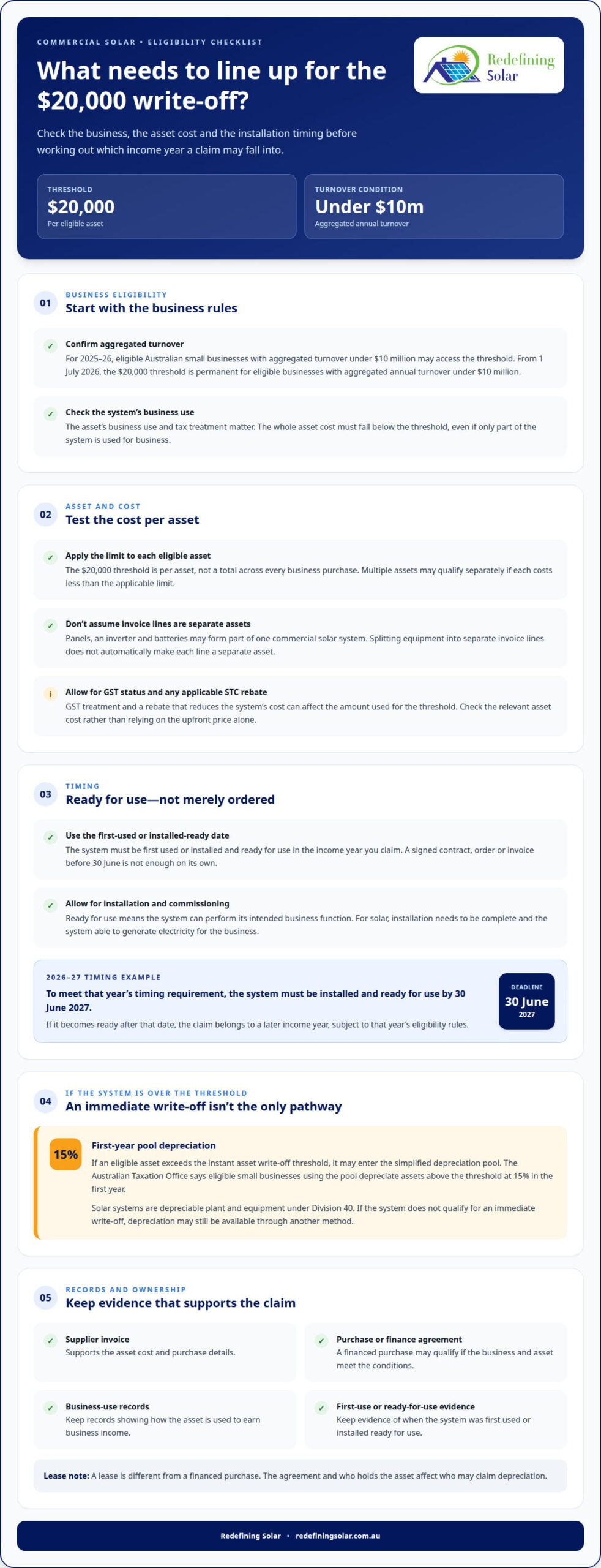
The instant asset write-off gives an eligible business an immediate deduction for an asset below the applicable threshold. Simplified depreciation places eligible assets above that threshold into a pool. According to the Australian Taxation Office, eligible small businesses using the simplified depreciation pool depreciate assets above the instant write-off threshold at 15% in the first year.
Temporary full expensing was a separate, temporary measure, not another name for the commercial solar instant asset write-off. The relevant scheme and eligibility conditions depend on the income year.
A financed purchase may qualify if the business and asset meet the applicable conditions. A lease is different: the agreement and who holds the asset affect who may claim depreciation. Keep the supplier invoice, purchase or finance agreement, business-use records, and evidence of when the system was first used or installed ready for use.
The $20,000 Instant Asset Write-Off threshold and its deadline
The threshold applies to each eligible asset, and the relevant income year depends on when it is first used or installed ready for use. Turnover, asset cost and timing all affect whether a commercial solar claim qualifies.
Per-asset threshold and timing
A per-asset threshold tests each asset’s cost separately, rather than adding every business purchase together. For eligible assets, the threshold is $20,000 per asset in the 2025-26 income year. Multiple assets may qualify separately if each costs less than the applicable limit. The relevant income year also depends on when the asset is first used or installed ready for use, not simply when you sign a contract.
Turnover and asset thresholds
For 2025-26, eligible Australian small businesses with aggregated turnover under $10 million may access the $20,000 threshold per asset. This answers what the write-off is for that year: an immediate deduction may apply to an eligible asset costing less than the limit. The invoice and asset treatment help establish the cost; splitting a system into component lines doesn’t automatically make each line a separate asset.
Thresholds across tax periods
The $20,000 threshold applies through 30 June 2026 for eligible assets in the relevant period, and was made permanent from 1 July 2026. That means the threshold continues for eligible businesses under the permanent rules, rather than ending after 2025-26. Check the income year attached to the claim: older thresholds don’t determine the treatment of a system acquired in a later period.
Eligibility and timing risks
A claim can fail if turnover or asset-cost requirements aren’t met, or if the system misses the income-year timing deadline. Timing can affect whether a solar system qualifies for an immediate deduction in a given income year. The whole asset cost must fall below the threshold, even if only part is used for business. An invoice date or signed contract alone doesn’t establish that the system was ready for use.
For commercial solar planning, allow time for installation and commissioning before the relevant 30 June deadline. The system’s effective life may matter if it exceeds the threshold and is depreciated instead.
First-used or installed-ready timing requirement
The claim year depends on when the solar system is first used or installed ready for use, not just when it is ordered. That date can determine whether the deduction falls into the intended financial year.
First-use timing
First-use timing means the asset must be put to use, or be ready for use, within the relevant income year. The purchase date alone doesn’t establish the claim year, so a signed contract or invoice before 30 June isn’t enough by itself.
For the 2026-27 financial year, a solar system must be installed and ready for use by 30 June 2027 to meet that year’s timing requirement. If the system becomes ready after that date, the claim belongs to a later income year, subject to that year’s eligibility rules.
Installation and readiness for use
Installed and ready for use means the system can perform its intended business function. For solar panels, that generally means installation is complete and the system can generate electricity for the business. An incomplete installation may not meet this timing test, even if the equipment has arrived onsite.
Allow time for installation and commissioning before the financial-year cutoff. A system that is still being connected, tested or commissioned on 30 June may not yet be ready for use. The relevant evidence should show when the system became operational, rather than only when panels were delivered or work began.
For example, a business that signs a contract before 30 June but has its system commissioned after that date can’t rely on the contract date alone to claim in the earlier year. The first-use or readiness date determines the timing. Keep the installation and commissioning records with the invoice, so the date supporting the claim is written down.
Timing also affects the deductible share if an asset has private use: only the business-use portion may be deductible. The immediate benefit therefore depends on both the applicable income year and the system’s actual use.
GST-exclusive costs and tax deductions
GST status and rebates affect the cost used to calculate a solar deduction. The same invoice amount can result in different deductible costs for different businesses.
GST-exclusive solar costs
A GST-exclusive cost removes GST that a registered business can claim back as a credit. For example, a GST-registered business’s A$9,900 GST-inclusive system is treated as A$9,000 for the write-off calculation when it can claim the full GST credit.
Installation costs included in the solar asset’s cost affect the amount assessed against the threshold. If an eligible business uses simplified depreciation and the asset exceeds that threshold, pooling changes when deductions are claimed; it does not make the asset immediately deductible.
STC rebates and deductible costs
Small-scale Technology Certificates (STCs) reduce the solar asset cost used for depreciation when a rebate lowers the amount paid. For instance, a A$6,500 cost after an STC rebate is the relevant starting amount, rather than the higher pre-rebate figure.
The deduction is based on the cost remaining after any rebate, subject to GST treatment and other eligibility rules. Keep the invoice and rebate details together so the calculation reflects the system’s net cost.
Combining rebates and deductions
An STC rebate and a tax deduction can both affect the same purchase, but they work differently. The rebate reduces the asset’s cost; the deduction applies to the eligible cost remaining after that reduction.
For an eligible small business, a qualifying asset below the relevant threshold may be written off immediately. An asset above it may instead be depreciated through the simplified small business pool. Aggregated turnover and the asset’s tax treatment determine whether those rules apply.
For a commercial rental property, ownership and installation matter. A landlord may claim a solar system write-off only if they purchase and install the system. A tenant’s claim depends on the tenant purchasing and installing it.
The write-off is an Australian tax deduction; it does not set separate state or territory incentive terms. Other programs have their own eligibility requirements and conditions.
For a commercial system cost breakdown, discuss your solar project and its equipment requirements.
Redefining Solar: Commercial Solar Systems
Redefining Solar supplies and installs commercial solar systems for businesses seeking to reduce their reliance on grid electricity. If you’re considering an installation, discuss the system scope and expected timing alongside your tax planning, so commissioning deadlines and asset records are considered early.
The right system depends on your site, energy use and operational needs. Redefining Solar can help shape a commercial solar project around those requirements, while your accountant assesses the asset’s potential tax treatment. This is a practical next step if you’re weighing system design against the relevant write-off rules.
For a straightforward discussion about your business’s solar requirements, contact Redefining Solar.
Plan your next move with confidence
A solar project is easier to plan when system requirements, installation timing and tax treatment are considered together. Before committing, match the proposed system scope to your business’s operating needs, then discuss the tax treatment with your accountant. This gives you a clearer basis for deciding, without making a potential deduction the only reason to install solar.
Planning a commercial solar instant asset write-off alongside system design can help keep practical details in view, including the records needed to support the asset’s cost and use. Redefining Solar can help with the commercial solar system, while your accountant advises on your tax position.
When you’re ready to discuss the solar requirements for your business, talk through your project with Redefining Solar. A considered conversation can help you move towards a system plan that suits your site and business needs.
Frequently Asked Questions
Can landlords claim the write-off?
A landlord may claim a deduction for a solar system they purchase and install for the property. If a tenant purchases and installs the system, the tenant may be entitled to claim instead. For a leased commercial site, make sure the purchase documents show who acquired the equipment and arranged its installation, then keep those records with the tax return.
What about home businesses and mixed use?
A home-based business can generally claim only the share of a solar asset’s cost that relates to earning assessable income. If the system serves both household and business use, the private-use share is not part of the business deduction. Keep a reasonable record of how you calculate the business-use proportion, and discuss it with your tax agent.
Can I claim multiple solar systems?
A business may claim more than one solar system if each asset meets the rules for the relevant income year. For example, systems at separate business premises can be assessed individually, while the project’s combined spend does not by itself determine eligibility. Keep a clear invoice and asset record for each system, including its location, purchase details and date it was put into use.
Does system size affect the depreciation calculation?
System capacity alone does not determine the depreciation deduction. The calculation depends on the asset’s cost, its tax treatment, its business-use share and, for depreciation over time, its effective life. A larger system may cost more and exceed the applicable write-off threshold, but capacity alone does not decide the tax outcome. Your accountant can apply the relevant method to the asset records.
What tax incentives are there with solar?
Businesses may be able to claim a tax deduction for eligible solar assets, while eligible small-scale solar PV systems may generate Small-scale Technology Certificates (STCs). STCs can reduce the upfront system cost when assigned for a discount, but they are not an income tax deduction. Their value can vary, so include the net asset cost and any STC arrangement in your tax records.
Need help before the EOFY deadline?
Yes, Redefining Solar can help with the commercial solar system planning and installation side, while your accountant advises on eligibility and the tax claim. Share your site requirements and intended timing early, so the proposed system and installation schedule can be discussed alongside the relevant income-year cutoff. For a practical conversation about your project, contact Redefining Solar.