A 6.6kW solar system’s price in Australia depends on the equipment, roof and installation requirements, so there isn’t one figure that suits every home. The average cost of a 6.6kW solar system is shaped by factors such as panel and inverter choices, roof complexity and whether you include a battery.
It’s sensible to compare the full system design, not just the headline price. The right size depends on how much electricity you use and when you use it, while savings and payback depend on how much solar power your household can use directly.
This guide explains how 6.6kW systems are sized, what affects their cost, and how to think about savings and payback in Australia. Pricing depends on your project and is provided after a quote request, with system components, roof conditions and installation requirements all affecting the final amount.
Key Takeaways
- Compare system quotes by looking at the panels, inverter, installation needs and whether a battery is included.
- Match system size to your household’s electricity use and when you use power, as this affects how much solar you can use directly.
- Understand how self-consumption, location and electricity export rates influence potential savings and payback.
- Learn how Small-scale Technology Certificates can reduce the upfront cost of an eligible solar system.
6KW Solar Panel Systems: How Much Do They Cost?
A 6.6kW system’s installed price depends on its equipment and site requirements. Comparing what each quote includes helps households assess the system’s overall value.
Installed Prices Across System Types
An installed price covers the solar equipment and work needed to make the system operational. Adding a battery changes the design and total project cost, so compare solar-only and solar-plus-battery quotes separately.
A 6.6kW system suits households whose annual electricity use and daytime consumption align with its potential generation. Review your bills and usage patterns to judge whether that capacity fits your home.
Installation Costs and Cost Factors
Installation costs include the labour and site work needed to fit and connect the system. Roof complexity, access, panel layout, inverter choice and electrical work can all affect the scope.
The installation price can include panels, an inverter, mounting equipment, wiring, labour and system commissioning. The exact inclusions matter because two quotes for a 6.6kW system may cover different equipment or work.
The price depends on the project. Roof access, equipment, system design and electrical work all affect the final quote.
Rebates, Incentives and Applicable Rules
In Australia, eligible systems may receive a solar rebate through Small-scale Technology Certificates (STCs), reducing the upfront cost. According to the Clean Energy Regulator, each megawatt hour of renewable electricity generated by an eligible system earns one STC.
A 6.6kW system is below the stated 100kW eligibility threshold, and the listed annual output limit is 250MWh. The rebate affects the amount paid upfront, so compare quotes on the same basis: before or after the solar rebate.
What the Installation Price Includes
An installed quote should describe the equipment and work included, not just name the 6.6kW capacity. Check whether it covers panels, the inverter, mounting, wiring, installation labour and commissioning.
For a battery-ready design, check whether the battery equipment is included or the system is simply prepared for a future upgrade. This distinction helps you compare the installation scope with the system you plan to use.
Solar payback periods and savings
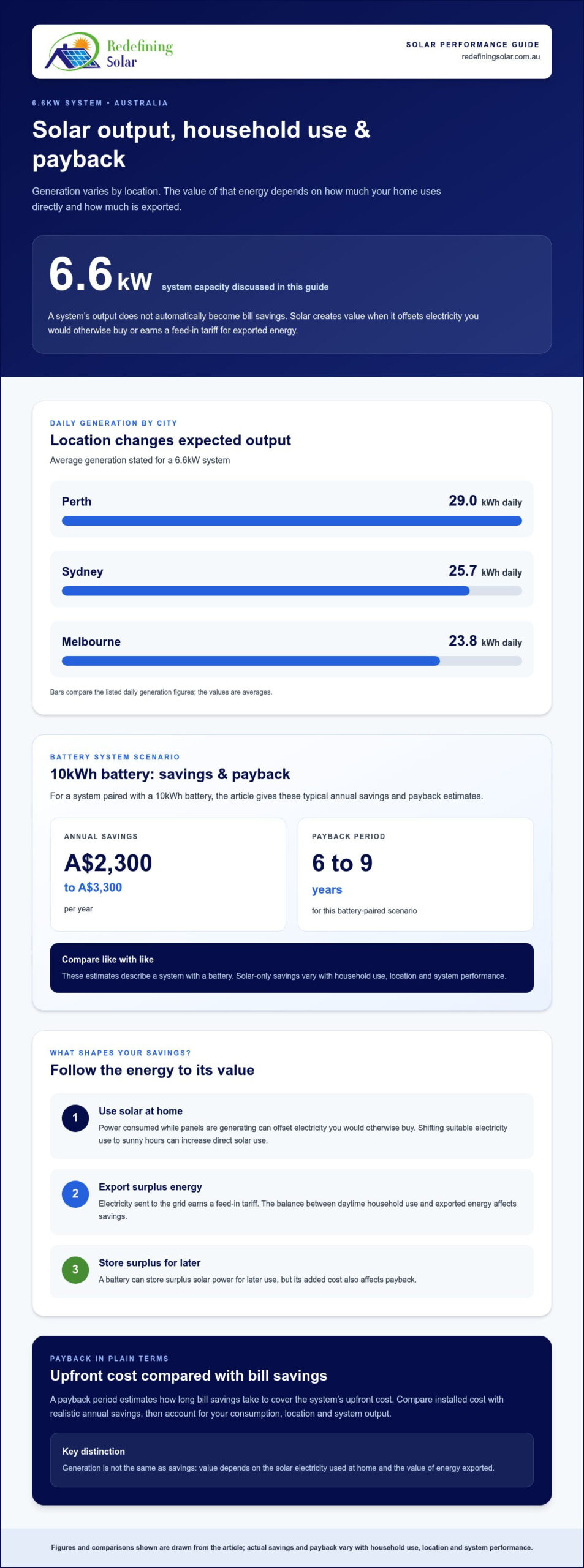
A solar payback period estimates how long bill savings take to cover the system’s upfront cost. Solar-only systems can reduce electricity bills, but the savings and time to recover the upfront cost vary with household usage, location and system performance. A system paired with a 10kWh battery typically saves A$2,300 to A$3,300 annually, with payback taking 6 to 9 years. These are separate system scenarios, so compare like with like.
Output is one part of the calculation. A 6.6kW system in Sydney generates an average of 25.7kWh daily, compared with 23.8kWh in Melbourne and 29.0kWh in Perth. That energy does not automatically become bill savings. The value depends on how much electricity your household consumes while panels are generating, plus the value of exported energy.
Self-consumption matters because using solar power at home offsets electricity you would otherwise buy. Exported energy earns a feed-in tariff, so the balance between daytime use and exports affects savings. Shifting suitable electricity use to sunny hours can increase the share of solar power you consume directly. A battery can store surplus for later use, but its added cost also affects payback.
To estimate payback, compare the system’s installed cost with realistic annual bill savings, then consider how your consumption, location and system output influence that figure. A 6kW solar system follows the same basic logic: its output only creates value when it offsets imported electricity or earns export credits. Use your electricity bills to understand when demand occurs, then compare that pattern with expected generation. For a closer look at solar system options, consider how the design fits your household’s energy use.
Average system cost in Australia
There isn’t one national figure that represents every 6.6kW solar installation. Averages combine projects with different equipment, roof layouts and installation requirements, so use them as context rather than a like-for-like quote. The average cost of a 6.6kW solar system is most useful when its inclusions and location match your own project.
Location changes the conditions installers work with. A home in Sydney may have a different roof design and electrical setup from a property in Adelaide or Darwin. Those differences can affect system layout, access and installation scope, even when each household is considering the same panel capacity.
The system specification also matters. Two 6.6kW designs may use different panels and inverters, or include different provisions for a future battery. Comparing the headline amount alone can hide those differences. Check the equipment list and installation scope before deciding whether one quote is genuinely lower.
Federal rebates can affect how a published average is presented. A figure may be shown before or after an eligible solar rebate, so confirm which basis it uses when comparing prices. Keep rebates separate from expected savings, which depend on system output, household consumption and the value of electricity used at home or exported.
For a fair comparison, note the location, system capacity, equipment and rebate treatment behind each figure. Then compare those details with your own property and electricity use. A 6kW system is not identical to a 6.6kW system, so avoid treating their averages as interchangeable.
The final price depends on your project: equipment selection, roof layout, electrical work and installation scope all shape the amount. A project-specific quote is more useful than relying on a national average that may describe a different home or system.
How much does a 6.6kW solar system cost after the federal STC rebate?
There isn’t one fixed after-rebate price for every 6.6kW solar system. The federal Small-scale Technology Certificate (STC) discount depends on the system’s eligible generation and the certificate value used in the offer. The final amount also reflects equipment, roof conditions and installation work.
STCs reduce eligible system costs by representing renewable electricity generation. According to the Clean Energy Regulator, each megawatt hour of renewable electricity generated by an eligible system earns one STC. The certificate value is listed at A$40, but the total discount depends on how many certificates apply and the value credited in the quote.
The deeming period affects certificate calculations. It dropped from six years to five years on 1 January 2026. This change affects the period used to estimate eligible generation, rather than setting a universal rebate amount for every 6.6kW installation.
To compare net prices, check whether each quote shows the total before or after the STC discount. Then compare the discount separately from the equipment and installation scope. Two quotes may both include a federal STC deduction but differ in panels, inverter, roof work or other inclusions. A single headline figure can hide those differences.
System design, equipment, roof access and installation work all shape the final price. Treat the STC discount as one part of the calculation, not a guaranteed fixed reduction. The quote should show how the discount has been applied and what remains payable.
For guidance on a system design that accounts for eligible certificates and your roof, discuss your solar system requirements.
Redefining Solar: Battery Ready & Upgrades
Redefining Solar offers Battery Ready & Upgrades for households planning a solar system or considering battery storage later. When comparing system costs, consider how the current design fits your future energy needs. Residential Solar Systems are available for homes, and commercial systems for businesses.
Redefining Solar also offers Solar Panel Sales / Supply Only. The right option depends on whether you need a complete system, an upgrade or panels supplied separately. Discuss your priorities to clarify which offering suits your project.
Contact Redefining Solar to talk through your solar requirements.
Turn your solar research into a clear next step
Use the average cost of a 6.6kW solar system as a starting reference, then focus on what you want your system to do for your property. Before making a decision, write down your priorities, such as managing daytime electricity use or planning for changing household needs. This gives the conversation a practical focus and helps keep the system design connected to your goals.
Start by discussing your property, energy use and the options you’re considering. Redefining Solar offers a free solar assessment to help you explore a suitable solar solution for your home or business, including whether a battery-ready approach fits your plans. You don’t need to have every detail settled before getting started.
Talk with Redefining Solar about your solar plans and take the next step with a clearer sense of what matters to you. A considered decision starts with the right questions, and you can move forward at your own pace.
Frequently Asked Questions
What is the average installed price of a 6.6kW solar system in Australia in 2026?
There isn’t one installed price that applies to every Australian home in 2026. The amount depends on the system design, equipment, roof access and installation work, as well as how the federal STC discount is applied. Compare quotes using the same inclusions and rebate basis. The project-specific price is provided after a quote request.
How do 6.6kW solar system prices vary by Australian state and city?
Prices vary because properties may need different installation work and system designs. Roof layout and access, local electrical requirements, equipment selection and installation scope all affect the quote. Compare proposals for the same system capacity and inclusions, and check whether each figure accounts for the federal STC discount. This makes the comparison more useful than location alone.
How does the cost of a 6.6kW system vary by panel and inverter quality?
Panel and inverter choices affect the system specification and the quote. Common residential panels range from 440W to 490W, so a 6.6kW array may use around 14 panels. The inverter converts panel electricity for household use, and its capacity must suit the design. Compare the named equipment and installation scope, rather than judging quality from the system size alone.
How much electricity and bill savings can a 6.6kW solar system deliver in Australia?
Generation varies with location and system conditions. For example, a 6.6kW system in Adelaide produces an average of 27.7kWh per day. Bill savings depend on how much of that energy your household uses as it is generated, alongside the value of exported electricity. Comparing your daytime consumption with expected output gives you a more useful view of potential bill impacts.