Yes, you may be able to combine federal solar support with a state incentive, provided you meet each programme’s separate eligibility rules. For federal solar rebate eligibility in 2026, rooftop solar systems need to be installed by a Solar Accreditation Australia-accredited installer, with panels and inverters on the Clean Energy Council’s approved lists to qualify for STCs. Battery support has its own requirements.
It’s understandable to want a clear answer before you commit to a system, especially when household, property and equipment rules can all affect eligibility. This guide explains which solar and battery installations may qualify, how pre-approval works, and what to know about combining federal support with state incentives. You’ll also see how installer and equipment requirements fit into the decision, so you can better understand the criteria before moving ahead.
Key Takeaways
- In Victoria, a property is generally ineligible for the solar rebate if a solar panel system was installed there in the last 10 years, according to Solar Victoria.
- Solar Victoria says Victorian solar rebate eligibility generally requires combined taxable household income for all owners to be below $150,000 per year.
- Timing matters: a Victorian household that installs its solar system before its rebate eligibility is approved won’t receive the rebate.
- Federal and state incentives may be combined, but each has its own eligibility rules, so the system type and application requirements matter.
Solar installer and equipment requirements
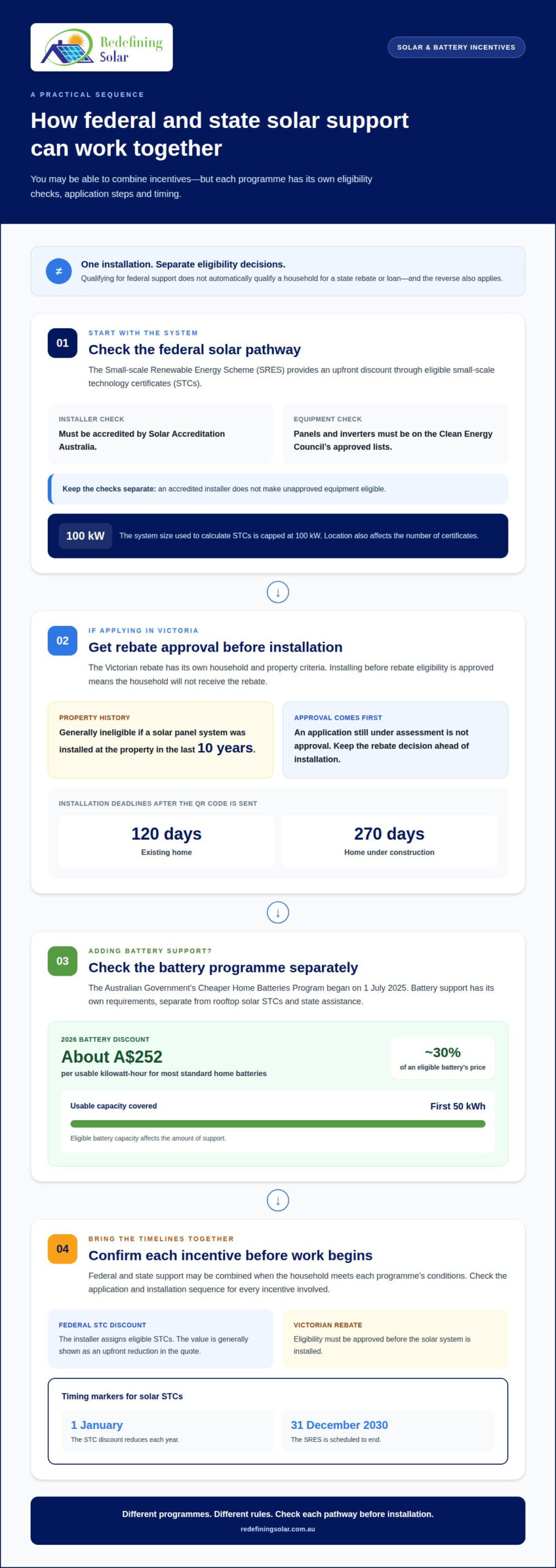
For rooftop solar to qualify for Small-scale Renewable Energy Scheme (SRES) certificates, the installer must be accredited by Solar Accreditation Australia. Panels and inverters must also be on the Clean Energy Council’s approved lists. These are separate checks: an accredited installer does not make unapproved equipment eligible. Confirm the installer and proposed system components before work begins to help avoid losing the certificate discount.
System size, location and installation date affect the certificate calculation. The system size used to calculate STCs is capped at 100 kW, while location affects the number of certificates. For example, a 6.6 kW Adelaide system generates 48 STCs in 2026. The STC discount reduces on 1 January each year, and the SRES is scheduled to end on 31 December 2030.
There isn’t one fixed maximum dollar rebate for every home system. The SRES calculation uses eligible system capacity and STCs, with the size capped at 100 kW. That example illustrates how the amount varies with the system and certificate value.
Installers apply the discount by assigning the system’s STCs, with the value generally shown as an upfront reduction in the quote. Check that the quote lists the STC discount separately from the system price, so you can see how it affects the amount payable. The certificate value depends on the number of eligible STCs and their sale value.
Victoria has additional property and timing rules. Solar Victoria says a property is generally ineligible for the solar rebate if it had a solar panel system installed in the last 10 years. For an existing home, installation should be finalised within 120 days of the QR code being sent; a home under construction has a 270-day deadline. These deadlines make application timing and installation scheduling important.
For solar rebate applicants in 2026, the key timing points are the annual STC reduction on 1 January and the SRES end date of 31 December 2030. From 1 October 2026, planned SRES changes supporting mid-scale solar apply to installations, subject to regulations being in place. Check that your installer, equipment, system size and location align with the relevant scheme rules before installation.
Application and pre-approval process
Timing matters particularly for Victoria’s state rebate, where approval must come before installation. If a household installs its solar system before its rebate eligibility is approved, it will not receive the rebate. Treat approval as a prerequisite, not a step to complete after the panels are installed. This is especially important if installation dates are being arranged while an application is still under assessment.
Think of the process as two separate tracks. For a Victorian household rebate, the application establishes eligibility before installation. Under the federal Small-scale Renewable Energy Scheme (SRES), eligible rooftop solar systems receive support through small-scale technology certificates (STCs). The schemes have different requirements, so qualifying for one does not automatically establish eligibility for the other.
From 1 May 2026, Victorian applicants seeking the interest-free solar loan must select it when applying. This choice matters at the application stage, rather than after the solar system has been installed. If you want the loan, account for that selection alongside the rebate application before making installation arrangements. The rebate and loan are separate parts of the Victorian application decision.
Before lodging a Victorian application, gather the information needed to assess the household and property against the programme criteria. The application must be considered before installation, so booking installation for an earlier date can put the rebate at risk. Coordinate the application decision with the installation timing rather than treating them as unrelated tasks. This sequence helps prevent avoidable timing problems.
For the federal STC discount, eligibility is tied to the system’s installation and assignment of its certificates. The installer applies the discount by assigning eligible STCs, so the quoted amount reflects the certificates rather than a later household rebate application. This differs from Victoria’s pre-approval requirement. A household may therefore face different timing rules for federal and state support, even for the same solar installation.
Use the application decision to clarify which incentive applies, what it covers, and when installation can proceed. In Victoria, do not treat an application in progress as approval. From 1 May 2026, select the interest-free loan during the application if you want it, then keep the rebate decision ahead of installation.
Combining federal and state incentives
Federal support and state programmes have separate eligibility rules, so one incentive does not automatically replace another. Eligible households may be able to combine support if they meet the conditions for each programme. The federal solar incentive works through Small-scale Technology Certificates (STCs), while state offers can include a separate rebate or loan. Review each programme’s timing and application requirements together before committing to installation.
For rooftop solar, the federal Small-scale Renewable Energy Scheme (SRES) provides an upfront discount through eligible STCs. State and territory support varies by location and programme. Victorian assistance has its own household and property criteria, separate from the federal STC calculation.
Battery support is another federal incentive. The Australian Government’s Cheaper Home Batteries Program began on 1 July 2025, and its discount is intended to cover roughly 30% of an eligible battery’s price. In 2026, the rebate is about A$252 per usable kilowatt-hour for most standard home batteries. It applies to the first 50 kWh of usable capacity, so a battery’s eligible capacity affects the support.
Treat the equipment and incentives as distinct parts of one project. A household adding a battery to rooftop solar may be considering federal STCs for the solar system, federal battery support, and a state programme where available. Each benefit has separate rules, and eligibility for one does not establish eligibility for another. The incentives available depend on the installation, location, application conditions and equipment covered.
To compare offers in your state or territory, list each incentive separately: what it supports, who can apply, and when approval must happen. Victoria’s solar rebate is a clear example of location-specific assistance, while federal schemes apply under national programme rules. For the federal solar rebate eligibility 2026, assess solar and battery support separately, then consider how eligible state assistance fits alongside them.
Household income and property value limits
Victoria’s household and property tests apply to its state solar rebate. They are separate from the federal Small-scale Renewable Energy Scheme, so meeting the federal scheme’s criteria does not automatically satisfy Victoria’s rules. Identify the programme you’re applying for before assessing your household against a state threshold.
For the Victorian rebate, Solar Victoria says combined taxable household income for all owners must be below A$150,000 per year. The test includes every owner, not just the person completing the application. For example, where two people own the property, their taxable household incomes are considered together. The threshold is a combined figure, rather than a separate allowance for each owner.
Property value is another Victorian eligibility test. For an existing home, or a home where construction is complete, the property must be valued below A$3 million. A property valued at A$3 million does not meet a requirement to be under that limit. The home’s value and the owners’ combined taxable income are distinct checks, so meeting one does not resolve the other.
Consider a household with two property owners and a completed home. It must assess the owners’ combined taxable income against the income threshold, then assess the property against the value limit. A household may meet the income test but exceed the property limit, or meet the property test while exceeding the income threshold. Both conditions matter for the Victorian rebate.
These limits are not nationwide rules for every solar incentive. State rebate criteria depend on the location and programme, while the federal scheme has its own eligibility conditions. Assess the two separately when comparing incentives. A Victorian household’s income or property value does not determine eligibility under every federal programme.
Before arranging installation, use the income and property tests to understand where a Victorian application stands. Then consider the relevant federal criteria separately. To discuss how a solar project fits your household’s plans, talk through your solar project.
Redefining Solar: Battery Ready & Upgrades
Redefining Solar can help plan a solar setup around your household’s needs, whether you’re considering a new system or preparing for battery storage. Its Battery Ready & Upgrades service helps homeowners adapt an existing solar setup, while Residential Solar Systems are available for new installations.
If you’re comparing equipment, Redefining Solar also offers Solar Panel Sales / Supply Only. The right starting point depends on whether you need a complete system, an upgrade or panels supplied for your project. Understanding the incentive rules first can help you decide what to explore next.
Contact Redefining Solar to discuss your solar plans.
Plan your next solar step
Use your eligibility decision as the starting point for planning a system that fits how you use energy. Consider whether your priority is generating power for a home, preparing for battery storage, or planning for a business site. Those needs shape the type of project to explore, beyond the incentive itself. Understanding federal solar rebate eligibility in 2026 can help you make that decision with a clearer view of the rules and your options.
Redefining Solar offers Commercial Solar Systems for business projects. A considered plan can connect your energy needs with the right project scope, whether you’re planning for a workplace or considering a future upgrade. You don’t need to have every detail settled before getting started.
Contact Redefining Solar to discuss your solar plans and take the next step with confidence.
Frequently Asked Questions
Can the Rebate Be Combined with State Incentives?
Yes, federal and state incentives may be combined if you qualify under each programme’s rules. For example, an eligible Victorian household may access state solar support alongside eligible federal STCs. Assess each incentive separately: one approval does not automatically secure another. Compare what each programme supports and when its application or approval must happen before deciding how to sequence your project.
Who Is Eligible?
Eligibility depends on the incentive and system, rather than one universal household test. Rooftop solar support under the federal Small-scale Renewable Energy Scheme applies to eligible residential and small commercial systems below 100 kW. The installer and equipment must meet scheme requirements. State rebates may add separate household, property or application conditions, so your address and project type help determine which criteria apply.
Who is eligible for the Australian federal solar rebate in 2026?
Households and small commercial property owners may qualify for federal solar support when their rooftop system meets the Small-scale Renewable Energy Scheme criteria. The system must be under 100 kW, installed by a Solar Accreditation Australia-accredited installer, and use panels and inverters on the Clean Energy Council’s approved lists. Federal solar support is not the same as a state household rebate, which can have additional eligibility tests.
Does the federal solar rebate apply to batteries in 2026?
Yes. The Cheaper Home Batteries Program provides federal support for eligible battery installations, separately from rooftop solar STCs. Eligible batteries have nominal capacity from 5 to 100 kWh, with support applying to the first 50 kWh of usable capacity. A battery installed under the programme must meet its equipment requirements and be installed by a Solar Accreditation Australia-accredited installer.
How do homeowners claim the federal solar rebate, and what documents are required?
For rooftop solar, the STC discount is generally applied upfront when the installer assigns eligible certificates, rather than through a later household claim. State rebates have their own application processes. In Victoria, approval must come before installation. Keep your application details, system proposal and approval records together, and follow the relevant programme’s requirements. The installer’s quote can show the STC discount separately.
Can renters, landlords and businesses access federal solar incentives in 2026?
Small commercial solar systems below 100 kW may qualify for federal STCs if they meet the scheme’s installer and equipment rules. For a rented property, the landlord and renter should agree on the proposed installation before work is arranged; the incentive relates to the eligible system, not a renter’s personal income. Battery incentives have separate system and installation requirements, so assess them independently.