
In NSW, retailers decide whether to offer a solar feed-in tariff and set the rate, while IPART’s all-day benchmark range for 2026-27 is 3.4 to 6.5 c/kW. A solar feed-in tariff comparison is most useful when you look beyond the export rate to the full electricity plan.
It’s easy to focus on what you’re paid for surplus solar, but a higher feed-in tariff doesn’t necessarily mean a lower electricity bill. Your usage, daily supply charge, export limits and any network export charges all affect the value of a plan.
This guide explains who sets feed-in tariffs, how NSW retailers price them and how rates and export charges differ across Australia. You’ll find a state-by-state comparison and a practical way to weigh each offer against your household’s solar exports and electricity use, so you can compare plans with a clearer picture of what matters.
Key Takeaways
- In NSW, retailers choose whether to offer an export payment and set its rate, while IPART publishes benchmark ranges.
- Compare export rates alongside usage charges and daily supply fees to judge the likely effect on your overall bill.
- Check how export charges and rate conditions apply in your state, as they can change the value of sending power to the grid.
- Use your household’s solar generation, electricity use and export pattern to decide whether a different plan or battery-ready upgrade may suit you.
Who sets the solar feed-in tariffs?
In NSW, retailers decide whether to offer a feed-in tariff and set their own rates. IPART publishes benchmark ranges, while in Victoria, retailers set rates within a regulated minimum.
A battery, virtual power plant or time-of-use electricity plan can affect when you export power and which plan terms apply. There’s no single feed-in rate for every setup, so include these details in your solar feed-in tariff comparison.
Export Rates and Retail Electricity Prices
Feed-in rates pay you for surplus electricity sent to the grid. They’re usually lower than retail electricity rates because the price you pay for grid power also reflects network and supply costs, not just the energy itself. Compare both rates, along with the daily supply charge, rather than judging a plan by its export payment alone.
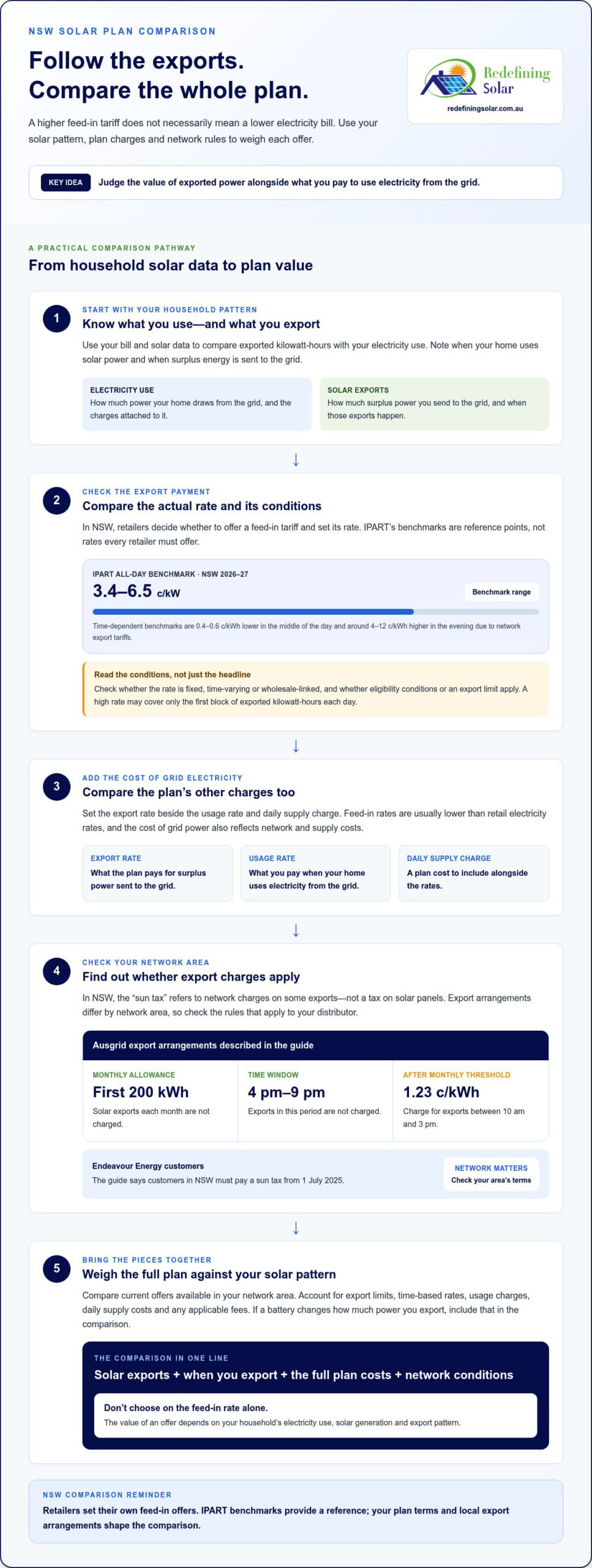
For NSW in 2026-27, IPART’s all-day benchmark range is 3.4 to 6.5 c/kW. Its time-dependent benchmarks are 0.4 to 0.6 c/kWh lower in the middle of the day and around 4 to 12 c/kWh higher in the evening due to network export tariffs.
Distributor and Network Area Differences
Your distributor and network area can affect export charges and the value of a retailer’s offer. In NSW, network export tariffs introduced in 2024 feed into IPART’s time-dependent benchmarks. The origin of an export charge is the local network’s treatment of power sent back to the grid, rather than a single national tariff.
Compare offers available in your network area, including their export limits or charges. A retailer may offer the same headline rate across plans, but network conditions affecting your exports can differ. Include those conditions in your solar feed-in tariff comparison.
| Option | Who sets or publishes it | What to compare |
|---|---|---|
| NSW retailer offer | Electricity retailer | Export rate, usage rate and daily supply charge |
| NSW benchmark | IPART | 2026-27 all-day range: 3.4 to 6.5 c/kW |
| Victoria minimum | Retailer, subject to the floor | 2026-27 average minimum: 0.8 c/kWh; floor: 0.0 cents per kWh |
Victoria’s retailers set their own minimum feed-in rates after the Electricity Industry Act 2000 was amended. To compare Victorian retailers, look at each electricity plan’s actual rate and conditions, not only the average minimum.
Use your bill and solar data to compare exported kilowatt-hours with your electricity use and supply charges. Factor in battery storage if it changes how much power you send to the grid, then assess the full plan before switching.
How NSW retailers set solar feed-in tariffs
NSW retailers decide whether to offer a feed-in tariff and set its rate. Compare each offer’s export conditions and electricity plan terms, not just its headline payment.
NSW Retailer Feed-in Tariff Comparisons
A retailer comparison shows how offers differ in export rates, eligibility conditions and plan charges. Rates can change, so compare current offers against your solar export pattern and electricity use. A household exporting substantial daytime energy may value a feed-in rate differently from one using most of its solar power at home.
IPART’s NSW benchmarks are reference points, not rates every retailer must offer. Compare retailer offers against the plan’s full costs and the amount of solar energy you expect to export.
Standard Retailer Feed-in Tariffs
A standard retailer feed-in tariff is the rate attached to an electricity plan’s standard offer. Unlike a special or time-based offer, it may not vary according to when you export. Read the plan terms to see how the rate applies, including any export limits or eligibility conditions.
Compare the standard rate with usage charges and daily supply costs. Those charges can outweigh a higher export payment if your home draws electricity from the grid at other times.
Fixed, Time-varying and Wholesale-linked Tariffs
A fixed tariff pays the same rate across eligible export periods. A time-varying tariff changes its rate by time; Victoria’s 2025-26 options included different rates for specified periods. A wholesale-linked tariff follows market prices, so its value can change as prices shift.
Check when your panels generate power and when your home exports it. A time-based offer suits your usage only if its higher-rate periods align with your exports.
To switch, compare available plans, then contact your chosen retailer to arrange the change. Any applicable fees depend on the plan terms, so include them in your comparison. Before switching, you can also ask your current retailer to match a competing offer.
Green ratings are a separate consideration: assess a plan’s stated energy credentials alongside its rates and conditions. A green label doesn’t prove that the plan will deliver better solar savings.
If storage could change how much energy you export, explore solar battery options as part of your plan comparison.
Solar export charges and the sun tax
Solar export charges can reduce the value of electricity sent to the grid. In NSW, the “sun tax” refers to network charges that apply to some exports, not a tax on solar panels. Ausgrid and Endeavour Energy customers have different export arrangements, so your network area matters.
From 1 July 2025, Endeavour Energy customers in NSW must pay a sun tax. Ausgrid customers aren’t charged for their first 200kWh of solar exports each month or for exports between 4pm and 9pm. Exports between 10am and 3pm incur a 1.23c/kWh charge after the monthly threshold. Check how those time periods align with your household’s exports.
Some Australian electricity plans limit a high feed-in tariff to the first block of exported kilowatt-hours each day. A lower rate may apply after that cap. Compare the cap with your typical export pattern rather than assuming the headline rate covers every kilowatt-hour your system sends to the grid.
In Victoria, distributor guidance can affect inverter and export limits. United Energy’s general guideline lists a 10kW single-phase solar system size limit. CitiPower/Powercor lists up to 5kW by inverter, while Jemena lists a single-phase inverter limit of up to 10kVA. These are different measures, so don’t treat them as interchangeable.
Using solar electricity at home can reduce the amount you export. Victoria’s government energy site advises that self-consumption usually provides greater savings than exporting solar electricity. Running appliances while your panels generate power can help you use that energy directly; a battery can store surplus power for later.
An export limiter controls how much power an inverter sends to the grid, while solar smoothing manages changes in system output. Neither changes your retailer’s feed-in tariff or removes network charges. Review your inverter settings, export conditions and plan together, especially if your distributor applies time-based charges.
Household solar feed-in tariffs by Australian state and territory
Feed-in tariff offers differ across Australia because retailer plans, network arrangements and legacy schemes vary by location. Most current solar plans offer 1c/kWh to 14c/kWh, while premium rates remain available to eligible participants in some closed schemes.
Use this state-by-state guide to narrow your solar feed-in tariff comparison. Your electricity retailer, network area and the excess energy your solar system exports all affect a plan’s value.
| State or territory | What households should compare |
|---|---|
| New South Wales | Retailer rates and network export charges; the NSW bonus scheme ended in 2016. |
| Victoria | Retailer offers and time-based rates; the regulated minimum ended on 1 July 2025. |
| Queensland | Retailer plans and eligibility for existing premium scheme payments. |
| South Australia | Retailer plans and eligibility for existing premium scheme payments. |
| Western Australia | Compare available retailer terms and local network conditions. |
| Tasmania | Compare retailer rates against your exports and electricity use. |
| Australian Capital Territory | Compare the full energy plan, not just its export rate. |
| Northern Territory | Compare retailer terms and how they value exported excess energy. |
Victoria illustrates that minimum feed-in tariffs can change over time. Retailers cannot set rates below 0.0 cents per kWh. In Queensland and South Australia, premium rates of 40c/kWh and above are limited to eligible existing Solar Bonus Scheme customers.
For a useful solar feed-in tariff comparison, match offers to your state, network and export pattern. Check whether a rate applies all day, varies by time or covers only a capped amount of electricity. Then weigh the export payment against usage rates and daily supply charges. A high rate may matter less if your system exports little surplus energy.
Review your solar system options to consider how your setup and energy use affect the power you export.
Redefining Solar: Battery Ready & Upgrades
Redefining Solar can help you assess how your solar setup fits your electricity use and export pattern. If you’re considering storing surplus power instead of exporting it, Battery Ready & Upgrades can prepare your system for a battery. For a new project, residential and commercial solar systems can be planned around how your property uses energy.
Supply-only solar panels are also available if you’re arranging installation separately. The right next step depends on whether you want to update an existing setup, plan a new system or explore battery readiness. Information about your generation and household or business energy use helps guide that discussion.
Contact Redefining Solar to discuss your solar plans, or visit redefiningsolar.com.au.
Plan your next solar step with confidence
Use your electricity bill and solar generation data to understand how your system works for you. The most useful solar feed-in tariff comparison is grounded in your actual energy use, export pattern and plans for the property. That gives you a practical basis for deciding whether to keep your current setup or consider a change.
If your needs are changing, look beyond the tariff alone. Redefining Solar offers Battery Ready & Upgrades, Residential Solar Systems and Commercial Solar Systems, helping you consider system options alongside how your home or business uses energy.
A steady, well-matched setup starts with understanding what you need from it. Contact Redefining Solar to discuss your next solar step and make a considered plan.
Frequently Asked Questions
How much can I earn from solar?
Your feed-in credit depends on the kilowatt-hours your meter records as exported and the rate your plan pays. To estimate it, multiply exported kilowatt-hours over a billing period by the applicable feed-in rate, then account for any rate tiers or export caps. If a plan pays different rates at different times, calculate each export period separately.
What are the current solar feed-in tariff rates by Australian state and territory?
Most Australian solar plans offer feed-in tariffs from 1c/kWh to 14c/kWh, with offers varying by state and plan. In NSW, IPART’s 2026-27 all-day benchmark range is 3.4 to 6.5 c/kW. In Victoria, the average minimum offered by retailers for 2026-27 is 0.8c per kWh, and the minimum cannot fall below 0.0 cents per kWh. Retail offers differ across networks.
Which Australian electricity retailers offer the highest solar feed-in tariffs?
There isn’t one retailer with the highest rate for every Australian solar household, because offers and conditions vary by location and plan. A headline rate may apply only during certain export periods or to a capped daily amount. Compare plans available in your network area, then weigh the rate against your expected exports, usage charges and supply charge.
What are the eligibility rules and conditions for solar feed-in tariffs in Australia?
Eligibility depends on the retailer’s plan terms, your network connection and your solar system. Eligibility for a feed-in tariff can depend on your solar system and plan conditions. Plans can also set export caps, time-based rates or sign-up conditions. Premium rates of 40c/kWh and above are available only to eligible existing Solar Bonus Scheme customers in South East Queensland and South Australia.
How do solar feed-in tariffs compare with import electricity rates and daily supply charges?
A feed-in tariff credits electricity you export, while import rates apply to power you draw from the grid; the daily supply charge applies separately. To compare their impact, use your bill’s imported and exported kilowatt-hours, apply the relevant rates and include the supply charge. This helps you compare plans if your household uses more power after sunset.
What are the current state-mandated minimum solar feed-in tariffs, if any?
Victoria has a minimum floor of 0.0 cents per kWh from 1 July 2025; the state no longer has a regulated minimum rate. For 2026-27, Victorian retailers’ average minimum offer is 0.8c per kWh. In NSW, retailers may choose whether to offer a feed-in tariff and set their rates, while IPART’s benchmark is guidance rather than a retailer minimum.