The lowest quote doesn’t always deliver the best value. Water heating accounts for about 25 percent of average household energy use in Australia, according to the Australian Government Department of Climate Change, Energy, the Environment and Water, so the solar thermal system cost-versus-savings balance depends on how much of your hot-water demand the system can meet.
It’s reasonable to want a clear picture of the upfront solar thermal system cost vs savings over time. A quote is meaningful only in context: the system design, your hot-water use and the conditions at your property all affect performance and value.
This article explains what affects installation costs and potential savings, and how to compare quotes fairly. You’ll see why system size, site conditions and everyday hot-water demand matter, so you can weigh the trade-offs instead of relying on a headline figure.
Key Takeaways
- Estimate potential bill savings by considering how much hot water your household uses and when it’s needed.
- Assess payback by weighing the system’s upfront cost against its ongoing energy savings and performance.
- Compare solar thermal, heat pump and solar PV options by how each meets your home’s energy needs.
- Check how incentives differ across Australian states and territories, as they can affect the overall value.
How much can a solar thermal system save on annual energy bills in Australia?
Water heating accounts for about 25 percent of average household energy use in Australia, according to the Australian Government Department of Climate Change, Energy, the Environment and Water. That share shows why heating water with sunlight can affect household energy costs. The actual bill reduction depends on how much hot water your household uses, the energy source it replaces and when you use it.
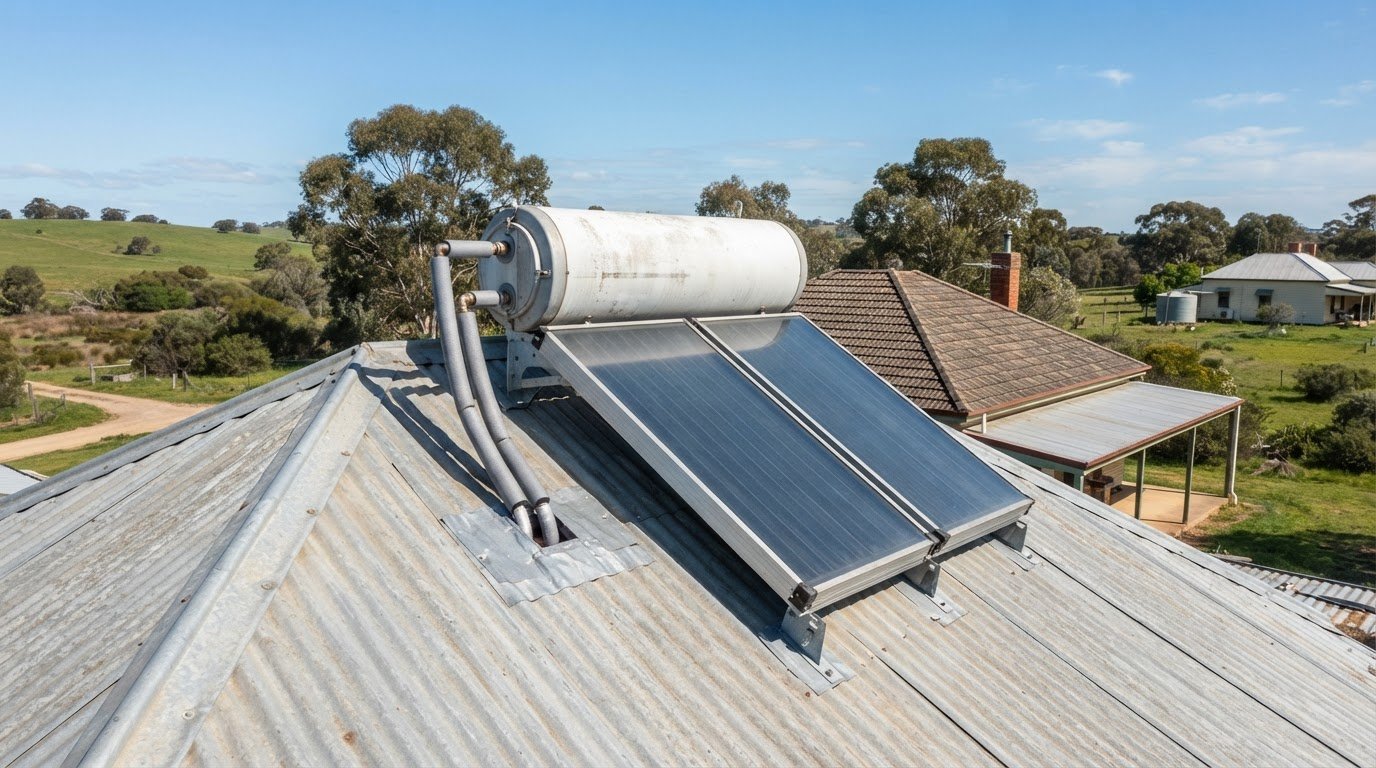
A solar thermal system collects heat from sunlight and transfers it to water in a storage tank. When you use hot water, that stored heat can reduce the energy your usual water heater needs. A household with higher hot-water demand may have more opportunity to replace conventional heating, while lower demand can leave some collected heat unused. The key comparison is how much hot water your household uses against how much solar heat the system can provide.
System performance varies with weather and site conditions. One estimate found collectors’ annual energy output could vary by about 10-20% per year depending on the weather. Another estimated that a particular system supplied about 95% or more of a dwelling’s domestic hot-water load. These are examples, not a universal result. Orientation, shading, seasonal sunlight, tank capacity and household demand all affect how much solar heat reaches your taps.
To understand annual savings, consider the energy your existing water heater would otherwise consume across the year. Daily use matters: household size, showers, laundry and hot-water habits change demand from one home to another. Annual hot-water demand is calculated by multiplying daily demand by 365 days. Then consider whether solar heat meets that demand when needed, or whether another heat source must fill the gap. This is why a sound estimate connects the system’s expected output with your actual hot-water use, rather than relying on collector performance alone. The result is a clearer basis for assessing the solar thermal system cost-versus-savings balance, without treating an example as a promise of your household’s bill reduction.
What is the typical payback period for solar thermal hot water in Australia?
A simple payback estimate shows how long it may take for accumulated bill savings to equal the system’s upfront cost. There is no single period that applies to every Australian installation. You need two project-specific figures: the total installed cost and the estimated annual reduction in water-heating bills. Divide the installed cost by the annual savings to estimate simple payback.
A home that uses more solar heat in place of conventional water heating may build savings faster than one with lower hot-water demand. Savings also depend on which energy source the system replaces. Electricity or gas tariffs, household routines, available sunlight and the amount of backup heating required all affect the result. A sound estimate matches expected solar heat with the household’s actual hot-water use.
Don’t use general rooftop solar payback figures as a substitute. An Australian residential solar system is estimated to return its cost in 3 to 5 years, but that figure concerns solar systems generally, not a typical solar thermal hot-water installation. Solar photovoltaic panels generate electricity, while solar thermal collectors heat water directly. Their equipment, energy output and bill savings are different, so the payback calculation must suit the technology being assessed.
Compare quotes on the same assumptions. Check that each accounts for the installed system, expected hot-water demand, the energy source being replaced and any ongoing costs included in the estimate. Then compare projected annual savings as well as the upfront price. If one quote assumes solar will cover most hot-water use and another allows for substantial backup heating, their payback estimates are not directly comparable.
A payback estimate is a forecast, not a guaranteed bill outcome. Weather affects how much heat collectors capture, and household routines determine how much of that heat is used. Consider the estimate alongside system performance and expected service life. This gives you a more useful basis for assessing the investment than treating a general solar payback figure as a benchmark for solar thermal.
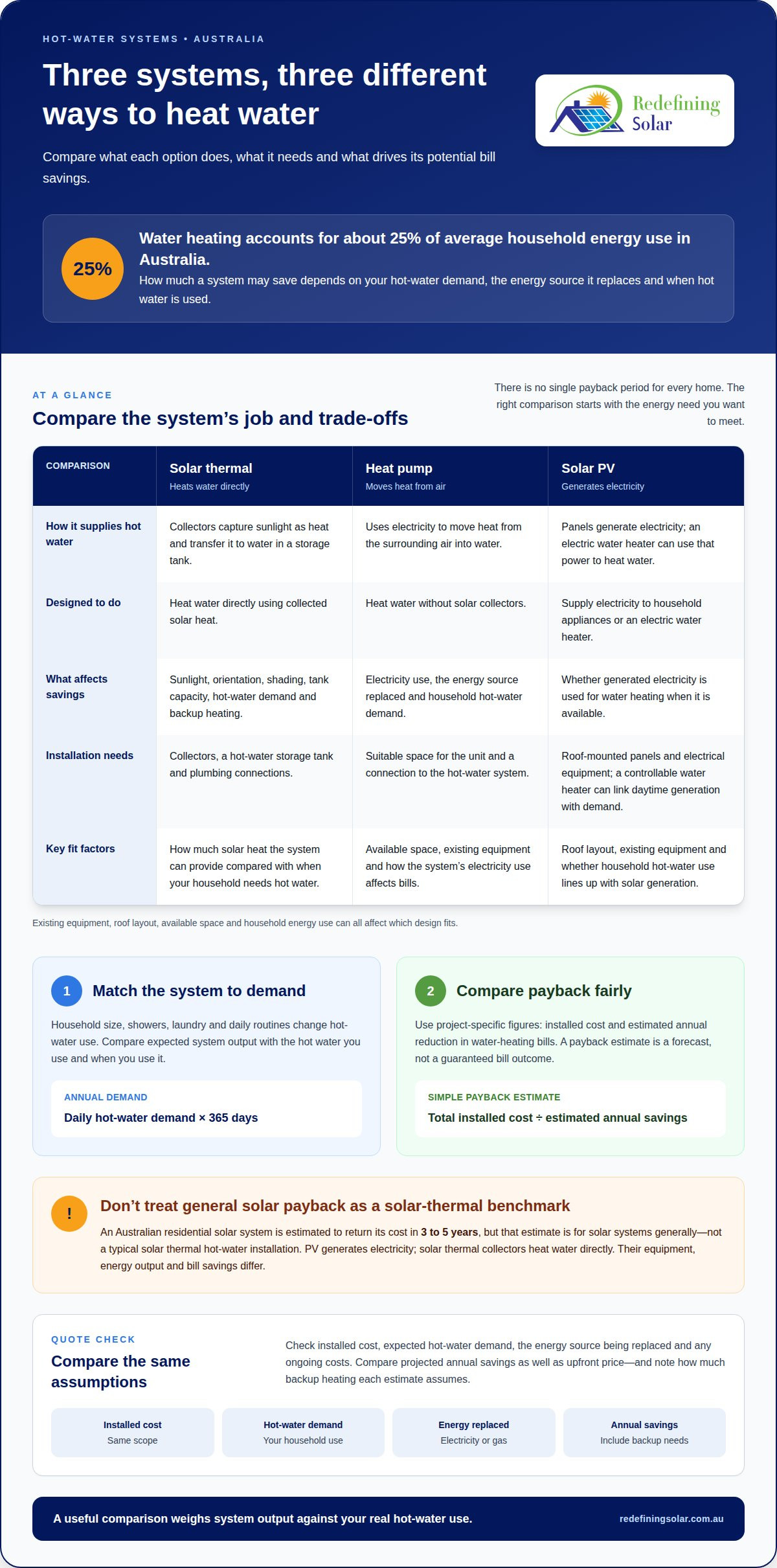
How do solar thermal hot water costs and savings compare with heat pump and solar PV systems?
Solar thermal, heat pump and solar photovoltaic (PV) systems reduce energy use in different ways. Solar thermal collectors capture sunlight as heat and transfer it to stored water. A heat pump uses electricity to move heat from the surrounding air into water. Solar PV panels generate electricity for household appliances or an electric water heater. Start your comparison with the job you need the system to do.
For hot water alone, solar thermal is designed to heat water directly. Its performance depends on sunlight, storage and household demand. A heat pump can heat water without solar collectors, but its electricity use affects potential bill savings. Solar PV can supply several electrical loads; its contribution to hot-water savings depends on whether generated electricity is used to heat water when it is available.
Each option has different installation requirements. Solar thermal needs collectors, a hot-water storage tank and plumbing connections. A heat pump needs suitable space for its unit and a connection to the hot-water system. Solar PV uses roof-mounted panels and electrical equipment; a controllable electric water heater can link daytime generation with hot-water demand. Existing equipment, roof layout, available space and household energy use help determine which design fits.
Compare potential savings by identifying the energy source each system replaces and how it supplies hot water throughout the day. A household with high daytime hot-water use may use available solar PV electricity directly, while solar thermal stores collected heat in water. A heat pump’s electricity demand and operating pattern also affect running costs. A PV payback estimate does not automatically apply to solar thermal or a heat pump.
Installed prices depend on the system design, site conditions, storage and required plumbing or electrical work; the price is provided after a quote request. A useful comparison sets out those costs alongside expected hot-water performance and likely energy savings. That makes the trade-offs clearer than comparing equipment names alone, and helps you assess which system best suits your household’s hot-water needs.
What rebates, certificates, or incentives are available for solar hot water in each Australian state and territory
There is no single incentive figure that applies across Australia. Rebates and certificate values depend on the program, eligible equipment and installation requirements. For solar hot water, distinguish a government rebate from a certificate benefit: a rebate is a direct program discount, while certificates may affect the quoted cost when the relevant scheme and equipment qualify.
Compare incentives by jurisdiction and check whether a program covers solar water heating or only solar electricity generation. A rooftop solar PV incentive does not automatically apply to a solar hot-water system. A program for replacing an existing water heater may also have different conditions from one supporting a new installation. Ask for any assumed incentive to be itemised in the quote, separately from the system price.
For a state-by-state comparison, use the same criteria for each Australian jurisdiction:
- New South Wales: Identify whether the applicable program covers solar hot water and your type of installation.
- Victoria: Distinguish hot-water incentives from support for rooftop solar or batteries.
- Queensland: Check the equipment and installation conditions attached to any relevant incentive.
- South Australia: Separate solar hot-water support from schemes aimed at household electricity systems.
- Western Australia: Confirm whether the program applies to your location and proposed system.
- Tasmania: Assess eligibility for the particular hot-water technology and installation.
- Australian Capital Territory: Review the program conditions for solar water heating specifically.
- Northern Territory: Check whether the incentive covers the system type and property location.
For certificates, check how their value is treated in the quote and whether eligibility depends on the selected equipment. Do not count the same incentive twice, first as a discount and then as a reduction in system cost. A clear quote should state the incentive assumed and the amount payable after it, making it easier to compare options on the same basis.
If you’re weighing system design alongside incentive eligibility, discuss solar hot-water options for your property.
Redefining Solar: Residential Solar Systems
Redefining Solar designs and installs residential solar systems to help households assess their energy options and make use of solar generation. System design is tailored to your energy use, roof and plans for storage.
If you’re considering solar panels alongside hot-water improvements, it helps to understand how each option meets your energy needs. Redefining Solar offers residential solar systems, battery-ready upgrades and solar panel supply, as well as solar thermal water heating systems. Businesses can discuss commercial solar systems for their properties.
Share what you’re hoping to achieve and what you want your system to support. Contact Redefining Solar to discuss your solar project.
Make your next decision with a clear purpose
Before choosing a system, decide what matters most: reducing reliance on your current water heater, supporting a broader energy plan or keeping the design straightforward. That priority helps focus the decision on suitable equipment and performance, rather than an appealing payback figure in isolation. The solar thermal system cost-versus-savings balance is useful when it reflects what you need the system to do day to day.
Redefining Solar supplies and installs solar thermal water heating systems, and can discuss how one may fit your household’s energy needs. Be ready to describe your hot-water use, existing setup and priorities. A free solar assessment can help clarify the relevant options and a suitable next step.
Contact Redefining Solar to discuss your options and take the next step with confidence.
Frequently Asked Questions
What is the installed cost of a solar thermal hot water system in Australia?
There is no single installed price for every Australian home. Cost depends on system design, roof access, existing hot-water equipment and required plumbing work. Compare what each quote includes, such as collectors, a storage tank, installation and any changes needed to connect the system to your home.
How do household size, hot water use, and climate affect solar thermal system costs and savings?
Household size and routines affect how much hot water a system needs to supply. A home with frequent showers and laundry, for example, has a different demand profile from one with fewer occupants. Climate also affects the sunlight available for collecting heat throughout the year. Together, these factors influence system design, backup heating and how much conventional water heating solar energy can replace.
What roof, plumbing, and installation factors affect the price of solar thermal hot water?
Roof shape, orientation, shading and access affect collector placement and installation. Plumbing matters too: the distance between collectors, storage and existing hot-water connections can influence the work involved. The condition and layout of current equipment may also affect how the system connects. A property-specific quote should reflect these site details and the installation scope.
How can homeowners estimate solar thermal hot water savings using local tariffs and hot water usage?
Start by identifying your household’s hot-water use and the energy source currently heating it. Estimate how much of that heating solar energy could replace, then apply your current tariff to the displaced energy. Use the relevant usage rate for electricity or the applicable gas charge. Allow for backup heating and seasonal variation, then compare the estimated annual reduction with the quoted installed cost.