The biggest solar system your roof can hold may not be the right fit for your business. A suitable size depends on when you use electricity, how much the panels can generate, available roof space, shading and what your local network allows. For small to medium Australian businesses, 10 kW is a useful starting point, while commercial systems commonly range from around 10 kW to installations exceeding 100 kW. This commercial solar system sizing guide explains how to find a size that suits your demand and site.
It’s understandable to look for one ideal system size, but the same capacity can suit businesses with different operating hours and energy use. Compare your consumption patterns with the site’s practical limits to make a more informed choice.
This guide explains how demand patterns and panel output shape capacity, and how roof space, shading, budget and network limits affect what can be installed. Use it to understand your options before moving towards a commercial solar system design.
Key Takeaways
- Use your business’s electricity-use patterns to judge how much solar generation can be used on site, rather than sizing from total consumption alone.
- Relate panel capacity and expected output to monthly electricity use to build a more practical estimate of the system size you need.
- Factor in usable roof area, orientation, shading and network limits, as these can affect what fits and how much energy can be exported.
- Bring demand, site conditions and future energy needs together when assessing a system, so the final design suits how your business operates.
Roof space, shading, budget and network restrictions
Usable roof area, sunlight, project budget and network limits all affect the system size a business can install. They also influence how much solar electricity the business can use on site rather than export.
Assessing Roof Space and Panel Weight
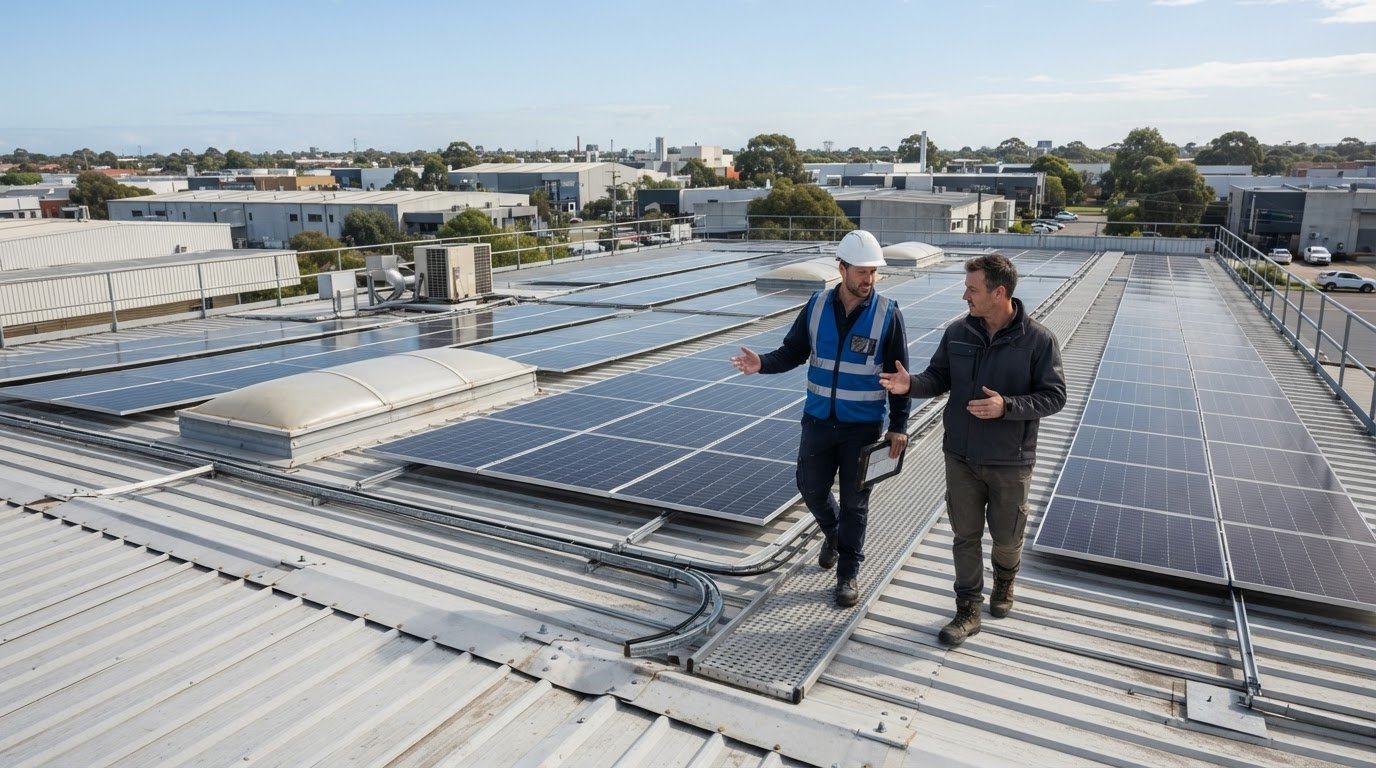
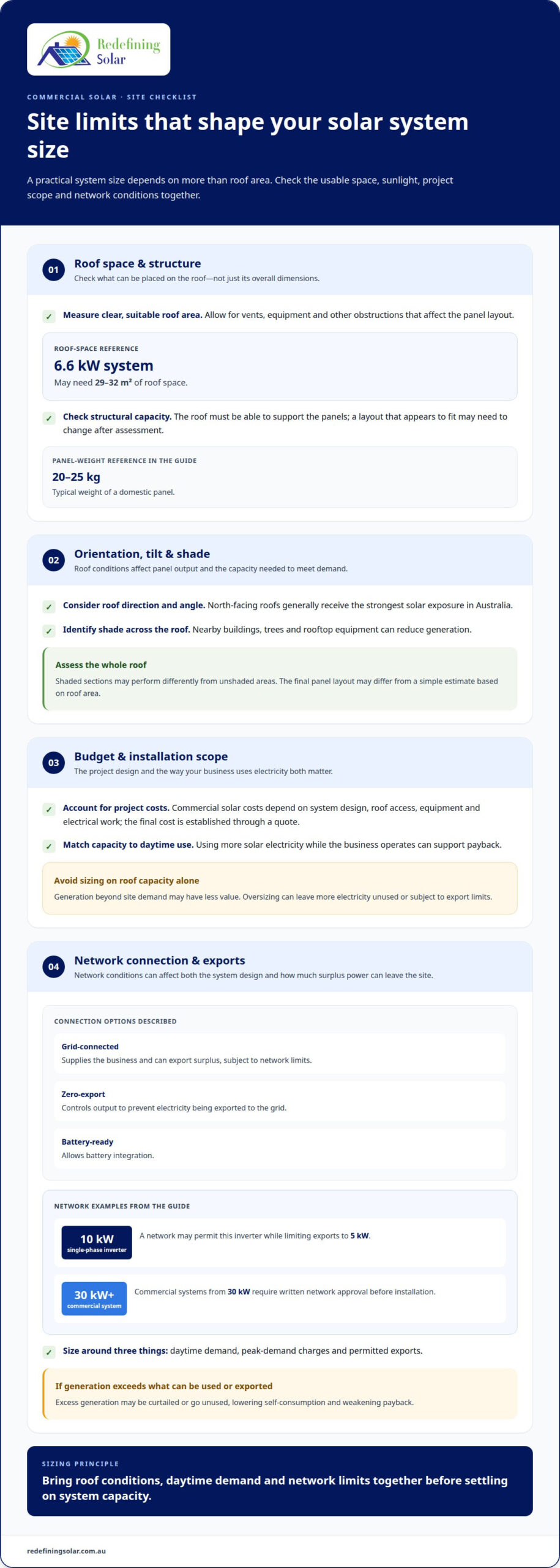
Roof assessment measures clear, suitable space and considers whether the structure can support the panels. A 6.6 kW system may need 29-32 square metres of roof space, while a typical domestic panel weighs 20-25 kg. Roof dimensions, obstructions and structural capacity therefore affect how many panels installers can place. A system that fits on paper may need a different layout if vents or equipment take up usable space.
Accounting for Orientation, Tilt and Shading
Roof orientation, angle and shade affect panel output, so they influence how much capacity may be needed to meet your demand. North-facing roofs generally receive the strongest solar exposure in Australia. Nearby buildings, trees and rooftop equipment can cast shade and reduce generation. An assessment should consider conditions across the roof, as shaded sections may perform differently from unshaded areas. The final layout may therefore differ from a simple estimate based on roof area.
Budget and Installation Costs
Budget affects the capacity and installation scope a business can take on. Commercial solar costs in Australia depend on the system design, roof access, equipment and electrical work, so the final cost is established through a quote. Sizing should also reflect daytime loads and demand charges. Using more solar electricity while the business operates can support payback, while generation beyond site demand may have less value. Oversizing can leave more electricity unused or subject to export limits.
Grid Connection and Export Restrictions
A grid-connected system can supply the business and export surplus, subject to network limits; a zero-export design controls output to prevent grid exports, while a battery-ready system allows battery integration. A network may permit a 10 kW single-phase inverter but limit exports to 5 kW. Commercial systems from 30 kW require written network approval before installation. Size the system around daytime demand, peak-demand charges and permitted exports: excess generation may be curtailed or go unused, lowering self-consumption and weakening payback.
Commercial solar system capacity and panel output
System capacity is the combined rated power of the panels; actual output varies with operating conditions. The design also needs to suit your roof, inverter and electricity use.
Australian commercial installations must address applicable standards, including AS/NZS 4777 and AS/NZS 5033, as well as network connection requirements. These affect the system design and approval process.
Panel Capacity and System Size
System size, measured in kilowatts (kW), is the combined rated capacity of its solar panels. One kilowatt equals 1,000 watts, making panel ratings easier to add together. Commercial systems in Australia commonly range from around 10 kW to installations exceeding 100 kW. Knowing the combined capacity helps you compare designs against your demand, roof area and expected generation, rather than relying on panel count alone.
Panel Wattage and Panel Count
Panel wattage indicates each panel’s rated power; dividing the target system capacity by panel wattage estimates the panel count. Standard commercial panels are described as generating around 300-400 watts each. For example, a 30 kW array using 400-watt panels would need 75 panels by rated capacity. Actual output varies with conditions, so this calculation estimates system size, not daily energy production.
Inverter-to-Panel Sizing
The inverter converts the panels’ direct-current electricity into alternating current for business use and grid connection. Its capacity is considered alongside total panel capacity, the site’s electrical supply and network conditions. A 6.6 kW system is often paired with a 5 kW inverter. Commercial systems of 100 kW capacity or smaller may be eligible for Australia’s STC incentive; systems over 100 kW are not eligible for STCs and must instead claim LGCs.
Common System Sizes and Business Returns
A 30 kW commercial system generates about 120 kWh daily on average over a year in Australia. Savings depend on how much generation your business uses on site, alongside its electricity tariffs and operating pattern. Commercial systems can commonly achieve payback within 5 years, as of early 2025, but project results depend on those same factors. Installed costs vary with system capacity, equipment, roof access and electrical work; pricing depends on the project and is provided after a quote request.
Which size solar system is best?
A suitable system size reflects your business’s electricity use and how much of that demand solar can meet. Annual bills show total consumption, while interval data reveals when electricity is used.
Sizing from Electricity Consumption
Use your electricity consumption as a starting point, then compare expected solar generation with demand during operating hours. Review a full year of bills to account for seasonal changes, and use interval data to see when loads occur. Smart meters record electricity use every 15 or 30 minutes. A smart or interval meter user can request 12 months of interval data from their distribution network service provider.
Monthly consumption can help estimate panel numbers. About 30 standard solar panels may produce 1,000 kWh of electricity per month; 21 larger 400-watt panels may produce the same amount. These figures offer a planning reference, not a substitute for matching generation to your business’s actual usage. A daytime-heavy business can use more solar directly than one with most demand outside operating hours.
Accounting for Location and Consumption
Location affects solar generation, so system estimates should reflect the conditions at your business site. Australian businesses should also consider seasonal changes, including increased air-conditioning use in summer. A system’s expected output across the year can differ from its generation on a sunny day, making annual estimates more useful for comparing capacity with annual consumption.
Look beyond total electricity use and identify which loads run during daylight. Equipment operating through business hours, for example, can use solar as it is generated, while evening demand may need another source. Household averages are a poor substitute for business records because operating hours and equipment loads differ. Use bills and interval data together to estimate a system size that matches your consumption pattern and local generation conditions.
Factors affecting commercial and rooftop solar system sizing
Solar sizing balances electricity demand with the solar power a site can use and its connection can accept. A calculator can estimate capacity from consumption and location, but it cannot replace a site-specific assessment. The best fit may be smaller than the roof’s maximum panel capacity if daytime electricity use is low or exports are restricted. This distinction matters when weighing upfront investment against useful generation. A commercial solar system sizing guide helps you assess these trade-offs against how your site operates.
Generation estimates should reflect local conditions, not panel ratings alone. Australian panels can produce some electricity on cloudy days and during winter, but output changes with sunlight and season. System losses, including inverter efficiency, can reduce estimated output by 10-20%. A calculator that ignores those losses may overstate the solar power available to meet your loads. Compare estimated generation with operating hours, seasonal air-conditioning demand and electricity used during daylight.
Connection capacity also shapes the practical system size. With a 10 kW-per-phase connection limit, a single-phase supply could connect an inverter up to 10 kW; a three-phase connection could support an inverter up to 30 kW. These examples describe connection capacity, not guaranteed export permission. Some Australian councils require approval for solar systems larger than 10 kW, so local requirements can also affect the design and timing.
Start with interval consumption, then compare expected generation with daytime demand and network limits. If you expect electricity use to rise, that may increase the value of a larger system; if current loads are low, a smaller design may better match usage. The key question is not simply how many panels fit. It is how much energy the site can use, connect and sensibly fund after estimated output losses. Use a commercial solar system sizing guide to organise these factors before settling on a design.
For a site-specific assessment of commercial solar sizing, discuss your business’s solar requirements.
Redefining Solar: Commercial Solar Systems
Redefining Solar designs and installs commercial solar systems for Australian businesses considering system size. We bring your electricity demand, operating hours, roof conditions and network constraints together in a design suited to your site. When you’re ready to move from estimates to a practical system plan, request a free solar assessment.
If you’re considering battery storage in the future, battery-ready upgrades can form part of your planning. Start with a clear picture of how your business uses electricity and what the site can support. Redefining Solar can translate those details into a commercial solar system design.
Contact Redefining Solar to discuss your business’s solar requirements.
Plan for the way your business will grow
A solar system should support the business you’re building, not just how it operates today. Changes to trading hours, equipment or site use can shift when and how much electricity you need. Include those plans in the design discussion so the proposed system remains relevant as your operations develop.
A commercial solar system sizing guide can help you understand what shapes a suitable design. The next step is applying those factors to your site and business goals. Redefining Solar can help turn that information into a considered commercial solar proposal centred on your operating needs.
Take the next step at a pace that suits your business. Contact Redefining Solar to discuss your commercial solar plans and explore a practical way forward.
Frequently Asked Questions
How Much Power Can You Expect?
Your system’s kilowatt rating describes the panels’ maximum capacity, not the electricity they produce continuously. Actual generation changes as sunlight shifts throughout the day, so a rooftop array produces variable output rather than a constant amount. For planning, consider expected generation across a typical day or year, then compare it with the hours your business needs power.
How much electricity will my system generate?
Expected generation depends on system capacity, location and operating conditions. Ask for estimates across the year, not just for a peak-sun day, because seasonal patterns affect production. Then compare the generation profile with your business’s consumption profile. A site with steady daytime equipment use, for example, can use solar generation differently from one whose main loads run after sunset.
How to size a commercial battery alongside solar, and when is battery storage worthwhile?
Size a commercial battery around the electricity you regularly have left over during the day and want to use later. Compare surplus solar generation with after-hours demand, then consider how much stored energy your business can use. Battery storage is more relevant when daytime production regularly exceeds immediate demand and later electricity use can draw on the stored supply. It may add little value if little surplus is available.