The installer’s accreditation number is the starting point, not the whole check. To learn how to check if a solar installer is accredited, ask for their Solar Accreditation Australia (SAA) number and verify their current status before seeking a quote. Then check the relevant electrical licence and public liability insurance details.
Look beyond the panels: accreditation can apply to professionals who design or install grid-connected solar, batteries and standalone power systems. Knowing what to check helps you identify who is responsible for the work and whether their credentials match the job.
This guide explains how to check accreditation, what to look for in licences and insurance, and how these checks apply to solar and battery work. It also explains why each person’s role matters, helping you make an informed decision before signing a contract.
Key Takeaways
- Confirm the installer’s current accreditation and that it covers the work they’ll do on your system.
- Check that the relevant electrical licence and public liability insurance details are in order.
- Accreditation can apply to professionals who design or install solar, battery and standalone power systems.
- Before signing, review the proposed components and the contract’s coverage for installation, warranties and support.
1. Solar Accreditation Australia as the accreditation scheme operator
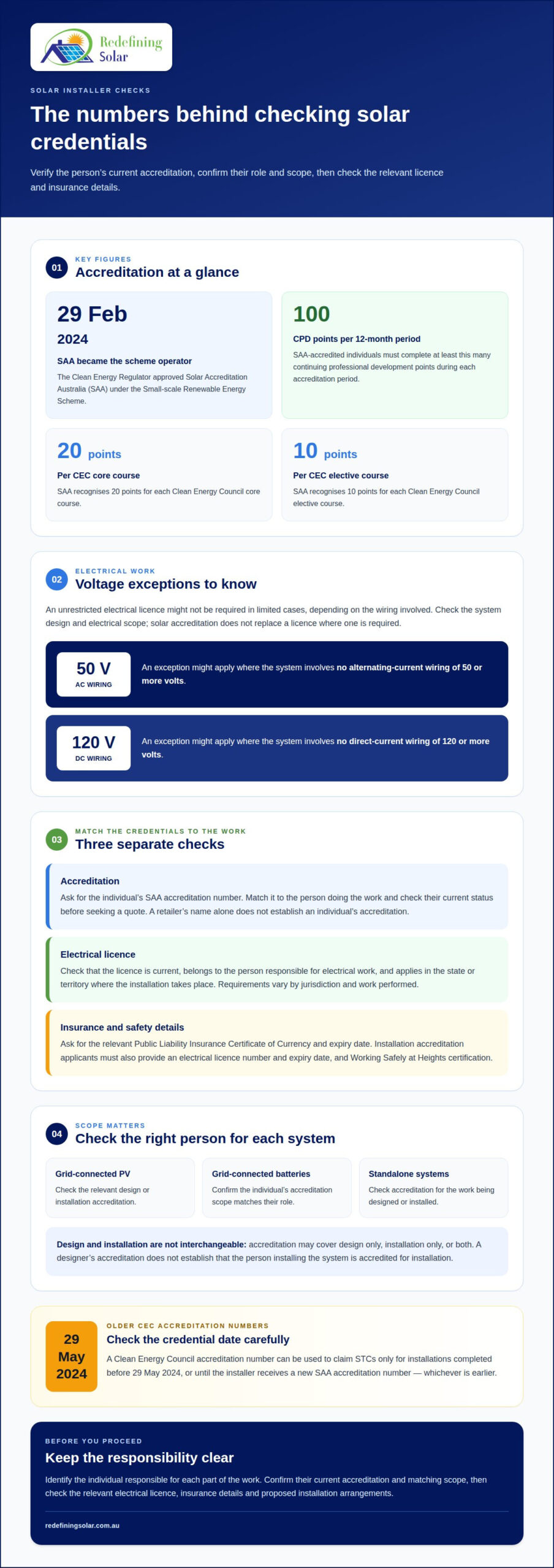
Solar Accreditation Australia (SAA) manages installer and designer accreditation for solar work in Australia. The Clean Energy Regulator approved SAA as the accreditation scheme operator under the Small-scale Renewable Energy Scheme on 29 February 2024. SAA became responsible for accreditation on that date, following a three-month transition from the Clean Energy Council.
This change matters when checking an installer’s current credentials. Solar Accreditation Australia advises customers to ask for the installer’s accreditation number and check their status before seeking a quote. To check whether a solar installer is accredited, match the number to the individual doing the work, then confirm their status using SAA’s accreditation check. A retailer’s name alone does not establish an individual installer’s accreditation.
SAA accreditation covers professionals who design or install eligible solar systems, including grid-connected photovoltaic and battery systems. Accreditation can be for design only, installation only, or both, so check that the person’s scope matches their role. Accredited individuals must also complete mandatory courses by their due dates and meet continuing professional development requirements during their accreditation period.
Accreditation supports work carried out in line with Australian Standards, SAA guidelines and other regulations. If a design or installation is reported as failing relevant requirements, SAA contacts the responsible accredited person about the issue and any required remedial action. That makes it important to identify the individual responsible, rather than relying only on a retailer or business name.
If an installer is unaccredited, pause before proceeding and ask for their current accreditation details. If you believe work breaches Australian solar standards, raise the concern with SAA. When notified, SAA contacts the responsible accredited person about the issue and any remedial action.
2. Installer licensing and insurance requirements
Accreditation and licensing are separate checks. Requirements vary across Australia: some jurisdictions require solar installers to be accredited, and some also require an electrical contractor’s licence or an appropriate builder’s licence. The licence required depends on the jurisdiction and the work being performed.
For electrical work, an accredited installer must generally hold an unrestricted electrical licence in the state or territory where the installation takes place, subject to stated exceptions. Check that the licence is current, belongs to the person responsible for the electrical work, and applies where your property is located. A licence from another jurisdiction may not meet local requirements.
There are limited voltage-related exceptions. An unrestricted electrical licence might not be required where a system involves no alternating-current wiring of 50 or more volts, or no direct-current wiring of 120 or more volts. These thresholds relate to the wiring involved, so the system’s design and electrical scope matter. Don’t assume a general solar accreditation replaces an electrical licence where one is required.
Insurance is another practical check. Applicants for SAA installation accreditation must provide an electrical licence number and expiry date, Working Safely at Heights certification, and a Public Liability Insurance Certificate of Currency with its expiry date. These are applicant requirements. Ask for the relevant details and compare names and dates with the proposed installation arrangements.
Keep the distinction clear: accreditation relates to the installer’s solar scheme status, while an electrical licence relates to regulated electrical work. Insurance provides a separate layer of cover. If you’re weighing system options while reviewing these credentials, explore solar system planning alongside your licensing and insurance checks.
3. Accreditation for solar, battery and standalone power system professionals
Solar Accreditation Australia (SAA) accredits individuals working across several clean energy system types. This includes professionals who design or install grid-connected photovoltaic systems, grid-connected battery systems and standalone power systems. For Small-scale Technology Certificates (STCs), the relevant individual must hold accreditation under the SAA Scheme. Check whether their scope is design only, installation only, or both, and confirm it matches the work.
This distinction helps identify who is responsible for each part of a project. A designer’s accreditation, for example, does not show that the person installing the system is accredited for installation. SAA provides nationally recognised accreditation for professionals working with consumer energy resources, including solar, batteries and smart energy systems. Match each person’s role to the relevant accreditation category.
Accreditation also involves ongoing learning. SAA-accredited individuals must complete at least 100 continuing professional development points during each 12-month accreditation period. SAA recognises 20 points for each Clean Energy Council core course and 10 points for each Clean Energy Council elective course. These requirements help keep accredited installers and designers engaged with current practices.
Applicants provide photo identification, a selfie and a copy of their training certificate. Installation accreditation applications also require an electrical licence number and expiry date, Working Safely at Heights certification, and a Public Liability Insurance Certificate of Currency. These requirements give the accreditation scheme information about identity, training and relevant work credentials.
Check the accreditation number’s date carefully if it relates to an older Clean Energy Council credential. A Clean Energy Council accreditation number can be used to claim STCs only for installations completed before 29th May 2024 or until the installer receives a new SAA accreditation number, whichever is earlier. For installations from 30 May 2024, an SAA accreditation number must be used, or from the date the installer receives the new number, whichever is earlier. Also check quoted panels, inverters and batteries against the Clean Energy Council’s approved products list.
4. What accreditations, licences, insurance and warranties should I check before signing a solar contract?
Before signing, match the named installer’s Solar Accreditation Australia status and accreditation scope to the work. For rooftop solar, an accredited installer is required for the buyer to access Australian Government rebates under the Small-scale Renewable Energy Scheme. For installations from 30 May 2024, the installer’s SAA accreditation number must be used to claim STCs, or the date they receive their new number, whichever is earlier.
Review the licence and insurance information for the people responsible for installation. Check that the electrical licence applies in the state or territory where the work will take place, and note its expiry date. The Public Liability Insurance Certificate of Currency should identify the insured party and show its expiry date. Compare those details with the business and installer names in your contract so responsibilities are clear.
Read the contract’s warranty terms before committing. Identify what each warranty covers, its duration, any exclusions and how to make a claim. Distinguish equipment coverage from installation-work coverage, and check which business handles support if a component needs attention. The contract should name the panels, inverter and battery being supplied. Check those components against the Clean Energy Council’s approved products list.
Consumer protections matter too. The New Energy Tech Consumer Code is a voluntary code for solar and battery retail businesses. The Clean Energy Council’s NETCC service lets consumers search retailers committed to consumer protection; approved retailers meet standards covering sales, quotes, contracts, installation, warranties and support. The Australian Government recommends getting quotes from at least 3 suppliers, giving you a basis for reviewing contract details and support arrangements.
Solar Accreditation Australia says accredited installers help ensure systems are safe and compliant, with proper shutdown, labelling and emergency access. If you’re planning a home or business system, explore solar system options before settling on a contract.
Redefining Solar
Redefining Solar can help you move from checking credentials to planning a solar project. If you’re considering residential or commercial solar, a battery-ready upgrade or solar panel supply, the team can discuss system options suited to your property and energy needs. Clear information about the proposed work and equipment makes it easier to review accreditation, licensing and contract details before deciding how to proceed.
Bring your project requirements and questions about the system scope to the conversation. Redefining Solar can help you understand the next steps for your solar project and keep the process straightforward.
Contact Redefining Solar to discuss your solar project.
Take your solar plans forward with confidence
Knowing how to check if a solar installer is accredited gives you a stronger starting point. Your next decision is choosing a system that suits your property and plans. Consider what you want solar to support, whether that’s household energy use, a commercial site or the option of adding a battery later. A clear brief keeps conversations focused on the outcome you need, not just technical details.
Redefining Solar offers Residential Solar Systems, Commercial Solar Systems and Battery Ready & Upgrades. If you’re ready to explore a project, share what you hope to achieve and discuss the next steps with the team.
Contact Redefining Solar to talk through your solar plans. A considered next step can make the process feel more manageable.
Frequently Asked Questions
How do I check if a solar installer is accredited by Solar Accreditation Australia (SAA)?
Ask for the individual installer’s SAA accreditation number, then use Solar Accreditation Australia’s accreditation status check to search it. Confirm that the result matches the installer’s name and the work they’ll perform. If one person designs the system and another installs it, check that each person’s accreditation covers their role. A retailer’s credentials do not replace checking the individual installer.
Where can I search the SAA accredited installer directory in Australia?
Use Solar Accreditation Australia’s online accreditation search to look up an installer using their accreditation details. Start with the number they provide, then compare the result with the person named in your quote or contract. If you’re given only a business name, ask which accredited individual will be responsible for the design or installation. This distinguishes a company’s trading identity from an individual’s current accreditation.
What SAA accreditation categories are required for rooftop solar PV installation and battery storage?
The relevant category depends on the professional’s role and the system. SAA accreditation can cover design-only, installation-only, or design-and-install work for grid-connected photovoltaic and battery systems. A designer-only credential, for example, does not establish that the same person is accredited to install the system. Check the category against the tasks in the project documents, including any battery work.
How can I verify an installer’s electrical licence in my Australian state or territory?
Use the electrical licensing register or licence-checking service for the state or territory where the installation will take place. Search by licence number and the individual’s name, then confirm the licence is current and appropriate for the work. If the installer works across state borders, a licence issued in one jurisdiction may not cover work in another. Keep the licence details with your contract records.
How do I confirm an installer and retailer are approved for state solar rebates or battery incentives?
Check the current eligibility rules for the specific incentive, because state and territory programs can set different conditions for systems, installers and retailers. SAA accreditation supports eligibility for Small-scale Technology Certificates, but does not by itself establish eligibility for every state rebate or battery incentive. Confirm the program’s requirements for the installation professional and retailer, and check that your proposed system meets them.
How can I spot fake or expired solar accreditation claims?
Look for mismatches between the person’s name, accreditation number and status in Solar Accreditation Australia’s search. Treat a certificate or logo as supporting material, not a substitute for checking the current record. Compare any expiry information on documents with the current status. If a quote names a different installer from the person whose credentials were supplied, ask for the responsible individual’s details before agreeing to the work.