A 25-year solar panel warranty doesn’t mean every part of the panel is covered for 25 years. In Queensland, 25 years is standard for a panel’s performance warranty, but materials and construction cover is commonly around 10 years. Knowing what to look for in a solar panel warranty means understanding what each type protects, not just comparing the number of years.
It’s reasonable to expect long-term cover for panels designed to produce power for many years. A performance warranty sets out how much electricity a panel should still produce over time. A product warranty, also called a materials and construction warranty, covers defects in the panel itself. The two warranties can have different terms, exclusions and claim requirements.
This guide explains how performance, product and installation warranties differ, what a 25-year promise can mean in practice, and why the panel’s physical construction deserves close attention. You’ll also learn which details in the warranty terms can affect your protection, so you can assess the cover with greater confidence.
Key Takeaways
- A 25-year performance warranty describes a panel’s expected output over time, not necessarily how long its physical components are covered.
- Compare the output thresholds at different points in the warranty, rather than relying on the headline term alone.
- Materials and construction cover commonly lasts around 10 years; coastal Queensland conditions make corrosion protection another useful detail to understand.
- In Australia, importers are responsible for manufacturers’ warranties, so knowing who stands behind the product can matter when seeking a remedy.
Is a 25-year solar panel warranty standard in QLD?
Across the Australian market, 25 years is standard for a solar panel performance warranty, but physical product cover can be shorter. Knowing what to look for in a solar panel warranty starts with separating these two promises and reading their conditions.
Product warranty coverage and duration
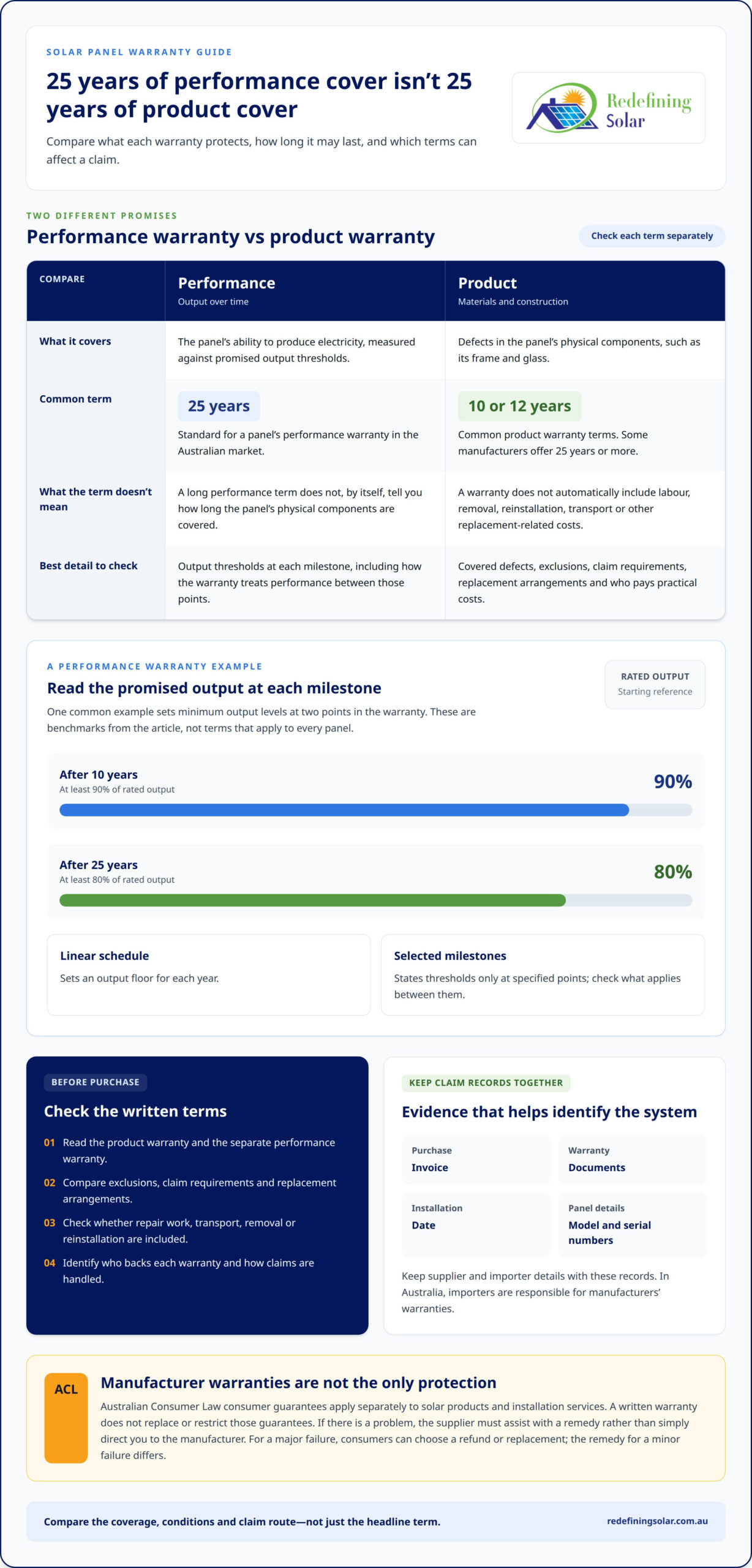
A product warranty covers defects in a panel’s physical components, such as its frame and glass. Solar panel product warranties commonly last 10 or 12 years, although some manufacturers offer 25 years or more. A separate performance warranty covers output over time, so a 25-year performance term doesn’t automatically mean 25 years of product cover.
Labour, removal and reinstallation aren’t automatically covered just because a panel has a warranty. Check the written terms to see whether they include repair work, transport or replacement-related labour, and whether excluded work could incur a charge.
Manufacturer reliability and warranty risks
A manufacturer’s ability to honour a long warranty matters if a fault appears years after purchase. Production volume may help you assess whether a manufacturer has an established presence, but it can’t guarantee the business will remain available throughout the warranty period.
Some manufacturers offer optional insurance for risks such as theft or failure. This is separate from standard product and performance cover. If a supplier or manufacturer closes or becomes insolvent, arranging a remedy may become difficult. Check who backs each warranty and how claims are handled.
Warranty documents and conditions
Before buying, read the product warranty and separate performance warranty, then compare their terms and coverage. Check the covered defects, exclusions, claim requirements, replacement arrangements and responsibility for transport. These details show whether cover applies only to a faulty panel or also to the practical costs of putting things right.
Keep the purchase invoice, warranty documents, installation date, and panel model and serial numbers together. These records help identify the product and establish when it was installed if you make a claim. To decide what to look for in a solar panel warranty, check its evidence requirements, claim process and remedy, not just its term.
Section 8: What warranties are available?
Solar warranties may cover panels, inverters and installation, while Australian Consumer Law provides separate consumer guarantees. The party responsible for a claim depends on the product and how you bought it.
Importer responsibility for manufacturer warranties
In Australia, importers are responsible for manufacturers’ warranties, so a product’s overseas origin doesn’t remove local responsibility. This is relevant if a manufacturer is based overseas or a warranty claim needs action in Australia. Keep supplier and importer details with your purchase documents. If one business sold and installed the system, that business generally remains responsible for providing a remedy, including for subcontracted installation work.
Manufacturer stability and Australian presence
Manufacturer stability and Australian presence affect how practical it is to pursue a warranty claim over the product’s expected life. Solar panels may carry performance cover for 25 years, so consider who handles claims if the manufacturer changes or stops trading. A local importer gives you an Australian business responsible for manufacturers’ warranties. For panels, batteries and inverters, identify the named warranty provider and the route for submitting a claim.
Australian Consumer Law protections and guarantees
Australian Consumer Law consumer guarantees apply to solar products and installation services, separately from manufacturer warranties. A written warranty doesn’t replace or restrict those guarantees. If a product or installation has a problem, the supplier must assist with a remedy rather than simply direct you to the manufacturer. For a major failure, consumers can choose a refund or replacement under Australian Consumer Law. The remedy for a minor failure differs.
Extended warranties and brand comparisons
An extended warranty adds coverage beyond the standard term, but its value depends on what it covers and who honours it. Some inverter warranties offer an additional five years, while some manufacturers offer upgrades to 10 years. How do solar panel warranty terms compare between Australian brands? Compare product and performance periods separately, then weigh exclusions, claim steps and replacement arrangements. A longer headline term may not cover the same components or costs. For solar panel supply options, compare the warranty terms alongside the panel specifications.
Solar panel performance warranties
A performance warranty sets minimum panel output over a stated period. Its thresholds show how much of its original capacity the manufacturer promises the panel will retain.
Performance warranty coverage
A performance warranty covers the panel’s ability to produce electricity, not physical defects in its components. A common example guarantees at least 90% of rated output after 10 years, then at least 80% after 25 years. That gives you measurable benchmarks for judging the panel’s expected performance over time.
Compare the threshold at each milestone, not only the final year. Some warranties use a linear schedule, which sets an output floor for each year. Others specify only selected points, such as 90% after 10 years and 80% after 25 years. The wording determines how the warranty covers performance between those milestones.
Degradation and warranty duration
Degradation is the gradual reduction in a panel’s electricity output as it ages. A performance warranty describes the permitted decline across its warranty period. Some panels may be guaranteed to degrade by no more than about 0.5% per year, while a linear warranty may promise 85% output after 25 years. These are different warranty structures, so compare their stated thresholds directly.
A longer period doesn’t automatically mean a stronger promise. For example, a warranty guaranteeing 80% output after 25 years sets a different final threshold from one guaranteeing 85% after 25 years. Some panels may retain 80% to 90% of their original capacity after 30 years, but the specific warranty defines the manufacturer’s commitment. Check whether each figure refers to rated output and how the terms describe degradation over time.
Performance cover doesn’t guarantee a particular solar system’s total energy production. System output depends on more than panel capacity, while the warranty focuses on the panel’s specified performance. Read the full schedule to understand the promised minimum at each point in the warranty period.
Solar panel materials and construction warranties
A materials and construction warranty covers defects in a panel’s physical components, rather than its electricity output. The distinction matters: a panel might meet its performance threshold while developing a fault in its frame or glass. Manufacturers commonly provide this cover for around 10 years, compared with longer performance warranty periods. Read the two terms separately to understand which promise applies to a physical fault.
Coastal conditions add another detail for Queensland buyers. Check whether panels have IEC 61701 salt spray corrosion certification, which relates to resistance to salt spray corrosion. Some manufacturer terms may exclude homes within 500 meters of the ocean when salt-certified equipment wasn’t selected. That makes corrosion protection relevant to both the panel specification and the warranty conditions, particularly for properties close to the coast.
Panel cover is also different from workmanship cover. A workmanship warranty relates to installation quality, while a materials warranty relates to defects in the panel itself. Workmanship warranty terms can vary, so check what the installer’s cover includes. If a fault appears, identifying whether it concerns the panel or the installation helps clarify which warranty applies. Keep the product warranty and installation documents together, so the distinction is clear when making a claim.
Read the exclusions alongside the covered defects. For example, note how the terms describe replacement panels, transport and any labour needed to remove or reinstall equipment. Weather-related damage and manufacturing defects may be treated differently, so the wording matters more than the warranty title. Monitoring records can help show changes in system energy output, but they don’t by themselves establish a materials defect. Explore solar panel options with the panel’s construction and warranty terms in view.
Redefining Solar: Solar Panel Sales / Supply Only
Redefining Solar offers Solar Panel Sales / Supply Only if you’re sourcing panels and want to consider warranty terms before purchase. Compare product cover, performance thresholds and exclusions alongside the panel specifications, so you understand what each warranty protects.
For a complete project, Redefining Solar also provides residential and commercial solar installation, as well as battery-ready upgrades. These options suit different needs, from selecting panels on their own to planning a broader solar system. The right starting point depends on whether you’re buying panels separately or considering a complete installation.
For help with solar panel supply or a system project, contact Redefining Solar.
Make warranty part of your next solar decision
A warranty is most useful when it fits how you plan to use your solar system. As you consider what to look for in a solar panel warranty, think about the outcome you want and how the equipment will support that goal. This gives you a clearer basis for discussing panel choices and cover, rather than treating the warranty as separate fine print.
Your next step could be choosing panels for a future project or exploring a complete system. Redefining Solar offers residential and commercial solar installation, along with battery-ready upgrades. These services can help shape a conversation around your project, whether you’re planning a home installation, a business system or an upgrade that allows for battery storage.
Take the time to choose an option that feels right for your plans. Contact Redefining Solar to discuss your solar project and its warranty considerations.
Frequently Asked Questions
What Happens When Your Warranty Ends?
When a manufacturer’s warranty expires, its additional contractual cover ends, but the solar system may continue operating. Check whether separate warranties still apply to other components, such as the inverter or battery. Australian Consumer Law guarantees are separate from manufacturer warranties and can’t be restricted or excluded. If a problem appears after expiry, keep service records and describe the fault clearly when seeking advice about available remedies.
What is the difference between a 10-year and a 25-year warranty?
The difference is the length of the stated cover, but the covered item matters just as much. A 10-year term might apply to a panel’s physical defects, while a 25-year term might relate to its electricity output. For example, a longer performance warranty doesn’t extend a shorter product warranty. Compare the covered item, start date, claim process and remedy before treating either term as broader protection.
What to Do If You Have Any Issues?
Record the fault and when you first noticed it, then gather your purchase invoice, installation paperwork and warranty documents. If monitoring is available, save relevant output readings or screenshots that show the change. Contact the business that supplied the system with a clear description and supporting records. If one business sold and installed the system, it is generally responsible for providing a remedy, even if installation was subcontracted.
What warranties are included with solar panels in Australia?
Solar panel purchases commonly include product cover for defects and performance cover for output over time. The installation may have a separate workmanship warranty, and other equipment, such as an inverter, has its own terms. Australian Consumer Law guarantees also apply separately to products and installation services. Read the documents together, because a panel warranty doesn’t automatically cover every part of the solar system.
How long do solar panel product and performance warranties last?
Product warranties commonly last 10 or 12 years, while performance warranties commonly run for 25 years. These periods can differ by panel and manufacturer, so use the warranty documents for the specific model you’re considering. Check the performance schedule as well as its end date: the promised output threshold at each milestone shows what the manufacturer commits to during the term.
What does a solar panel product warranty cover and exclude?
A product warranty generally covers defects in the panel’s physical components, such as its frame or glass. It doesn’t necessarily cover labour, removal, reinstallation or transport; the written terms determine which costs are included. Exclusions vary between manufacturers, so check the wording on damage, claim evidence and replacement arrangements. A performance shortfall falls under the separate performance warranty, not automatically the product warranty.