Commercial solar payback depends on your business, and some projects can accelerate returns to under two years. Eligible Australian businesses may be able to access incentives that reduce the upfront cost of a commercial solar system. If you’re weighing up future-proofing your business with commercial solar, these figures are useful starting points, but your energy use and system design matter too.
It makes sense to look closely at payback before investing, especially if you need operations to continue after dark or during a blackout. A battery can store excess solar energy for later use, but adds upfront cost and may not be necessary if your business uses most of its electricity during the day.
This guide explains what affects commercial solar payback, how battery storage can support night-time operations and backup needs, and how Australian incentives and STC rebates work. It also covers why eligibility, system size and location matter when assessing potential value for your business.
Key Takeaways
- Use your business’s energy-use profile and interval data to inform system sizing, then factor in site conditions and the grid connection.
- Assess whether battery storage could help manage peak demand charges as well as support the parts of your operation that need power during an outage.
- From 1 October 2026, eligible Australian commercial solar systems above 100 kW and up to 1 MW can access Small-scale Technology Certificates under the expanded Small-scale Renewable Energy Scheme, according to the Clean Energy Regulator.
- Understand how STC eligibility and certificate assignment affect the upfront discount, as these depend on system requirements and the chosen arrangement.
1. What Is a Realistic Payback Period for a Commercial Solar System?
There is no single payback period that applies to every Australian business. Some commercial solar projects may achieve payback in under two years, depending on electricity use, system size, tariffs and how much solar generation the business uses on site. A system generating power during operating hours may offset more grid electricity than one producing more than the business can use during the day. To assess payback, compare expected bill savings and export income with installation costs.
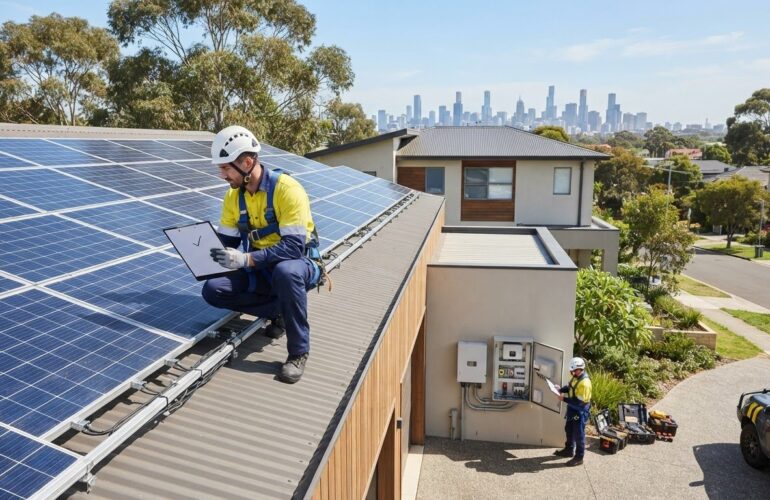
Installation planning also affects how smoothly a project connects to the grid. An installer assesses roof conditions, electrical infrastructure, energy-use data and proposed system size, then manages applicable permits and the network connection process. Connection requirements can affect system design and export capacity. Work may require access to the roof, switchboard or other areas, so scheduling around deliveries, customers or production can help limit disruption.
At least 12 months of electricity bills can show seasonal use, while half-hourly interval data records demand in 30-minute periods. Together, these details help match solar generation to the business’s load. Roof orientation, shading and planned expansion also affect expected output. For example, a site with daytime refrigeration may use more solar directly than one with most activity after sunset.
For leased premises, check lease clauses about alterations before work begins. Tenants need landlord permission through a Letter of Consent, while a Letter of Amendment should set out rectification responsibilities at the end of the lease. Put agreements about system ownership, maintenance and financial responsibilities in writing.
Discuss the safety management plan, external safety certification and audit process with the installer. Risks include lower-than-expected generation and connection delays. Review warranty terms and maintenance-contract conditions. Monitoring, regular checks and occasional inspections can help identify performance issues and support reliable operation over the system’s working life.
2. Battery storage for night operations and blackout protection
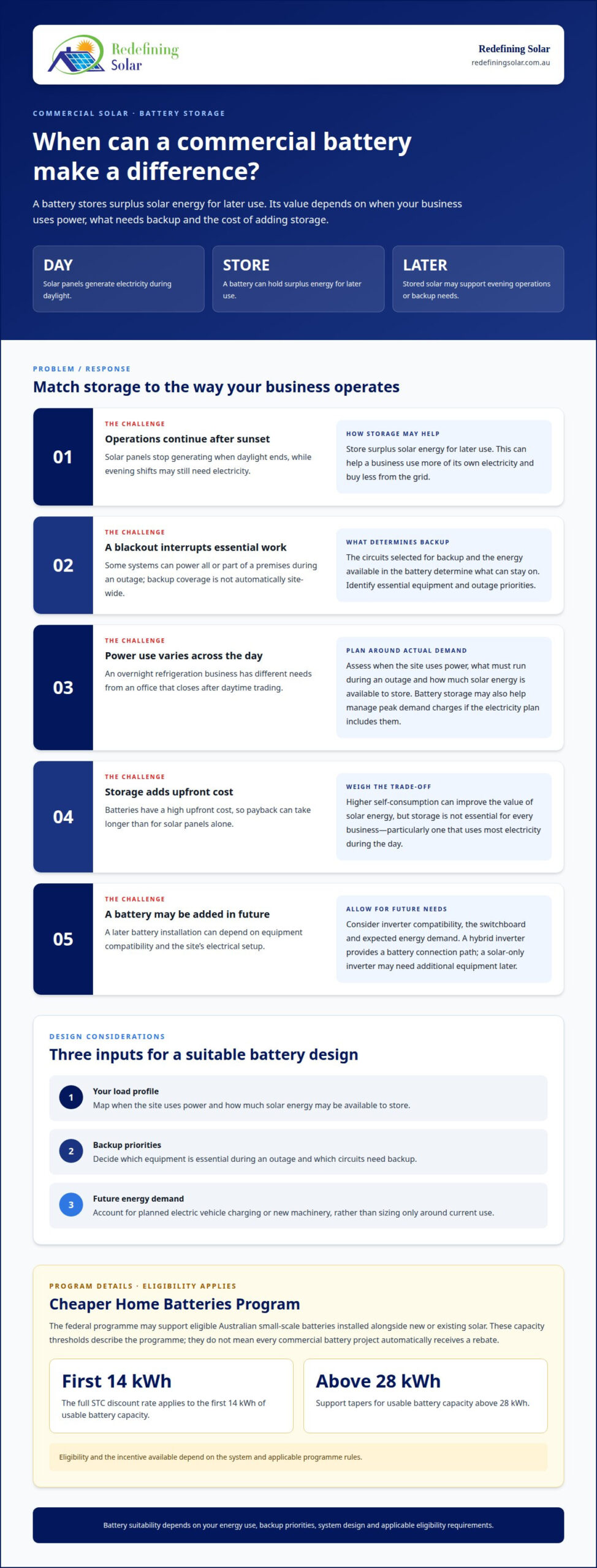
A commercial battery stores surplus solar energy for use after panels stop generating or when cloudy weather reduces output. This can help a business with evening shifts use more of its own electricity and buy less from the grid. During a blackout, some systems can power all or part of a premises. Which circuits stay on depends on the backed-up circuits and the energy available in the battery.
Battery storage may also help manage peak demand charges if your electricity plan includes them. An installer assesses when your site uses power, which equipment is essential during an outage and how much solar energy is available to store. A business running refrigeration overnight has different needs from an office that closes after daytime trading. Batteries have a high upfront cost, so payback can take longer than for solar panels alone.
If you may add a battery later, consider inverter compatibility, the switchboard and expected energy demand when selecting equipment. A hybrid inverter provides a battery connection path, while a solar-only inverter may need additional equipment for a later battery installation. System design should also account for planned electric vehicle charging or new machinery, rather than sizing the array only around current use.
The federal Cheaper Home Batteries Program may support eligible Australian small-scale batteries installed alongside new or existing solar. Its full STC discount rate applies to the first 14 kWh of usable battery capacity, and support tapers for usable capacity above 28 kWh. These thresholds describe the program, not an automatic rebate for every commercial battery project. Eligibility and the incentive available depend on the system and applicable program rules.
Higher self-consumption can improve the value of solar energy by replacing electricity you would otherwise buy. A battery can shift some daytime generation into night operations, but storage adds cost and isn’t essential for every daytime business. A commercial solar installer can assess your load profile, backup priorities and future demand to shape a suitable design. Explore commercial solar battery options for a system planned around your operating needs.
3. How Does the Commercial Solar Incentive Work?
Australian solar incentives can reduce the upfront cost of an eligible system, but the saving depends on its size, location and applicable scheme. Small-scale Technology Certificates (STCs) represent eligible renewable energy generation. For qualifying systems, certificates can be assigned to an installer, who passes their value on as an upfront price reduction. This reduces the initial outlay, not the system’s electricity generation or the amount your business consumes.
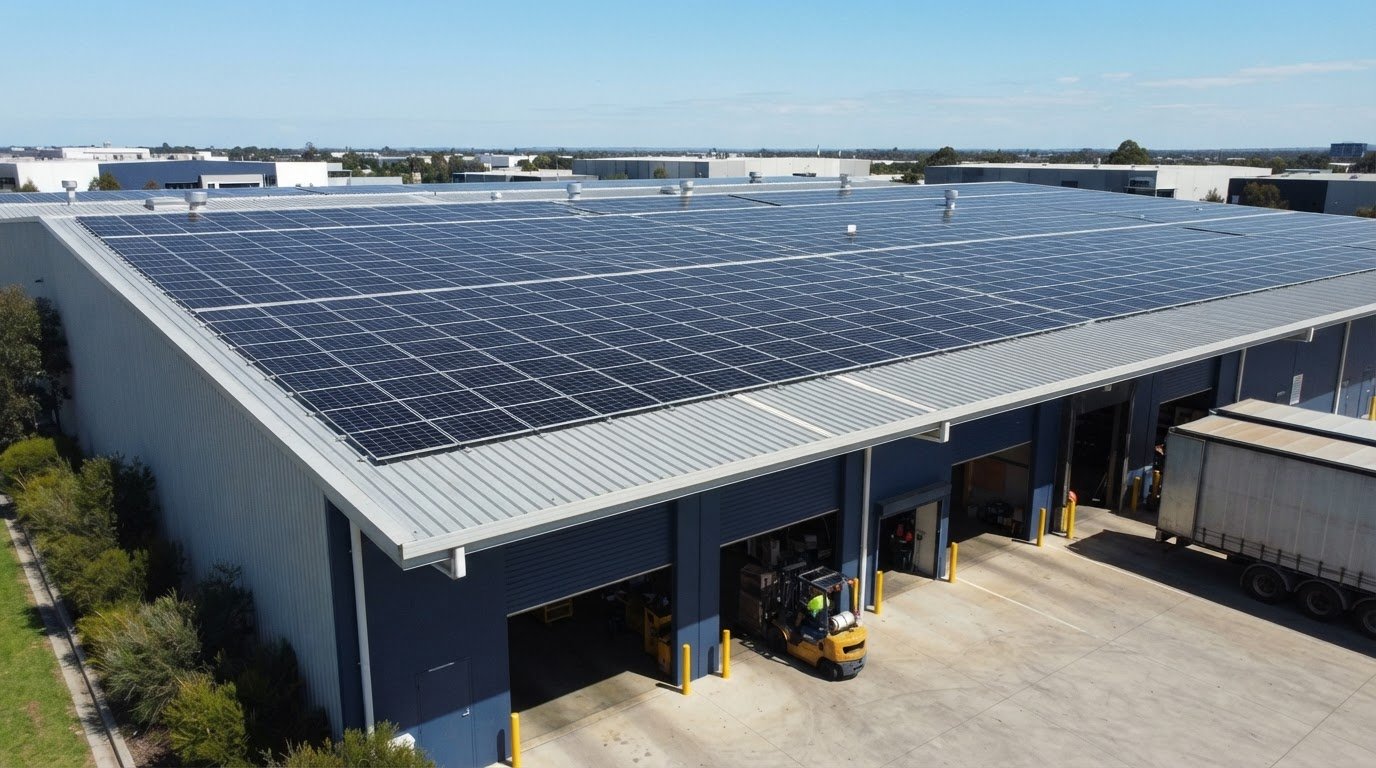
From 1 October 2026, eligible Australian commercial solar systems above 100 kW and up to 1 MW can access Small-scale Technology Certificates under the expanded Small-scale Renewable Energy Scheme, according to the Clean Energy Regulator. The Clean Energy Regulator also sets the expanded SRES range: eligible systems must have a capacity above 100 kW and up to 1 MW. This extension broadens STC access beyond systems up to 100 kW. The Australian Government estimates eligible businesses could save around 20% on larger rooftop solar installations through the expanded scheme.
Other certificate programs may apply depending on system size and location. These can include Large-scale Generation Certificates (LGCs) or Victorian Energy Efficiency Certificates (VEECs). Eligible renewable electricity systems accredited under Australia’s Large-scale Renewable Energy Target may create one LGC for each megawatt-hour generated. State and territory incentives also differ, so a rebate available in one location may not apply elsewhere. These mechanisms can affect project savings, but they are not interchangeable.
Tax treatment is separate from certificate rebates. Tax treatment may affect the overall economics of a solar installation, so businesses should consider it separately from certificate rebates. The applicable tax treatment and certificate eligibility depend on different criteria, so include both in your project planning. To assess the government incentives relevant to your site, first establish its location, proposed system capacity and installation timing. Then map each potential certificate or tax benefit against those details before estimating the net upfront reduction.
4. Australian STC rebates for commercial solar
Small-scale Technology Certificates (STCs) can reduce the upfront cost of eligible commercial solar panels. For systems up to 100 kW, certificates can be created under the Small-scale Renewable Energy Scheme, with their value passed on as an upfront price reduction. Eligible Australian businesses may be able to reduce the upfront cost of commercial solar through certificate incentives. The actual benefit depends on eligibility and certificate value, so treat it as one part of the project’s financial assessment.
The expanded scheme also changes the picture for mid-scale solar power. From 1 October 2026, qualifying commercial systems above 100 kW and up to 1 MW can access STCs. A 500 kW installation can qualify if it meets SRES eligibility requirements. The expanded STC scheme applies to qualifying mid-scale installations through 2030, giving businesses planning larger renewable energy projects a defined period to consider.
For mid-scale installations, the STC calculation uses a five-year deeming period each year through to 2030. This affects how certificates are calculated over the scheme’s remaining years. Eligibility and system capacity therefore matter alongside installation timing. A proposal near a capacity threshold may fall under a different part of the scheme, so system design and certificate eligibility should be considered together.
Eligible system owners can assign their right to create and sell STCs to the installer, who applies the certificate value as an upfront reduction in the installation price. This avoids the owner handling the certificate sale directly, while making the rebate visible in the project’s upfront costs. Keep the certificate arrangement clear in the project documentation and assess the net cost alongside expected electricity savings. For a commercial solar system planned around your site and STC eligibility, discuss your solar project.
Redefining Solar: Commercial Solar Systems
Redefining Solar can help turn your payback, battery and incentive considerations into a commercial solar plan. Its commercial solar systems are tailored to your business’s energy use, site conditions and future demand. If I’m future-proofing my business with commercial solar, I’d start by sharing planned changes to operations and energy needs. For businesses considering storage later, Battery Ready & Upgrades can help plan that next step.
Future-proofing my business with commercial solar also means considering how the site may change, not just its current electricity use. Sharing your priorities helps shape a discussion about system requirements, potential battery needs and relevant Australian incentives. Solar panels are also available on a supply-only basis.
To discuss a commercial solar plan for your business, contact Redefining Solar.
Plan for the way your business will grow
A solar decision should suit the business you’re building, not only the one operating today. Future-proofing your business with commercial solar starts with a clear view of how your site may change: new equipment, longer trading hours, added vehicles or a different use for the premises. Those plans can inform system design and whether battery readiness matters.
Bring your priorities to the planning conversation: which operations are essential, what changes are on the horizon and how you want to manage energy use. A tailored discussion can connect those practical needs with a solar solution suited to your premises, rather than treating every business the same.
If you’re ready to consider the next step, talk through your business’s solar plans with Redefining Solar. A clear starting point can make the decisions ahead easier to work through.
Frequently Asked Questions
What Is a Realistic Payback Period for a Commercial Solar System?
A realistic estimate is specific to your site, not a promise based on a national average. Ask what assumptions underpin projected savings, including how much solar electricity your business is expected to use. Comparing a cautious estimate with a higher-use scenario can show how sensitive the payback calculation is to changes in operating patterns.
How Big Should Your System Be If a Battery or EV Might Be Coming?
Tell the designer what changes you’re considering and roughly when they may happen. For an EV, explain whether charging is expected during work hours or after the business closes. If you may add a battery, clarify whether the priority is night-time use or backup. These details help align the proposed design with your plans instead of relying on a generic array size.
How Does the Commercial Solar Incentive Work?
An eligible incentive can reduce the upfront amount in a commercial solar proposal. Ask for the incentive and remaining project cost to appear as separate line items, so you can see how the reduction affects your business case. Keep the proposal and certificate arrangement with your project records. This helps distinguish the incentive from ongoing bill savings.
Is a Solar Battery Necessary for My Business?
No, not automatically. Start by identifying which equipment must keep running during an outage and which operations can pause. Then consider whether those essential loads run after solar generation ends. A battery decision should reflect your business’s operating priorities, not simply the presence of solar panels. This assessment can also clarify the backup coverage you need.
What About the 2026 Battery Rebate, and Does It Reward Future-Proofing?
The Cheaper Home Batteries Program supports eligible small-scale battery systems installed alongside new or existing solar. Planning for a battery later does not itself qualify for a rebate or earn extra support. Future-ready wiring or equipment choices may help with later planning, but the program relates to an eligible battery installation. Treat the rebate as a potential part of that separate decision.
What Does It Actually Mean to Future-Proof a Solar Installation?
Future-proofing means making practical provision for expected changes, rather than paying for capacity you may never use. During installation planning, an installer can consider reserving switchboard breaker space and fitting spare conduit for a later battery connection. These provisions may help avoid a switchboard upgrade when adding a battery. The design should still suit your current site and operations.