A solar installation can affect your roof, electrical system and day-to-day use of your property, so the right questions matter as much as the equipment. The most useful questions to ask a solar installer before signing cover their quality credentials, what each warranty protects, how the system will be maintained, how much energy it’s expected to produce and how your property will be protected during the work.
It’s reasonable to want clear answers before committing, especially when a proposal includes technical details that are difficult to compare. Ask what quality processes the installer follows, who handles warranty claims and how the energy estimate was calculated, including the effects of your roof’s orientation and any shading.
This guide covers questions about maintenance, workmanship and practical arrangements, such as protecting roof surfaces, managing site access and reporting damage. Use the checklist to understand the proposal and decide what you need clarified before taking the next step.
Key Takeaways
- Clarify what product, performance and workmanship warranties cover, and who is responsible if a claim needs attention.
- Ask how system upkeep works, including whether panel-level monitoring can help identify faults and how maintenance is handled.
- Request energy estimates for your property that account for roof position, shading and seasonal variation.
- Discuss how the installation team will protect your roof, electrical system and surrounding property while work is underway.
1. Product, performance and workmanship warranties
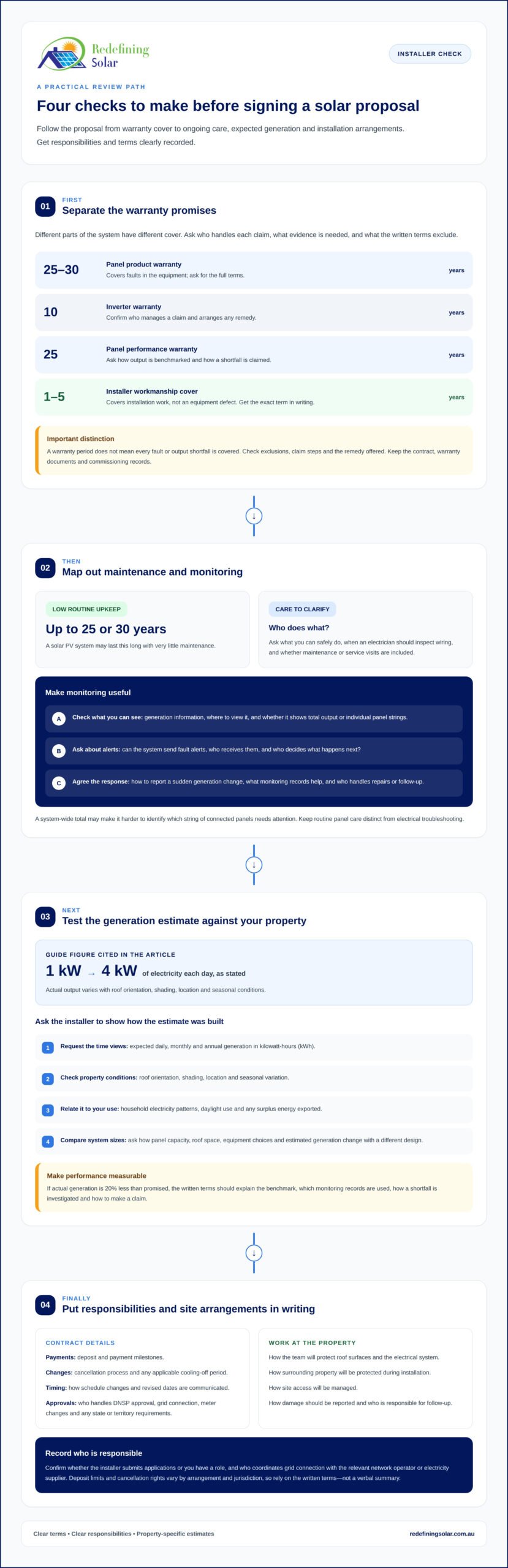
Before signing, distinguish between the warranties for panels, inverters and installation work. A product warranty covers faults in the equipment, while a performance warranty sets out the panel’s expected output over time. Ask who manages each claim and what evidence you’ll need. These questions to ask a solar installer before signing can clarify whom to contact if something goes wrong.
Solar panel product warranties are often described as covering 25–30 years, while inverter warranties are described as covering 10 years. Performance warranties commonly run for 25 years. These periods don’t mean every fault or output shortfall is covered. Ask for the full terms, including exclusions, claim steps and the remedy offered.
Workmanship cover relates to the installation rather than a panel or inverter defect. Installer workmanship warranties typically last between one and five years. Ask for the exact term in writing, what installation problems it covers, and who arranges repairs. For local support, clarify whether you contact the installer directly or the equipment manufacturer, and keep copies of the contract, warranties and commissioning records. Warranty responsibility is another of the questions to ask a solar installer before signing; have the agreed answer recorded in the contract.
Your contract should set out the deposit, payment milestones, cancellation process and any cooling-off period that applies to your agreement and jurisdiction. Deposit limits and cancellation rights vary by arrangement, so read the written terms before signing rather than relying on a verbal summary.
The contract should identify who handles DNSP approval, grid connection and meter changes, and who coordinates any state or territory requirements. Clarify whether the installer submits applications or whether you have a role. Ask who is responsible for connecting the system to the grid, such as the relevant network operator or your electricity supplier.
Ask how schedule changes will be communicated and what the contract says about revised dates. If the system underperforms, the written performance terms should explain the benchmark and claims process. Equipment warranties and workmanship cover may involve different parties if an installer closes its business, so keep the manufacturer’s warranty details and ask who handles unresolved claims.
2. How will the system be maintained?
Solar panels need little routine attention, but dirt, leaves and electrical faults can affect operation. Ask what upkeep the system needs, which tasks you can safely do, and when an electrician should inspect the wiring. A solar PV system may last up to 25 or 30 years with very little maintenance. Keep panels clear of debris and dirt, and arrange periodic electrical and wiring inspections by an electrician.
Monitoring lets you see whether the system is generating electricity as expected. Ask what generation information you’ll receive, where to view it, and whether readings show total output or individual panel strings. A string is a group of connected panels. If monitoring only shows the system-wide total, it may be harder to identify which string needs attention.
Ask whether the monitoring system can send fault alerts, who receives them and what happens next. Clarify whether you need to report a warning or whether someone reviews it and contacts you. Ask how to report a sudden change in generation and what information, such as monitoring records, can help identify the cause.
Your contract should state whether scheduled maintenance, monitoring access, fault response and workmanship cover are included, and who handles each. Ask how after-sales support works, which issues are covered, and whether service visits or repairs are separate. Clear responsibilities make it easier to know whom to contact if a warning appears or the system needs attention.
Ask what maintenance involves over the system’s life, including how inverter issues are assessed and how you’ll be told about required work. A clear written process can help you distinguish routine panel care from electrical troubleshooting. For ongoing system care, maintenance and repairs can help address faults and upkeep needs.
3. System generation estimates and performance guarantees
A useful estimate shows expected generation in kilowatt-hours (kWh) for your roof, not just a system’s rated capacity. Ask for daily, monthly and annual figures, and how the calculation accounts for roof orientation, shading, location and seasonal changes. As a guide, a 1kW solar PV system in Australia is stated to generate 4kW of electricity each day, although actual output varies with those conditions.
Relate the proposed system size to your household’s electricity use. Ask how the estimate reflects your usage patterns and whether it assumes you’ll use electricity during daylight or export surplus energy. If the proposal includes an export credit, ask what assumptions it uses and have it shown separately. This helps you see which parts of the estimate depend on your consumption.
Ask why the recommended system size suits your property and priorities. The explanation should connect panel capacity, available roof space and estimated generation to your energy needs. If budget affects the design, ask what changes with a different system size, including the expected generation and equipment choices. A clear comparison helps you weigh a smaller initial system against your intended energy use.
Ask how actual generation will be compared with the estimate, what monitoring records are used and how a shortfall is investigated. For example, clarify whether shading, seasonal conditions or a system fault could explain lower output, and what the written performance terms cover. An example of 20% less electricity than promised shows why the contract should explain the benchmark and claim steps.
Ask for a quote that lists equipment, switchboard upgrades, scaffolding, metering and grid connection fees individually. Each item should be marked as included, excluded or subject to a separate charge, so the scope is clear before you sign. Also ask whether maintenance assumptions affect the generation estimate and who arranges any inspections needed to assess performance over time.
4. Protecting homes and businesses during installation
Before work begins, agree on how the crew will protect your property. Ask for a site-specific plan covering access routes, work areas, existing roof surfaces and nearby equipment. At home, this might include keeping a clear path to the roof and protecting garden beds beneath the work area. At a business, clarify how staff, customers and deliveries can move around the site.
Ask who supervises the work and how the team will communicate changes to the agreed plan. If installers need access through a garage, plant room or work area, identify the route and anything that needs to be moved beforehand. The plan should also explain where tools and materials will be stored and how the work area will be left at the end of each day.
Discuss roof access specifically. Ask how panels, rails and other equipment will be moved onto the roof and how the crew will avoid unnecessary contact with roof surfaces. If the manufacturer specifies handling requirements for panels or inverters, ask how the team will follow them. Agree on how damage to tiles, gutters, walls or other property will be documented and reported.
Electrical work can affect access to parts of your property. Ask which areas may be unavailable, when power interruptions might occur and how the team will notify you before work starts. At a business, discuss the timing of work near customer areas or essential equipment. Put the arrangements in writing, including whom to contact if access or site conditions change.
At completion, ask who removes packaging and installation waste, and how the team records any outstanding work. A practical handover includes a clear walk-through of the installed equipment and the condition of the work area. These questions help make property protection part of the job plan, not an afterthought. Plan your solar installation with property access and site protection in mind.
Redefining Solar
Redefining Solar can help you assess a solar proposal and plan a system around your property’s needs. If you’re weighing warranty terms, generation estimates or installation arrangements, discussing the project can help clarify its scope before you proceed.
Redefining Solar provides residential and commercial solar systems, battery-ready upgrades and solar panel supply. Whether you’re planning a new installation or considering a future battery, the right system depends on your energy use, site and priorities. Discuss equipment, expected generation, maintenance and property protection to ensure the proposal addresses the details that matter to you.
For practical guidance on your solar project, contact Redefining Solar.
Take the next step with confidence
Before you commit, use your remaining questions to clarify how the proposed system suits your property and what happens after installation. These questions to ask a solar installer before signing can help you explain your priorities, whether you’re managing household energy use, planning for a business site or preparing for a battery later.
Redefining Solar provides residential and commercial solar systems, along with Battery Ready & Upgrades. If you’re still weighing the proposal, discuss the options relevant to your project and what to consider next.
There’s no need to have every technical detail sorted before you start. Bring the questions that matter most to you and take the next step at a pace that feels right.
Contact Redefining Solar to discuss your solar project.
Frequently Asked Questions
Do you have quality certification?
Quality certification and an electrician’s licence are different credentials. Redefining Solar is directed by a licensed A-Grade electrician. That describes electrical licensing, not an ISO quality certification. If certification matters to your decision, ask the installer to identify the specific quality standard and explain which parts of the installation it covers. The contract should make clear who will carry out the work.
Does the installer use the correct DC cable rather than the AC cable?
Cable type depends on the electrical part of the solar system it serves. Panels produce direct current (DC), which travels to the inverter. The inverter converts it to alternating current (AC) for use in the property. Ask the installer to show where each cable type appears on the proposed layout and how the selection meets the equipment manufacturer’s requirements.
Does the racking use both mid- and end-clamps to secure the modules?
Mid-clamps secure neighbouring modules along a mounting rail, while end-clamps hold modules at the outside edges. Ask the installer to show both in the proposed panel layout rather than relying on a general description of the racking. The arrangement should suit the modules and mounting system being installed. Clear drawings can help you understand how each panel is secured.
How long will it take from deposit to installation?
Australian solar installation lead times can range from three weeks up to four months from deposit to installation. Ask for the expected timeframe for your project and have the estimated start or installation date recorded in the contract. Also ask how schedule changes will be communicated, and whether any site preparations or approvals need to happen before installation can proceed.
How will the system be maintained?
Keep the system’s handover documents together, including equipment details, monitoring instructions and maintenance records. If an inverter warning appears or monitoring shows an unexpected change, note the date and retain the available system information before arranging an assessment. Redefining Solar provides maintenance and repairs, including for systems installed by other installers, so existing equipment can be assessed too.
Is your REC/STC discount locked in from when you deposit?
Paying a deposit alone doesn’t explain how the certificate discount is treated. Australian installers commonly apply the solar incentive as an upfront discount, so ask the installer to specify the STC discount used in your quote and how any change before installation would be handled. STCs are Small-scale Technology Certificates; ask the installer to distinguish them clearly from any broader use of “REC”.