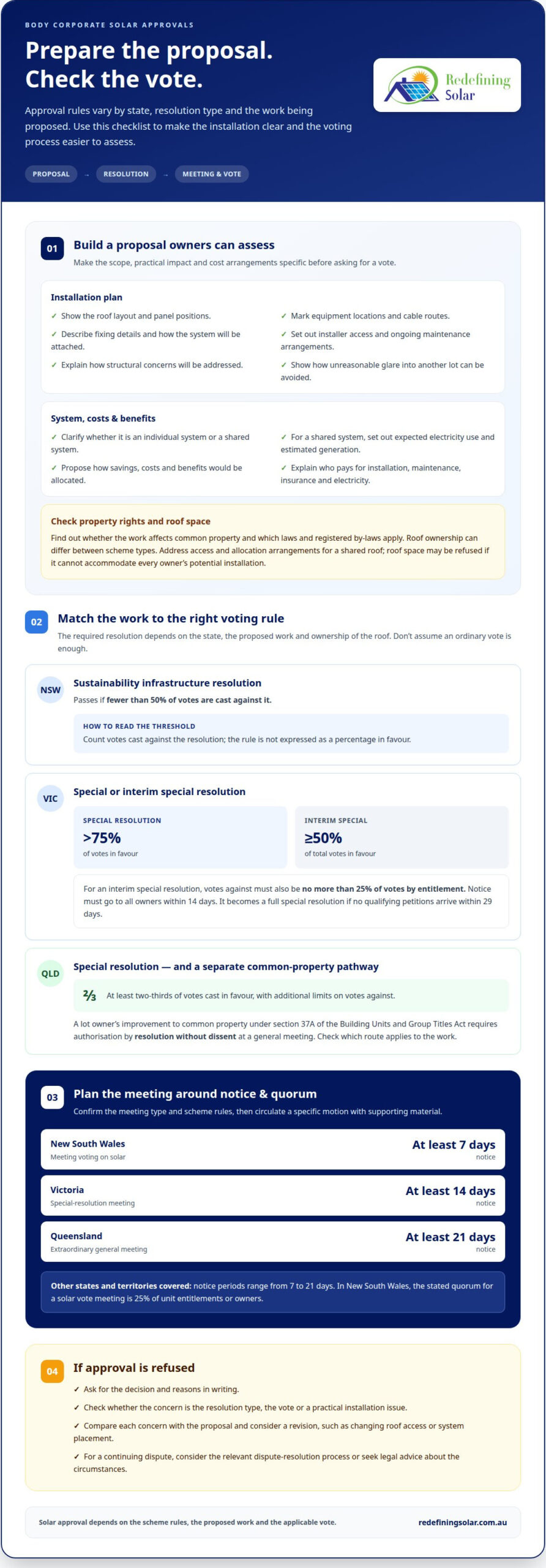
Solar approval isn’t decided by one national voting rule. To understand how to convince your body corporate to approve solar, first identify your state’s requirements: in New South Wales, a sustainability infrastructure resolution passes if fewer than 50% of votes are against it; in Victoria, a special resolution needs more than 75% of votes in favour; and in Queensland, a special resolution needs at least two-thirds of votes cast in favour, with additional limits on votes against.
It’s understandable to ask whether owners who won’t install panels can opt out. The answer depends on what the proposal covers and the rules for your scheme, so clarify the project scope before the vote. A practical proposal should explain the system, its location, how it will be installed and how concerns such as roof access, safety or glare will be addressed.
This guide explains how to prepare a clear proposal, understand meeting and voting requirements, and respond constructively if approval is refused. It also covers installation details that can help the body corporate assess the impact on the building and residents.
Key Takeaways
- Find out whether the proposed panels affect common property, as this can change the approval process and who benefits from the installation.
- Prepare a clear proposal that explains the installation and addresses practical concerns such as roof space, structural impact and glare.
- Before seeking a vote, understand the resolution type, notice period and quorum rules that apply in your state or territory.
- If approval is refused, ask for the reasons and consider whether a revised proposal or reasonable installation conditions could address the concerns.
When can solar panels be refused?
- Identify which laws and scheme rules apply before proposing solar panels. Australian strata requirements vary by state or territory, and registered by-laws also matter. In Queensland, panels on common property in a building format plan are usually an improvement to common property. In a standard format plan, owners own roofs and external walls forming part of their lots. The Queensland Government says the Building Act 1975 limits when a relevant instrument can prohibit solar photovoltaic cells on common property, including where prohibition is necessary to preserve structural integrity. These rules don’t create an unrestricted right to install solar panels.
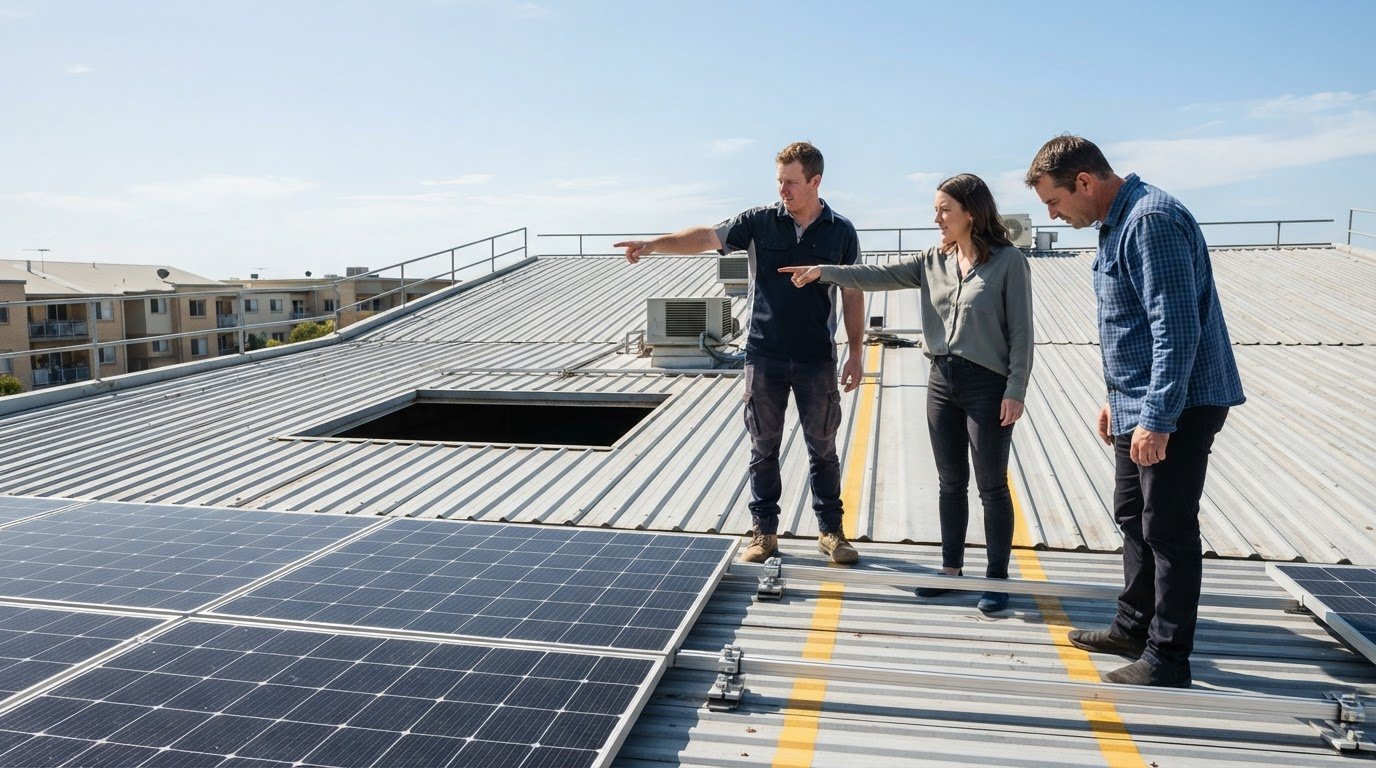
- Make the installation’s practical impact clear in your proposal. Include a roof layout, panel positions, equipment locations, cable routes, fixing details and access arrangements. Add technical information on how the system will be attached and how structural concerns will be addressed. Show how installers can avoid unreasonable glare into another lot. These details give owners evidence to assess, which is central to how to convince a body corporate to approve solar.
- Clarify who benefits and how costs will be shared. Compare an individual system with a shared system using expected electricity use, estimated generation and a proposed allocation of savings. Explain who pays for installation, maintenance, insurance and electricity, and how costs and benefits would be divided among participating owners. To understand how to convince a body corporate to approve solar, make the proposed cost and benefit arrangements clear before the vote.
- Address exclusive use and common-property rights directly. In Queensland, Section 30 of the Building Units and Group Titles Act allows exclusive use or other special privileges over common property by by-law and resolution without dissent, with written consent from affected owners. Section 22 provides for a body corporate to authorise a lease over common property. A service easement under Section 17 doesn’t itself grant rights to install solar equipment. Roof space may also be refused if it cannot accommodate every owner’s potential installation. For a shared roof, explain access and allocation arrangements before seeking approval.
Solar approval resolutions and voting thresholds
Check the resolution and voting rules that apply in your state before putting a solar installation to owners.
-
Identify the required resolution
Start by identifying the resolution type for your scheme and the proposed work. In New South Wales, a strata sustainability infrastructure resolution passes if fewer than 50% of votes are cast against it. Victoria uses special or interim special resolutions for solar proposals. In Queensland, a lot owner’s improvement to common property under Section 37A of the Building Units and Group Titles Act requires authorisation by resolution without dissent at a general meeting. Don’t assume an ordinary vote is enough: the work and ownership of the roof affect which route applies.
-
Confirm voting thresholds
Set out the applicable threshold in the meeting motion, then make sure the proposed vote is counted using the right measure. Victoria’s special resolution needs more than 75% of votes in favour. An interim special resolution needs at least 50% of total votes in favour and no more than 25% of votes by entitlement against. Notice must go to all owners within 14 days, and it becomes a full special resolution if no qualifying petitions arrive within 29 days. In Queensland, a special resolution needs at least two-thirds of votes cast in favour, with additional limits on votes against.
-
Address refused consent
If owners refuse consent, ask for the decision and reasons in writing, then compare each concern with the proposal. Clarify whether the refusal relates to the resolution type, the vote, or a practical issue with the installation. A revised motion can address specific concerns, such as roof access or system placement, without changing the decision into a different kind of request. In Queensland, Washingtonia, dated 23 April 2024, concerned approval of solar panels installed on a common-property roof. For a continuing dispute, owners can consider the relevant dispute-resolution process or seek legal advice about their circumstances.
Meeting notice periods and quorum requirements
Plan the solar vote around your scheme’s notice period, meeting type and quorum rules. A clear agenda helps owners understand the motion and prepare to vote.
- Confirm the required meeting type and notice period before setting a vote date. In New South Wales, give at least 7 days’ notice for a meeting voting on solar. Queensland schemes must give at least 21 days’ notice for an extraordinary general meeting. Victoria special-resolution meetings require at least 14 days’ notice. For other Australian states and territories covered, notice periods range from 7 to 21 days. Build in time to circulate the proposal with the meeting notice.
- Prepare a specific motion and include supporting material with the notice. State whether owners are voting on an individual installation or a shared system, and describe the proposed roof area and equipment. Include plans showing panel placement and cable routes, along with details about access and ongoing maintenance. For a shared system, explain how electricity use and benefits would be allocated. A precise motion gives owners a clear proposal to consider, rather than a general request to support solar.
- Check the quorum rules for your state and the meeting type. In New South Wales, a solar vote meeting has a quorum of 25% of unit entitlements or owners. If that quorum isn’t reached within 30 minutes, the meeting can proceed with those present. In Queensland, the quorum for a solar vote is 25% of eligible voters. Confirm how eligible votes will be recorded so the chair can establish whether the meeting can conduct business.
- Allow for Victoria’s attendance rules when arranging a special-resolution meeting. The general quorum is 50% of owners, but business can proceed if a quorum isn’t reached after 30 minutes. Tell owners how to participate and cast votes, then record attendance and the result in the meeting minutes. If the meeting lacks a quorum, follow the applicable scheme process rather than treating an informal discussion about solar as an approval.
Body corporate obligations to act reasonably
In Queensland, body corporate decisions about rooftop solar must balance the proposal’s practical effects with owners’ rights.
- Ask the body corporate to assess the actual installation, rather than reject rooftop solar as a category. Queensland bodies corporate established under the Body Corporate and Community Management Act 1997 must act reasonably when deciding about solar panels. They may set reasonable installation conditions and may reasonably refuse some proposals. A written decision should connect its reasons to the specific system, building or scheme.
- Address each concern with a practical response in your proposal. If the concern is roof capacity, provide relevant structural information; if it is glare, show panel placement and its likely effect on nearby lots. Queensland rules allow consent to be withheld for common-property solar infrastructure if there isn’t enough space for every other owner to install on that surface. A revised layout may help resolve space concerns.
- Separate reasonable safety conditions from a blanket prohibition. Queensland’s Building Act 1975 limits when a relevant instrument can prohibit photovoltaic cells on common property, including where prohibition is necessary to preserve the building’s structural integrity. A condition about safe installation may be different from refusing every rooftop solar proposal. Ask for the specific issue, then respond with information that addresses it directly.
- Consider how the installation could affect other residents’ use of the building. Queensland owners should account for possible impacts, including significant glare into another lot. For a solar hot water system on common property, consent may be withheld to the extent necessary to prevent pipe noise unreasonably interfering with someone’s use or enjoyment. Explain how the proposed design could limit these effects.
- Keep a clear record of the proposal, decision and reasons. If a condition appears unrelated to a stated concern, ask the body corporate to explain how it addresses the installation’s impact. A focused response can identify a workable adjustment without overlooking structural integrity or other owners’ interests. To shape a proposal around your building, discuss a solar system proposal.
Redefining Solar
Redefining Solar supplies and installs residential and commercial solar systems, helping you move from body corporate approval discussions to a system proposal for your property. A clear outline of the proposed installation helps owners consider practical details, such as panel placement and how the system fits the building.
Turn to Redefining Solar when you’re ready to explore a solar system for your home or business, or a battery-ready upgrade as part of your planning. The next step is to discuss the property and the system you’re considering, so the technical proposal reflects your project rather than relying on a generic plan.
Contact Redefining Solar to discuss your solar plans.
Turn approval into a clear next step
Use the decision as a practical handover point. Keep the agreed system scope, any conditions and the meeting outcome together to keep planning and installation aligned with what owners considered. This creates a clear record if building access or project details need to be discussed again.
Knowing how to convince your body corporate to approve solar is only the first step. The proposal also needs to work for the building and the people affected. If owners raise a concern, carry that feedback into the next planning conversation. A specific response can keep the discussion constructive and clarify what needs to be resolved before work proceeds.
Keep communication straightforward: explain what will change, what remains within the agreed scope and why. That helps owners follow the project from proposal to delivery.
Contact Redefining Solar to discuss your next step. A clear plan can help you move forward with confidence.
Frequently Asked Questions
Can non-participating owners opt out?
With an individual system, owners who aren’t installing it don’t take part in that owner’s electricity use. A shared rooftop system needs clear written rules covering participation, access, maintenance and how electricity benefits are allocated. Before proposing shared equipment, explain whether non-participating owners contribute to costs and what rights they receive. Make these arrangements clear in the motion, rather than leaving them to be settled after approval.
What if my strata manager isn’t proactive?
Send a concise written request asking for the solar proposal to be considered at a body corporate meeting. Attach the proposed motion and supporting documents, and ask for confirmation of the next step under your scheme’s meeting process. If there’s no response, follow up in writing and keep copies of your correspondence. You can also ask other owners to support submitting the motion, giving the proposal clear backing.
What if the vote doesn’t pass?
Ask for the recorded result and the concerns owners raised, then sort the feedback into issues that need more information and those that require design changes. For example, a concern about access could prompt a clearer maintenance access plan. Discuss a revised proposal with interested owners before submitting it again through the scheme’s meeting process. Don’t treat discussion at an informal gathering as approval to install the system.
What approval process applies to installing solar panels in an Australian strata scheme?
First, identify whether the panels and related equipment would be on an owner’s lot or common property. Then review the scheme’s registered by-laws and determine the required resolution and meeting process. Prepare a motion describing the system, its proposed location and its effect on shared areas. Include plans and practical information for owners to assess. Make the approved scope clear before proceeding with installation arrangements.
What voting threshold is needed for a body corporate to approve solar in each Australian state and territory?
There’s no single threshold across Australia. In New South Wales, a strata sustainability infrastructure resolution passes if fewer than 50% of votes are cast against it. Victoria requires more than 75% in favour for a special resolution; an interim special resolution needs at least 50% of total votes in favour and no more than 25% of votes by entitlement against. Queensland special resolutions need at least two-thirds of votes cast in favour, with additional limits on votes against. Other jurisdictions use their applicable scheme rules.
What objections do body corporates commonly raise about solar, and how can owners address them?
Common practical concerns include roof capacity, limited shared space, glare, access for repairs and disruption to residents. Address them with panel placement plans, structural information, safe access arrangements and a maintenance plan. For a solar hot water system, explain how pipe noise will be managed. For a shared system, set out how installation and ongoing responsibilities will be divided so owners can assess the impact clearly.